Driving
●
Adapt your speed and safety dist
ance to
the vehicle in front of you at all times to suit
visibility, weather, road and traffic condi-
tions.
●
Do not use Travel Assist when visibility is
bad, on steep roads, on windy roads or in
slippery circumstances (such as snow, ice,
rain or loose gravel), or on flooded roads.
●
Do not use Travel Assist offroad or on
roads where the surface is not firm. Travel
Assist has been designed for use on paved
roads only.
●
Travel Assist does not react to people or
animal or vehicles crossing your path or
which approach you head-on in the same
lane.
●
Brake immediately if Travel Assist does
not slow down enough.
●
Brake immediately when a braking mes-
sage is displayed on the instrument panel
screen.
●
Brake when, after an indication to brake,
the vehicle rolls without it being desired.
●
Keep your hands on the steering wheel at
all times, to ensure you have control over
the steering at all times. The driver is al-
ways responsible for keeping the vehicle in
its own lane.
●
If driver intervention is requested on the
instrument panel display, immediately re-
sume control of the vehicle.
●
Always be prepared to adjust the speed
yourself.
Indications on the instrument panel
displ
ay
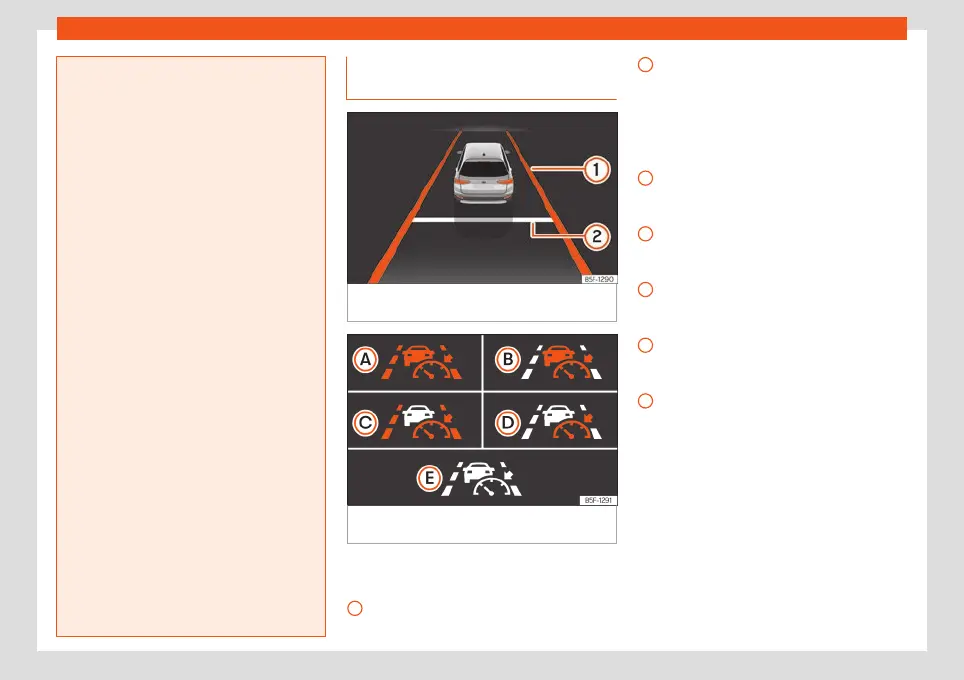
Fig. 171
On the instrument panel display: indi-
cation with activ
e adjustment.
Fig. 172
On the instrument panel display: con-
tr
ol l
amps.
Displays on the screen
›
›
›
Fig. 171
The adaptive lane guidance function is
active.
1
Adjusted distance.
In addition, depending on the equipment,
contr
ol l
amps indicat
e the status of the sys-
tem on the instrument panel display:
›››
Fig. 172
Travel Assist active, adaptive cruise con-
trol and adaptive lane guidance function
are active.
Travel Assist active, adaptive cruise con-
trol active and adaptive lane guidance
function passive.
Travel Assist active, adaptive cruise con-
trol passive and adaptive lane guidance
function active.
Travel Assist active, adaptive cruise con-
trol and adaptive lane guidance function
are passive.
Inactive Travel Assist.
2
A
B
C
D
E
242



 To Next Page