accessories, or storing power tools. Such preventive safety measures
reduce the risk of starting the power tool accidentally.
d. Store idle power tools out of the reach of children. Do not allow
persons unfarmiliar with the power tool or these instructions to operate
the power tool. Power tools are dangerous in the hands of untrained
users.
e. Maintain power tools. Check for misalignment or binding of moving
parts, breakage of parts and any other condition that may affect the
power tool's operation. If damaged, have the power tool repaired
betore use. Many accidents are caused by poorly maintained power
tools.
f. keep cutting tools sharp and clean. Properly maintained cutting tools
with sharp cutting edges are less likely to bind and are easier to control.
g. Use the power tool, and accessories in accordance with these
instructions, taking into account the working conditions and the work
to be performed. Use of the power tool for operations different from
those intended could result in a hazardous situation.
h. Children should be supervised to ensure that they do not play with the
device.
5. Battery tool use and care
a. Recharge only with the charger specified by the manufacturer. A
charger that is suitable for one type of battery pack may create a risk
of fire when used with another battery pack.
b. Do not open the battery. The danger of short-circuiting.
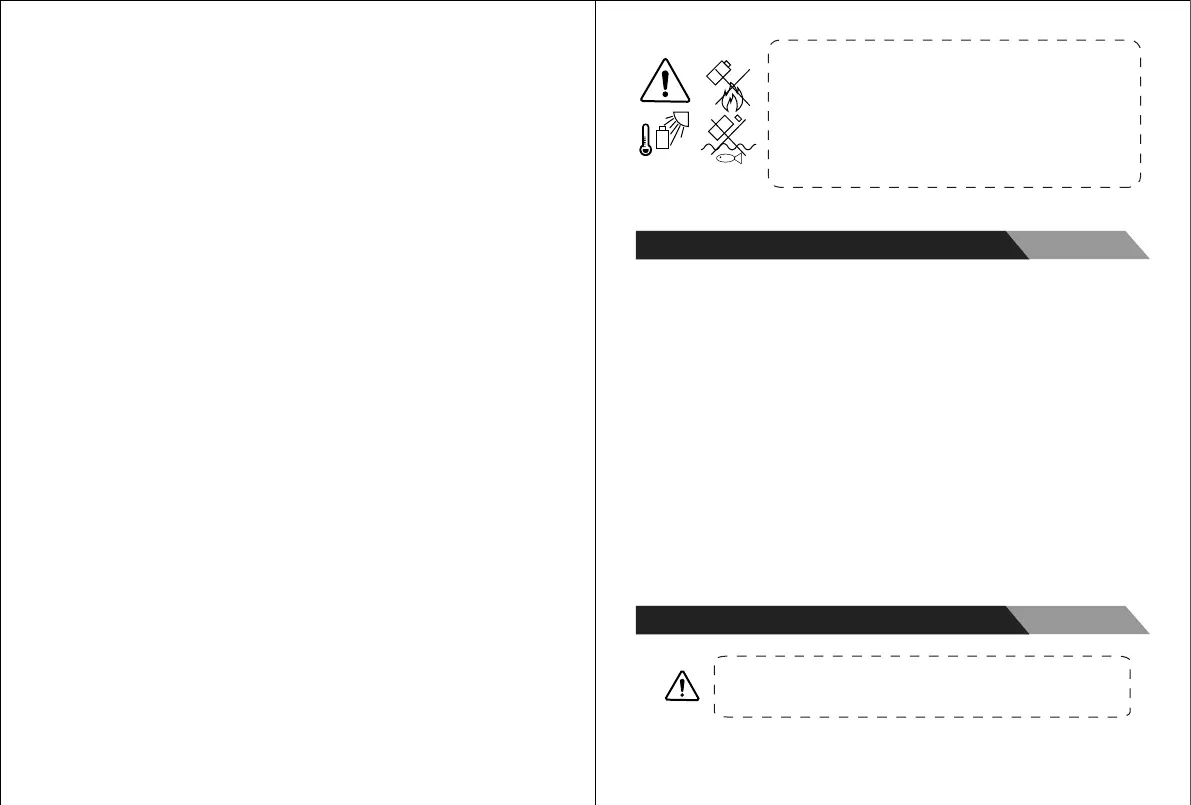
c. Protect the battery from heat, such as continuous strong sunlight, fire,
water and humidity. The danger of explosion.
d. Use power tools only with specifically designated battery packs. Use
of any other battery packs may create a risk of injury and fire.
e. When the battery pack is not in use, keep it away from other metal
objects, like paper clips, coins, keys, nails, screws or other small metal
objects that can make a connection from one terminal to another.
Shorting the battery terminals together may cause burns or a fire.
f. Under abusive conditions, liquid may be ejected from the battery; avoid
contact. If contact accidentally occurs, flush with water. If liquid
contacts eyes, additionally seek medical help.
Liquid ejected from the battery may cause irritation or burns.
CAUTION! RISK OF EXPLOSION!
Never charge non-rechargeable batteries!
Protect the rechargeable battery from heat,
for example from continuous exposure to
sunlight, fire, water, and moisture.
There is a risk of explosion.
• Do not allow any liquid to come into contact with the charger There is
a danger of electric shock.
• Do not place tools or chargers near water. For example, near the sink,
washbasin, or toilet.
• Do not spill liquid of any kind on the tool or charger. Doing so may
short out parts, causing damage to the product and creating the risk of
fire or electric shock.
• The most suitable temperatures to charge the battery pack are
between 68°F -77°F. During charging, batteries must be placed in the
well ventilated area!
• The appliance is not to be used by persons (including children) with
reduced physical, sensory or mental capabilities, or lack of experience
and knowledge unless they have been given supervisionor instruction.
• Children being supervised not to play with the appliance.
• Do not recharging non-rechargeable batteries!
Always check that the voltage of the power supply
corresponds to the voltage on the rating plate.
Safety Warnings for Charger
Electrical Safety
max50℃
+
-03-
-04-


 To Next Page