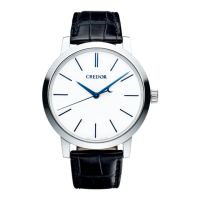
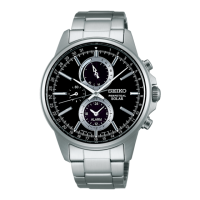
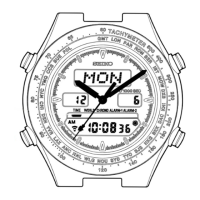
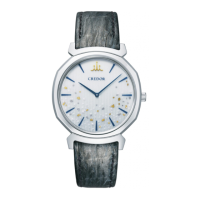
This document describes the operation and maintenance of CREDOR watches, which are mechanical timepieces known for their blend of traditional Japanese sensitivity and state-of-the-art technology. The CREDOR name, derived from the French "crête d'or" (crest of gold), signifies a commitment to excellence.
Function Description
CREDOR watches are primarily mechanical watches, meaning they are powered by a mainspring and do not rely on batteries. They offer various functionalities depending on the specific caliber.
Time Display
All models display the hour and minute hands. Some models also include a seconds hand (either a central seconds hand or a small seconds hand on a sub-dial) and a 24-hour hand. The 24-hour hand can serve as an a.m./p.m. indicator or as a dual time indicator for a different time zone.
Date and Day Display
Many CREDOR models feature a date display, while more advanced calibers also include a day of the week display. Some models incorporate a retrograde-type day hand, which sweeps across an arc and then instantly returns to its starting position.
Power Reserve Indicator
Certain models are equipped with a power reserve indicator, a sub-dial that shows the winding state of the mainspring. This feature allows the wearer to monitor how much power the watch has stored, helping to prevent it from stopping unexpectedly.
Chronograph Function
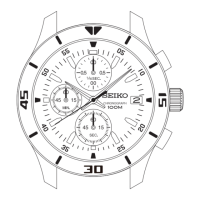
Specific 6S series models are chronographs, meaning they include a stopwatch function in addition to time display. These chronographs can measure time up to 12 hours in 1/8-second increments. The chronograph typically features a center chronograph seconds hand, a 12-hour dial (chronograph hour hand), and a 30-minute dial (chronograph minute hand).
Time Zone Adjustment Function
Some advanced calibers, such as the 4S77 and 8L36, are equipped with a "time zone adjustment mechanism." This allows the hour hand to be independently adjusted in one-hour increments using a dedicated crown, eliminating the need to stop the watch when traveling across time zones. The 24-hour hand can then be used to display the original (home) time, effectively making it a dual time watch.
Usage Features
Operating a CREDOR watch involves several key steps, primarily centered around the crown and, for chronographs, additional push buttons.
Winding the Mainspring
For manual winding types, the mainspring is wound by slowly turning the crown clockwise. For automatic winding types, the mainspring is primarily wound by the natural movement of the arm while wearing the watch. However, automatic watches also have a manual winding function, allowing the wearer to wind the mainspring by turning the crown. It is recommended to wind the mainspring fully every day at a fixed time to maintain accuracy, especially if the watch is not worn for more than 10 hours a day.
Setting the Time
To set the time, the crown is pulled out to a specific click position (usually the second click for models with a seconds hand, or the first click for models without). For models with a seconds hand, it's recommended to pull the crown out when the seconds hand is at the 12 o'clock position, which will stop the seconds hand for precise setting. The hour and minute hands are then adjusted by turning the crown. For mechanical watches, it's advised to set the hands slightly back and then forward to the correct time due to the gear train mechanism.
Setting the Date
For models with a date display, the date is set by pulling the crown out to the first click and turning it clockwise. It's crucial to avoid adjusting the date when the watch is displaying between 8:00 p.m. and 2:00 a.m., as this can cause damage or prevent the date from changing correctly. Date adjustments are necessary after months with fewer than 31 days.
Setting the Day of the Week and 24-Hour Hand
For models with day and 24-hour displays, the process involves multiple crown positions. Typically, the 3 o'clock position crown is used to set the 24-hour and minute hands, and then the hour hand and date. The 2 o'clock position crown is often used for time zone adjustments, allowing the hour hand to be independently moved in one-hour increments. Similar to date setting, it's important to avoid adjusting the date and day when the watch indicates between 9:30 p.m. and 2:30 a.m.
Using the Chronograph
The chronograph function is operated using START/STOP and RESET buttons. Pressing the START/STOP button initiates time measurement, and pressing it again stops the measurement. The RESET button returns all chronograph hands to the 0 position after measurement. The chronograph can also be used with a tachymeter scale to measure average speed or productivity rate per unit time, and with a telemeter scale to measure distance based on sound travel time.
Crown Types
CREDOR watches feature two types of crowns: a normal crown and a screw-down crown. A screw-down crown, when locked, enhances water resistance and prevents accidental operation. It must be unscrewed before pulling it out for adjustments and screwed back in after use.
Maintenance Features
Proper care and periodic maintenance are essential to preserve the quality, accuracy, and longevity of a CREDOR watch.
Daily Care
The watch body and band should be wiped with a soft cloth after each wear to remove perspiration and moisture. Chemical agents or cleaners should not be used. Turning the crown from time to time, even for screw-down crowns (without pulling it out), helps prevent corrosion and extends the life of the gasket.
Water Resistance
CREDOR watches have varying degrees of water resistance, indicated on the case back. It's important to adhere to these ratings. For instance, "WATER RESISTANT" models are suitable for everyday life but not swimming, while "WATER RESISTANT 10 (20) BAR" models are suitable for swimming and even diving without an air cylinder. It is crucial not to operate the crown when the watch is wet and to avoid exposing the watch to running water directly from a faucet, high temperatures (like baths or saunas), or leaving moisture, sweat, or dirt on it for extended periods.
Magnetic Resistance
CREDOR watches are designed to be magnetic resistant, compliant with JIS level-1 standards. However, strong external magnetic fields can still affect accuracy. It's recommended to keep the watch at least 5 cm away from common magnetic products like smartphones, speakers, and magnetic health pillows. If the watch becomes magnetized and its accuracy deteriorates significantly, demagnetization and readjustment may be required.
Band Maintenance
Bands, whether metallic, leather, or polyurethane, require regular cleaning to prevent deterioration, skin irritation, and staining. Metallic bands should be cleaned with water and a soft toothbrush to remove dirt from joint gaps, ensuring the watch body is protected from water. Leather bands should be gently blotted dry after exposure to moisture and kept away from direct sunlight. Polyurethane bands should be washed with water and replaced if they become less flexible or develop cracks. The band length should allow for slight clearance on the wrist for proper airflow.
CREDOR watches may feature 18-karat gold components, which are an alloy of 75% gold and 25% other metals. While gold maintains its luster, other metal components can discolor over time. Daily care helps prevent this, but persistent discoloration may require professional refinishing.
After-Sale Service and Overhaul
Periodic inspection and adjustment, including disassembly and cleaning (overhaul), are recommended approximately every 2 to 3 years. This process involves washing parts, changing oil, adjusting accuracy, checking functions, and replacing consumable parts like gaskets. Overhauls are crucial for maintaining optimal performance and preventing issues caused by wear, contamination, or deterioration of parts. For any repairs or services, it is advised to contact the retailer or a SEIKO CUSTOMER SERVICE CENTER. Original parts may be replaced with substitutes if unavailable.
Troubleshooting
The manual provides a troubleshooting guide for common issues such as the watch stopping, losing/gaining time, incorrect date changes, or blur in the display. Solutions range from winding the mainspring and resetting the time to seeking professional repair for demagnetization or overhaul.


 To Next Page
 General