SEL-411L Data Sheet Schweitzer Engineering Laboratories, Inc.
6
Two-Breaker Bays and
Multiterminal Lines
The SEL-411L can accommodate lines terminated as dual-
breaker connections or multiterminal lines. The SEL-411L
supports as many as three terminal applications over serial
and as many as four terminals over Ethernet communica-
tions. The relays measure and use all of the current inputs
and calculate an equivalent two-terminal alpha plane cur-
rent. The relays use a patented method to develop a remote
and local current for an equivalent two terminal system.
The equivalent local and remote currents are applied to
the tried and true alpha plane comparator. As a result, the
SEL-411L extends the advantages of alpha plane imple-
mentation to dual-breaker multiterminal lines.
Line Charging Current Compensation
The SEL-411L compensates for line charging current by
estimating an instantaneous value of the total line charging
current on a per-phase basis and then subtracting this value
from the measured differential current. The relay uses
instantaneous values of the line voltage and the suscep-
tance of the line (cable) to calculate charging current in
real time on a sample-by-sample basis.
This method is accurate under steady state and transient
conditions. These latter conditions can include external
faults, internal faults, switching events, and line energi-
zation, even with uneven breaker pole operation. Com-
pensating the phase currents removes the charging current
from the sequence currents automatically and improves
the sensitivity of the sequence 87L elements.
Each SEL-411L terminal with access to voltage uses the
lump parameter model of the transmission line and the
local terminal voltage to calculate the total charging current:
The relay subtracts a portion of the total charging current
proportional to the number of compensating terminals
from the local phase current. For example, with two relays
compensating for the charging current, each subtracts
half of the total charging current.
By subtracting the total charging current from the differ-
ential signal prior to using the generalized alpha plane
algorithm, the relay moves the operating point to the ideal
blocking point (1180°) when no internal fault conditions
exist. This allows more sensitive settings, particularly for
the 87LP element.
A loss of voltage at one of the line terminals causes the
scheme to use remaining voltages, with properly adjusted
multipliers, for compensation, resulting in removal of the
total line charging current. If no compensation is possi-
ble, the fallback logic engages more secure settings to
retain security of protection.
External Fault Detection
An external fault detection algorithm analyzes particular
characteristics of the 87L zone currents to identify exter-
nal events as a fault, load pickup under exceptionally high
X/R ratio, or a transformer inrush condition that could
jeopardize 87L security with possible subsequent CT sat-
uration. Assertion of the algorithm occurs before and regard-
less of CT saturation, bringing proper security to the 87L
scheme, particularly to the 87LQ and 87LG elements.
The external fault detection algorithm consists of two paths:
➤ The ac saturation path guards against potentially
fast and severe CT saturation resulting from high
current magnitudes such as those occurring during
close-in external faults.
➤ The dc saturation path guards against typically
slower and less severe saturation that can result
from relatively large and long-lasting dc
component in current signals as can exist during
transformer inrush or slowly cleared external faults
under large X/R ratios.
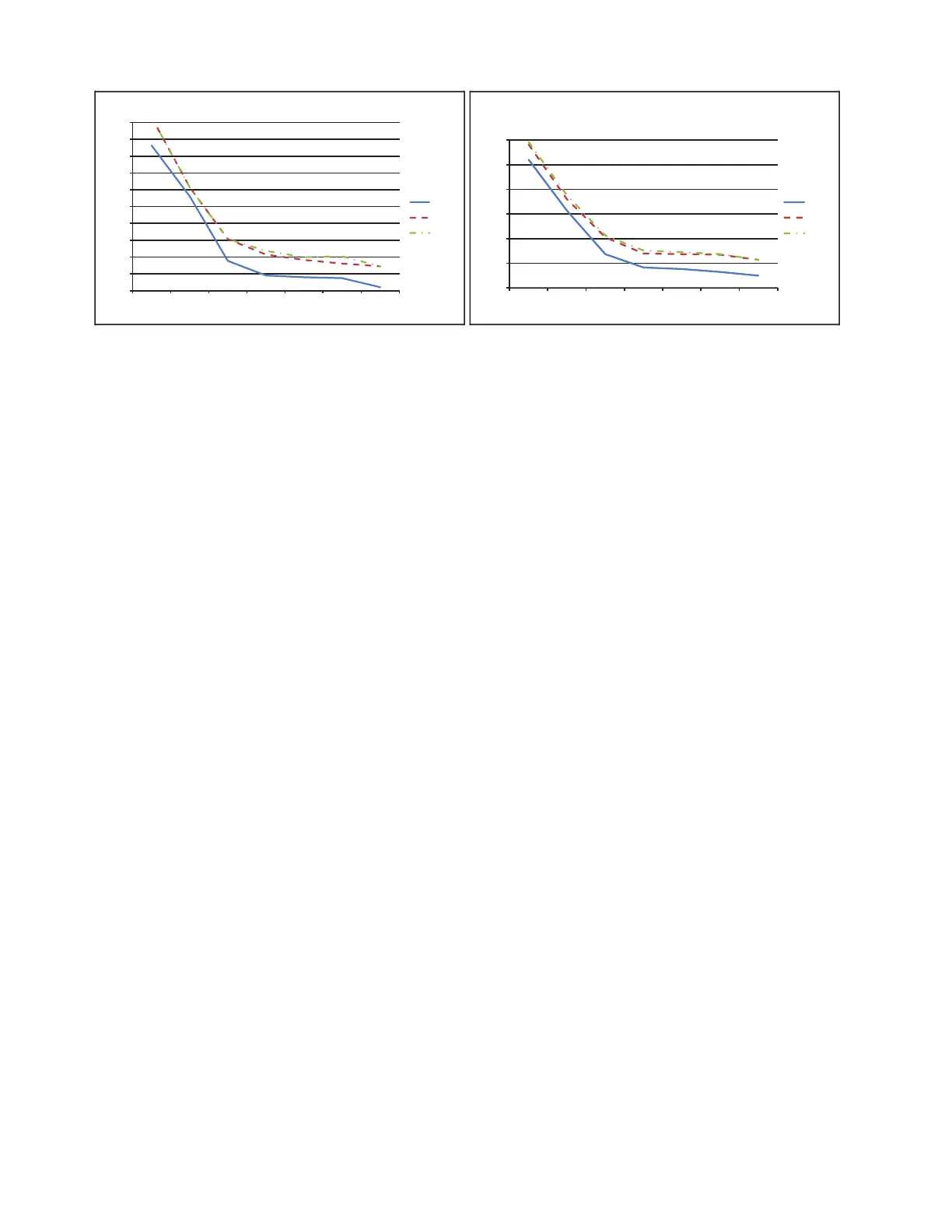
Figure 4 Operating Time Curves
0.6
0.8
1
1.2
1.4
1.6
1.8
0.6
0.7
0.8
0.9
1
1.1
1.2
1.3
1.4
1.5
1.6
1 2 4 8
Minimum Trip Time
Trip Time (Cycles)
Per Unit Differential Current
87LP
87LQ
87LG
Average Trip Time
Trip Time (Cycles)
87LP
87LQ
87LG
Per Unit Differential Current
201510 1 2 4 8 201510
i
CHARGE
C
LINE
dv
dt
------
• =


 To Next Page