Schweitzer Engineering Laboratories, Inc. SEL-411L Data Sheet
5
Protection Features
The SEL-411L contains all the necessary protective elements and control logic to protect overhead transmission lines
and underground cables (see Figure 2).
Complete Current Differential
Protection
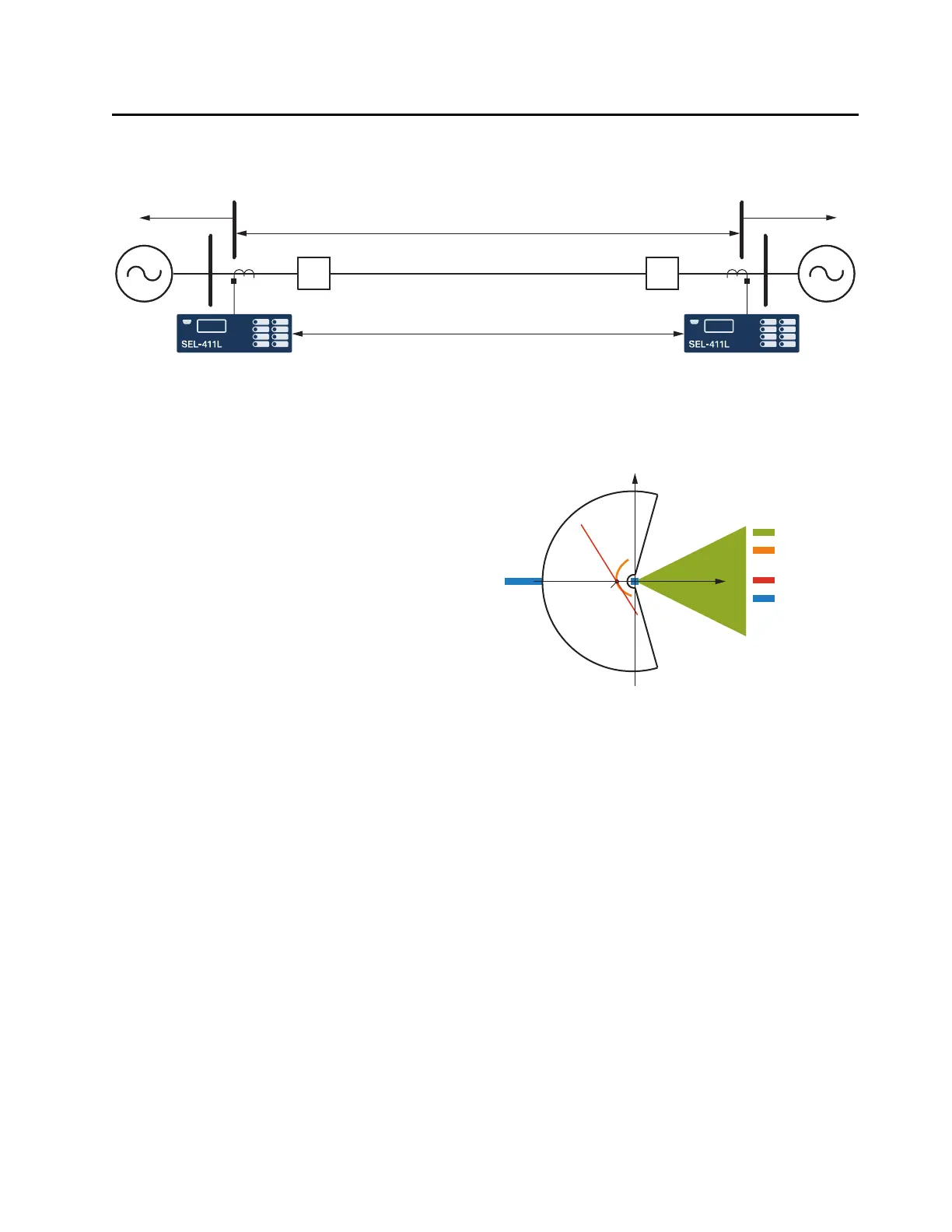
The SEL-411L differential elements compare phase,
negative-sequence, and zero-sequence components from
each line terminal, as Figure 2 illustrates.
The differential protection in the SEL-411L compares
the vector ratio of the equivalent local and remote cur-
rents in a complex plane, known as the alpha plane, as
Figure 3 shows. For load and external faults with no CT
or communication errors, the vector ratio of remote cur-
rent to local current is –1 or 1180º. The SEL-411L
restraint region surrounds the ideal external fault and
load current point, allowing for errors in both magnitude
and phase angle. CT saturation, channel asymmetry, and
other effects during faults outside the protected zone pro-
duce shifts in the magnitude and angle of the ratio. The
characteristic provides proper restraint for these condi-
tions while still providing good sensitivity for high resis-
tance faults with its negative- and zero-sequence
differential elements. You can adjust both the angular
extent and the radial reach of the restraint region.
The differential protection algorithms offer great security
against CT saturation effects. In addition to providing
individual breaker currents to the differential element,
the relay incorporates ultra-fast external fault detection to
cope with fast and severe CT saturation resulting from
high fault currents. It also provides a standing dc detec-
tion algorithm to cope with slower saturation resulting
from large and slowly decaying dc offset in the trans-
former inrush or fault currents under large X/R ratios.
Such provisions prevent the SEL-411L from tripping on
through faults and allows relaxation of CT requirements
for current differential applications.
The SEL-411L allows single-pole tripping from the 87L
elements. This includes tripping highly resistive faults
from the sensitive 87LQ and 87LG elements. These
87LQ and 87LG elements do not have inherent faulted-
phase identification capabilities. Therefore, the 87L
function incorporates its own faulted-phase selection
logic and uses symmetrical components in the phase dif-
ferential currents to provide very sensitive, accurate, and
fast fault-type identification. Figure 4 shows the operate
times for the 87L elements.
When performing single-pole tripping without differen-
tial enabled or available, the SEL-411L uses a proven
single-ended fault identification logic based on the angu-
lar relationships in the local current.
Figure 2 Differential Element Operate and Restraint Regions
Differential Operate
Phase Currents and Other 87L Data
Differential
Restraint
Differential
Restraint
Figure 3 Operate and Restraint Regions in Alpha Plane
Responses to System Conditions
Internal Faults
Synchronism
Errors
CT Saturation
Internal Faults
With Infeed or
Outfeed
Re(k)
–1
Restraint
Operate
Im(k)


 To Next Page