Need help?
Do you have a question about the Sencor SWK 1757SS and is the answer not in the manual?
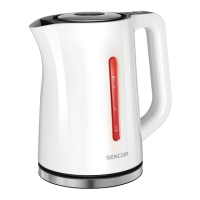
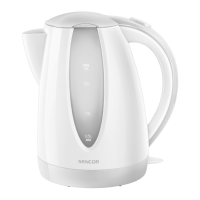
This document describes the Sencor SWK 1757SS Electric Kettle, a household appliance designed for boiling drinking water. The kettle features a stainless steel body and a base with a central connector, allowing for easy placement and removal.
The Sencor SWK 1757SS is an electric kettle primarily used for boiling water. It operates by heating water through an internal heating element located in its base. Once the water reaches boiling point, the kettle automatically switches off, indicated by the power indicator light turning off. This automatic shut-off mechanism ensures safety and prevents the kettle from boiling dry. The kettle is equipped with a lid that opens via a button, a spout with a removable filtration strainer, and a water level mark to guide users on appropriate filling levels.
To use the kettle, first ensure it is placed on a stable, even, and dry surface. The power cord length can be adjusted and pushed into a groove in the base for neat storage. Before filling, the kettle should be taken off its base. Water can be filled either through the spout or by opening the lid using the designated button. It is crucial to ensure the water level is between the minimum and maximum marks to prevent splashing of boiling water if overfilled, or damage to the kettle if operated empty. The minimum fill level is 0.5 liters, and the maximum is 1.7 liters. Once filled, the lid must be securely closed.
After placing the kettle on its base and plugging it into a properly grounded power socket, the kettle is started by setting the 0/1 switch to the "I" (On) position. A power indicator light will illuminate, signaling that the kettle is in operation. It is important never to turn on an empty kettle, as this can negatively affect its lifetime. If accidentally turned on without water, a thermostat will interrupt the electric circuit, and the switch will move to the "0" (Off) position, with the indicator light turning off. The kettle can be used again after a few minutes once the heating bottom has cooled down.
The boiling process can be interrupted at any time by manually setting the switch to "0" (Off). When pouring boiled water, maintain the kettle in a vertical position, especially if it is filled to the maximum mark, to prevent spills. If refilling, exercise caution when opening the lid due to escaping steam. After use, the kettle should be disconnected from the power socket, emptied, and allowed to cool down.
The kettle is designed for domestic use and similar environments such as staff kitchens, agricultural farms, hotel rooms, and bed and breakfast establishments. It should not be used near baths, showers, or swimming pools, nor on window sills, kitchen sink drainboards, or unstable surfaces. The kettle is exclusively for boiling drinking water and should not be used to heat other liquids or foodstuffs.
Regular cleaning and maintenance are essential for the kettle's longevity and safe operation. Before cleaning, always ensure the kettle is turned off, disconnected from the power socket, and cooled down.
For external cleaning, a dry cloth or a cloth dampened with a weak solution of neutral kitchen detergent can be used. After applying detergent, wipe the surface with a lightly damp cloth and then dry it. The base should only be cleaned with a dry cloth. Solvents or abrasive cleaning agents must never be used.
The kettle includes a removable filtration strainer in the spout, which captures limescale and prevents it from being poured into cups. This filter should be cleaned regularly under running water using a fine nylon brush. Alternatively, it can be submerged for several hours in a vinegar-water solution (recommended dilution ratio 1:2), followed by rinsing under clean running water.
Limescale deposits inside the kettle can negatively impact its lifetime and should be removed regularly based on usage frequency. For standard use (3 to 5 times per day), monthly descaling is recommended in areas with hard water, and every two to three months in areas with soft to medium hard water.
Two methods are suggested for limescale removal:
The surface of the heating element and the kettle body remain hot due to residual heat after use, so the handle should always be used for lifting and carrying. To avoid electrical shock, users should not attempt to repair or adjust the kettle themselves. All repairs must be performed by an authorized service center, as tampering with the appliance voids the warranty. If the power cord is damaged, it must be replaced by a professional service center, and the kettle should not be used with a damaged cord.
 Power
Power| rated voltage range | 220−240 V |
|---|---|
| rated frequency | 50/60 Hz |
| rated power input | 1 850–2 150 W |
 Capacity
| capacity | 1.7 l |
|---|


 To Next Page