Need help?
Do you have a question about the Sencor SWK 1813OR and is the answer not in the manual?
This document serves as the user's manual for the Sencor Electric Kettle, covering models SWK 1810WH, SWK 1811GR, SWK 1812BL, SWK 1813OR, SWK 1814RD, SWK 1815VT, SWK 1816YL, and SWK 1817TQ. It provides comprehensive instructions for safe operation, initial setup, daily use, and maintenance, ensuring users can effectively and safely operate their appliance.
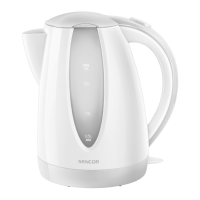
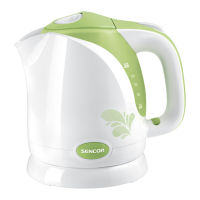
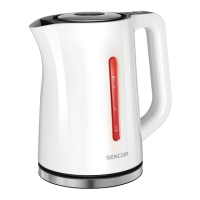
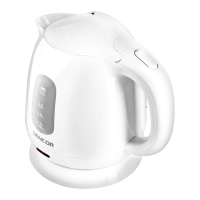
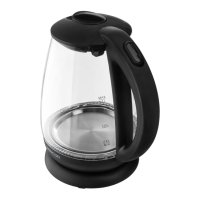
The Sencor Electric Kettle is designed primarily for boiling water for domestic use. It is suitable for various settings, including staff kitchens in stores, offices, and other workplaces; hotel or motel rooms and other living areas; bed and breakfast establishments; and agricultural farms. The kettle is not intended for outdoor use and should always be placed on a stable, even, and dry surface, away from window sills or unstable areas. It is specifically designed to boil water and should not be used for other liquids. The appliance features a central connector base, allowing the kettle to be placed on it from any angle. An I/O switch (power on/off) controls the heating process, and a power-on light indicates when the kettle is active. The kettle is equipped with an automatic shut-off mechanism that activates once the water reaches boiling point, and it also includes protection against damage from accidental dry running (operating without water).
Before first use, it is essential to remove all packaging materials and clean the kettle by filling it to the maximum water mark with clean water, boiling it, and then emptying it. This process should be repeated 2 to 3 times to ensure cleanliness.
To use the kettle, first set the desired length of the power cord by pushing it into the groove in the base, then place the base on a stable, even, and clean surface. Fill the kettle with the required amount of water, ensuring it is between the minimum (0.5L) and maximum (1.8L) marks. Water can be added through the spout or by lifting the lid, which is opened by pressing the safety lid lock. It is crucial never to fill the kettle while it is on the base, and to avoid overfilling, as boiling water could splash out. Once filled, place the kettle on its base, insert the power plug into an electrical socket, and ensure the lid is closed. To start boiling, move the I/O switch to the "I" (On) position; the power-on light will illuminate.
The kettle is protected against dry running: if it is accidentally turned on without water, the thermostat will interrupt the electric circuit, and the power-on light will turn off. The kettle can be used again after a few minutes once its stainless steel bottom has cooled down. Once the water boils, the kettle will automatically turn off, and the power-on light will extinguish. Users should always check that the kettle has turned itself off before removing it from the base. If it has not automatically turned off, it can be manually switched to "0" (Off). The boiling process can be interrupted at any time by moving the switch to "0" (Off). When pouring boiled water, keep the kettle in a horizontal position, especially if it is full, to prevent scalding from escaping steam. After use, disconnect the power cord from the socket, empty the kettle, and allow it to cool down. The kettle's body heats up during operation, so users should avoid touching hot surfaces and always use the handle for lifting and carrying.
Regular cleaning and maintenance are vital for the kettle's longevity and performance. The removable filter, designed to capture scale deposits, should be cleaned regularly under running water using a fine nylon brush or by submerging it in a vinegar-water solution (1:2 dilution) for several hours, followed by rinsing with clean water.
Water scale deposits inside the kettle should be removed regularly, with frequency depending on usage and water hardness. For standard use (3 to 5 times per day), it is recommended to remove deposits monthly in areas with hard water and every two to three months in areas with soft water. Scale can be removed using 8% white vinegar: pour 1.5L of vinegar into the kettle, let it settle for 2 hours without boiling, then empty and boil clean water four to five times before further use. Alternatively, citric acid can be used: boil 1.5L of water, add 30g of citric acid to the boiled water, let it settle for about 30 minutes, then empty and boil clean water four to five times.
For the exterior, use a dry cloth or a cloth dampened with a weak solution of neutral kitchen detergent. After applying the detergent, wipe the surface with a lightly damp cloth and then dry it. The base should only be cleaned with a dry cloth. Abrasive cleaning agents, petrol, or solvents should never be used on the kettle or its base.
The appliance should always be disconnected from the power socket when not in use, before moving, or before cleaning. If the power cord is damaged, it must be replaced by an expert service center; using the kettle with a damaged cord or plug is forbidden. Users should not attempt to repair or modify the kettle themselves to avoid electrical shock; all repairs must be carried out by an authorized service center, as tampering with the appliance during the warranty period will void the warranty.
 General
| Capacity | 1.8 L |
|---|---|
| Material | Stainless Steel |
| Color | Orange |
| Automatic Shut-off | Yes |
| Water Level Indicator | Yes |
| Filter | Removable |
| Heating Element | Concealed |
| Safety Features | Boil-dry protection |
| Base | 360° |


 To Next Page