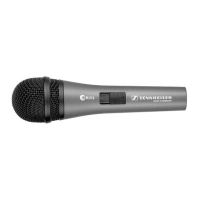
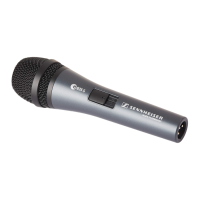
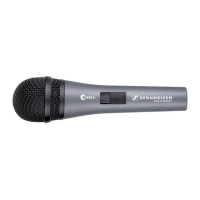
The Sennheiser e 825 S is a dynamic cardioid microphone designed for various audio applications, particularly for live performances and studio recordings. It is engineered to deliver a powerful, direct sound with a significant bass boost when used in close proximity, making it suitable for vocals and instruments where a strong, upfront presence is desired.
Function Description:
The e 825 S is a wired microphone that converts sound waves into electrical signals. Its dynamic transducer principle means it uses a coil and magnet to generate an electrical current in response to sound pressure, making it robust and suitable for high sound pressure levels. The cardioid pick-up pattern is designed to capture sound primarily from the front of the microphone, while rejecting sounds from the sides and rear. This characteristic is crucial for minimizing feedback in live sound environments and reducing crosstalk from other sound sources, ensuring a cleaner and more focused audio capture. The microphone includes an on/off switch for convenient control during use, which can also be locked in the "on" position to prevent accidental switching.
Important Technical Specifications:
- Transducer principle: Dynamic
- Frequency response: 80 - 15,000 Hz, providing a wide range for capturing various audio nuances.
- Pick-up pattern: Cardioid, offering excellent off-axis rejection.
- Sensitivity (free field, no load): 1.5 mV/Pa, indicating its efficiency in converting sound pressure to electrical voltage.
- Nominal impedance (at 1 kHz): 350 Ω.
- Min. terminating impedance: 1 kΩ.
- Connector: XLR-3, a standard professional audio connector.
- Temperature range: 0 °C to +40 °C, suitable for typical operating environments.
- Dimensions: Ø 48 x 180 mm.
- Weight: 330 g, making it comfortable to handle.
The polar pattern diagram illustrates the cardioid characteristic, showing maximum sensitivity at 0° (front) and significant attenuation at 180° (rear). The frequency response curve shows a relatively flat response across the mid-range, with a gentle roll-off in the bass and a slight boost in the upper frequencies, contributing to its clear and present sound.
Usage Features:
- Attaching the microphone: The e 825 S can be easily attached to a microphone stand using the MZQ 800 microphone clamp (included). The clamp screws onto the stand, and the microphone is then placed into the clamp, allowing for proper orientation.
- Connecting the microphone: It connects to audio equipment via a standard XLR-3 cable (optional accessory).
- Using the windshield: For outdoor use or to reduce plosives and wind noise, an MZW 4032 windshield (optional accessory) can be placed over the microphone head.
- Holding the microphone: For optimal sound quality and to maintain the intended pick-up pattern, it is recommended to hold the microphone by its body, avoiding covering the microphone head.
- Positioning the microphone:
- Close proximity (5-10 cm): Results in a high proximity effect (large bass boost) and a powerful, direct sound with very little crosstalk from other sources.
- Medium distance (approx. 10 cm): Offers less proximity effect (less bass boost), some room ambience, and a natural, balanced sound with more crosstalk.
- Further distance (>10 cm): Provides very little proximity effect, more room ambience, and an indirect sound with higher crosstalk.
- Sibilance reduction: If sibilance occurs, positioning the microphone slightly to the side of the mouth, rather than directly in front, can help.
- Positioning monitor loudspeakers: To prevent feedback and crosstalk, monitor loudspeakers should be positioned in the angle area of the highest cancellation of the microphone (approximately 180° from the front).
- On/off switch: The microphone features an on/off switch for easy control. A screw allows the switch to be locked in the "on" position, preventing accidental power-off during a performance.
Maintenance Features:
- General cleaning: The microphone should be disconnected from the power supply and any batteries removed before cleaning. It should be cleaned only with a soft, dry cloth.
- Caution with liquids: Liquids can damage the electronics, so they must be kept away from the product. Solvents or cleansing agents should not be used.
- Cleaning the sound inlet basket:
- Unscrew the sound inlet basket.
- Remove the foam insert.
- Clean the sound inlet basket (inside and outside) with a slightly damp cloth.
- If necessary, clean the foam insert with a mild detergent or replace it.
- Dry the foam insert thoroughly.
- Reinsert the foam insert.
- Replace the sound inlet basket on the microphone head and screw it tight.
The e 825 S is a versatile microphone suitable for a range of applications, including vocals, speech, and various instruments, as indicated by its compatibility with different sound sources in the "Overview of applications" chart. Its robust construction and clear sound reproduction make it a reliable choice for both amateur and professional users.

 Need help?
 General

 To Next Page
