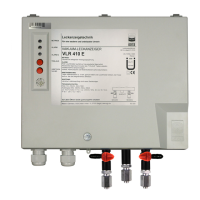
4.2.2 VLR …/E WITH connected solenoid valve
(1) Press button on the ZD (so that it latches). This causes the "Sensor alarm" on the leak
detector to go out.
(2) Execute start-up sequence in accordance with the documentation for leak detector VLR …/E
until the "Alarm OFF" pressure is reached.
(3) As soon as this underpressure is reached, the sensor alarm is triggered again, the solenoid
valve closes, the pump of the leak detector stops.
(4) Press button on the ZD (so that it unlatches). This causes the "Sensor alarm" on the leak
detector to go out again, and an additional start-up operation (underpressure build-up) can
be carried out until the operating underpressure is reached.
5. Normal operation
In normal operation the button on the ZD …
• must be pressed (latched) for the VL-HFw2, and
• not pressed (not latched) for the VLR …/E.
6. Functional tests
6.1. Testing the electrical connection
(1) Press the button on the ZD …, triggering the alarm on the leak detector.
(2) Press the button on the ZD … again; the alarm goes out
6.2. Testing the switching values
(1) Connect measuring instrument to the 3-way valve in the measuring line (below the leak
detector).
(2) Turn the valve 90° anti-clockwise, thus "blinding" the pressure switch in the lead detector.
(3) Ventilate the system at the leak detector using the ventilation unit and the 3-way valve in the
suction line until the alarm is activated.
(4) The switching value for "Alarm ON" must correspond to column 2, chapter 3.4.
(5) Build up underpressure in accordance with Chapter 4 of this appendix.
(6) The switching value for "Alarm OFF" must be lower than the "Pump OFF" switching value of
the leak detector.
The "Sensor alarm" is a priority circuit, i.e. this alarm has the topmost priority, because it originally
comes from an application in which a sensor was used in connection with a solenoid valve to replace the
hydraulic seal.



 To Next Page