EasyManua.ls Logo

Sharp GF-6060H - Page 6

Sharp GF-6060H
24 pages
Print Icon
To Next Page IconTo Next Page
To Previous Page IconTo Previous Page
Loading...
EXPLANATIONS
OF
APSS
AND
ALC
=
APSS
The
APSS
circuit
employed
for
the
GF-6060H
and
GF-6060E
is
a
little
different
from
that
for
the
con-
ventional
models
the
level
comparator
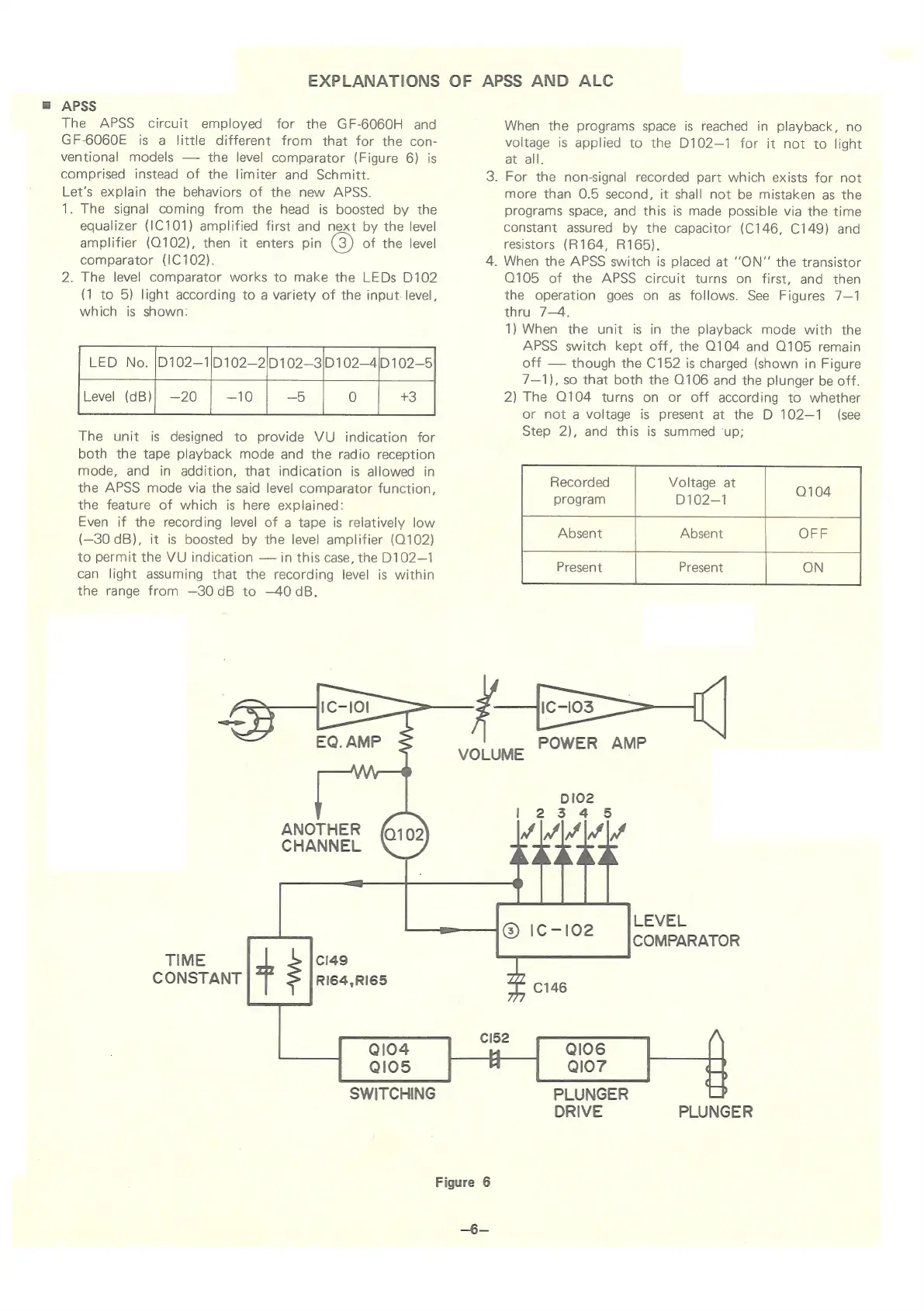
(Figure
6)
is
comprised
instead
of
the
limiter
and
Schmitt.
Let’s
explain
the
behaviors
of
the
new
APSS.
1.
The
signal
coming
from
the
head
is
boosted
by
the
equalizer
(1C101)
amplified
first
and
next
by
the
level
amplifier
(Q102),
then
it
enters
pin
of
the
level
comparator
(1C102).
2.
The
level
comparator
works
to
make
the
LEDs
D102
(1
to
5)
light
according
to
a
variety
of
the
input.
level,
which
is
shown:
LED
No.
/D102—11D102—2/D102—3|D102—4/D
102—5
Level
(dB)
The
unit
is
designed
to
provide
VU
indication
for
both
the
tape
playback
mode
and
the
radio
reception
mode,
and
in
addition,
that
indication
is
allowed
in
the
APSS
mode
via
the
said
level
comparator
function,
the
feature
of
which
is
here
explained:
Even
if
the
recording
level
of
a
tape
is
relatively
low
(—30
dB),
it
is
boosted
by
the
level
amplifier
(Q102)
to
permit
the
VU
indication
in
this
case,
the
D102—1
can
light
assuming
that
the
recording
level
is
within
the
range
from
—30dB
to
—40dB.
ANOTHER
CHANNEL
TIME
CONSTANT
Ccl49
RI64,RI65
When
the
programs
space
is
reached
in
playback,
no
voltage
is
applied
to
the
D102—1
for
it
not
to
light
at
all.
.
For
the
non-signal
recorded
part
which
exists
for
not
more
than
0.5
second,
it
shall
not
be
mistaken
as
the
programs
space,
and
this
is
made
possible
via
the
time
constant
assured
by
the
capacitor
(C146,
C149)
and
resistors
(R164,
R165).
.
When
the
APSS
switch
is
placed
at
‘‘ON”’
the
transistor
Q105
of
the
APSS
circuit
turns
on
first,
and
then
the
operation
goes
on
as
follows.
See
Figures
7—1
thru
7-4.
1)
When
the
unit
is
in
the
playback
mode
with
the
APSS
switch
kept
off,
the
Q104
and
Q105
remain
off
though
the
C152
is
charged
(shown
in
Figure
7—1),
so
that
both
the
Q106
and
the
plunger
be
off.
2)
The
Q104
turns
on
or
off
according
to
whether
or
not
a
voltage
is
present
at
the
D
102—1
(see
Step
2),
and
this
is
summed
‘up;
Recorded
Voltage
at
program
D102—1
Gules
Absent
Absent
OFF
Present
Present
ON
POWER
AMP
VOLUME
LEVEL
COMPARATOR
SWITCHING
PLUNGER
DRIVE
PLUNGER

Related product manuals