EasyManua.ls Logo

Sharp SM-307H - Circuitry Description

Sharp SM-307H
24 pages
Print Icon
To Next Page IconTo Next Page
To Previous Page IconTo Previous Page
Loading...
©
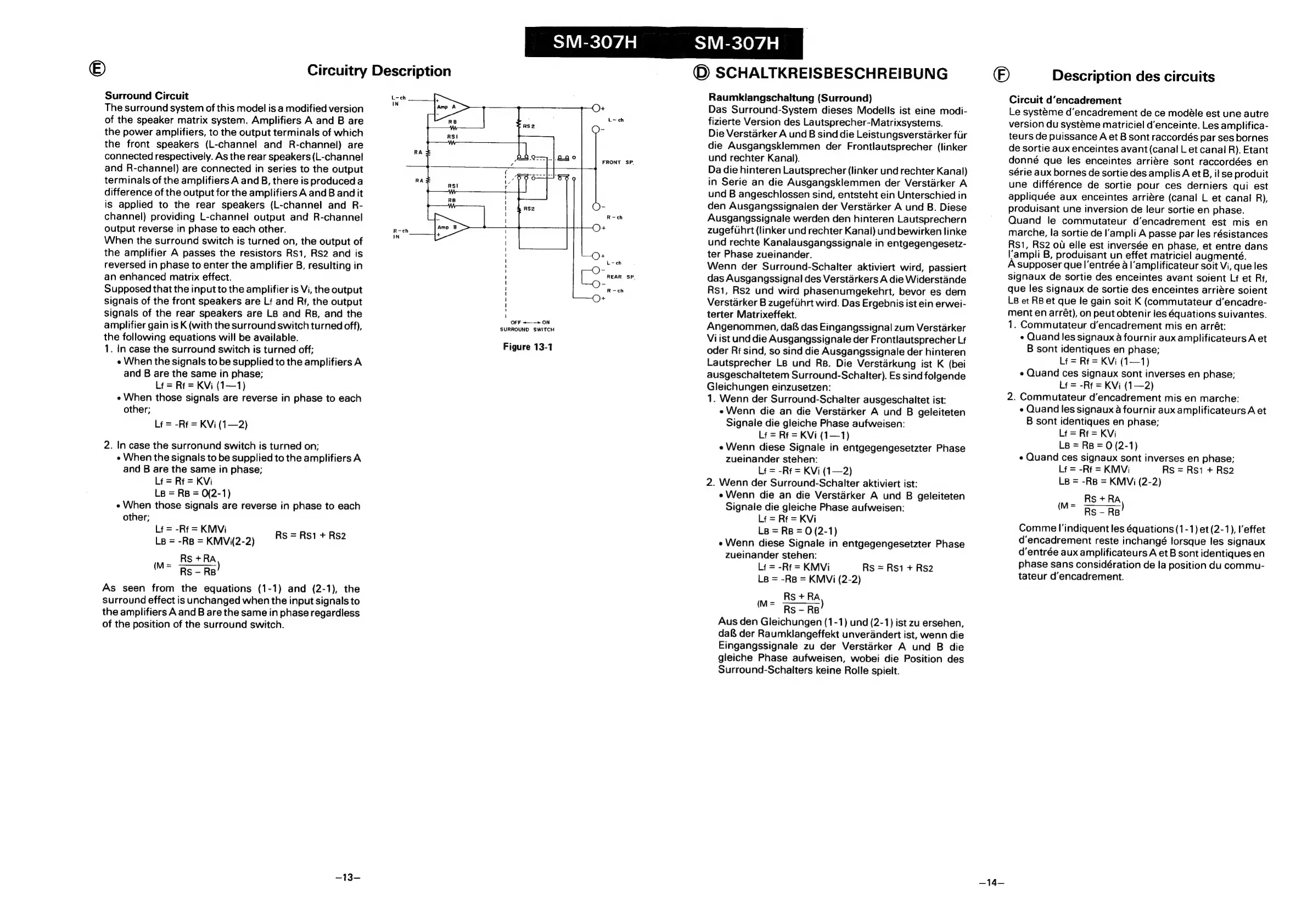
Surround
Circuit
The
surround
system
of
this
model
is
a
modified
version
of
the
speaker
matrix
system.
Amplifiers
A
and
B
are
the
power
amplifiers,
to
the
output
terminals
of
which
the
front
speakers
(L-channel
and
R-channel)
are
connected
respectively.
As
the
rear
speakers
(L-channel
and
R-channel)
are
connected
in
series
to
the
output
terminals
of
the
amplifiers
A
and
B,
there
is
produced
a
difference
of
the
output
for
the
amplifiers
A
and
B
and
it
is
applied
to
the
rear
speakers
(L-channel
and
R-
channel)
providing
L-channel
output
and
R-channel
output
reverse
in
phase
to
each
other.
When
the
surround
switch
is
turned
on,
the
output
of
the
amplifier
A
passes
the
resistors
Rs1,
RS2
and
is
reversed
in
phase
to
enter
the
amplifier
B,
resulting
in
an
enhanced
matrix
effect.
Supposed
that
the
input
to
the
amplifier
is
Vi,
the
output
signals
of
the
front
speakers
are
Lf
and
Rf,
the
output
signals
of
the
rear
speakers
are
LB
and
RB,
and
the
amplifier
gain
is
K
(with
the
surround
switch
turned
off),
the
following
equations
will
be
available.
1.
In
case
the
surround
switch
is
turned
off;
e
When
the
signals
to
be
supplied
to
the
amplifiers
A
and
B
are
the
same
in
phase;
Lt
=
Rf
=
KVi
(1—1)
e
When
those
signals
are
reverse
in
phase
to
each
other;
Lt
=
-Rf
=
KVi
(1—2)
2.
In
case
the
surronund
switch
is
turned
on;
e
When
the
signals
to
be
supplied
to
the
amplifiers
A
and
B
are
the
same
in
phase;
Lt
=
Rt
=
KVi
LB
=
RB
=
O(2-1)
e
When
those
signals
are
reverse
in
phase
to
each
other;
Lt
=
-Rf
=
KMVi
2
Le
=-Re=KMV(2-2)
RS=Rsi
+
Rs2
se
Rs
+
slag
(=
Rs-—
Re
As
seen
from
the
equations
(1-1)
and
(2-1),
the
surround
effect
is
unchanged
when
the
input
signals
to
the
amplifiers
A
and
B
are
the
same
in
phase
regardless
of
the
position
of
the
surround
switch.
~13-
Circuitry
Description
SM-307H
SM-307H
|
OFF
«——--»
ON
SURROUND
SWITCH
Figure
13-1
FRONT
SP.
©
SCHALTKREISBESCHREIBUNG
Raumklangschaltung
(Surround)
Das
Surround-System
dieses
Modells
ist
eine
modi-
fizierte
Version
des
Lautsprecher-Matrixsystems.
Die
Verstarker
A
und
B
sind
die
Leistungsverstarker
fur
die
Ausgangsklemmen
der
Frontlautsprecher
(linker
und
rechter
Kanal).
Da
die
hinteren
Lautsprecher
(linker
und
rechter
Kanal)
in
Serie
an
die
Ausgangsklemmen
der
Verstarker
A
und
B
angeschlossen
sind,
entsteht
ein
Unterschied
in
den
Ausgangssignalen
der
Verstarker
A
und
B.
Diese
Ausgangssignale
werden
den
hinteren
Lautsprechern
zugefuhrt
(linker
und
rechter
Kanal)
und
bewirken
linke
und
rechte
Kanalausgangssignale
in
entgegengesetz-
ter
Phase
zueinander.
Wenn
der
Surround-Schalter
aktiviert
wird,
passiert
das
Ausgangssignal
des
Verstarkers
A
die
Widerstande
Rs1,
RS2
und
wird
phasenumgekehrt,
bevor
es
dem
Verstarker
B
zugeftihrt
wird.
Das
Ergebnis
ist
ein
erwei-
terter
Matrixeffekt.
Angenommen,
da
das
Eingangssignal
zum
Verstarker
Vi
ist
und
die
Ausgangssignale
der
Frontlautsprecher
Lt
oder
Rf
sind,
so
sind
die
Ausgangssignale
der
hinteren
Lautsprecher
LB
und
Rea.
Die
Verstarkung
ist
K
(bei
ausgeschaltetem
Surround-Schalter).
Es
sind
folgende
Gleichungen
einzusetzen:
1.
Wenn
der
Surround-Schalter
ausgeschaltet
ist:
e
Wenn
die
an
die
Verstarker
A
und
B
geleiteten
Signale
die
gleiche
Phase
aufweisen:
Lt
=
Rt
=
KVi
(1—1)
e
Wenn
diese
Signale
in
entgegengesetzter
Phase
zueinander
stehen:
Lf
=
-Rf
=
KVi
(1—2)
2.
Wenn
der
Surround-Schalter
aktiviert
ist:
«Wenn
die
an
die
Verstarker
A
und
B
geleiteten
Signale
die
gleiche
Phase
aufweisen:
Lt
=
Rf
=
KVi
LB
=
RB
=O
(2-1)
e
Wenn
diese
Signale
in
entgegengesetzter
Phase
zueinander
stehen:
Le
=
-Rt=
KMVi
Rs
=
Rs1
+
Rs2
Le
=
-Re
=
KMVi
(2-2)
m=
RS+RA,
(M=
Rs—RB
Aus
den
Gleichungen
(1-1)
und
(2-1)
ist
zu
ersehen,
daf&
der
Raumklangeffekt
unverandert
ist,
wenn
die
Eingangssignale
zu
der
Verstarker
A
und
B
die
gleiche
Phase
aufweisen,
wobei
die
Position
des
Surround-Schaliters
keine
Rolle
spieit.
©
Description
des
circuits
Circuit
d’encadrement
Le
systeme
d’encadrement
de
ce
modéle
est
une
autre
version
du
systéme
matriciel
d’enceinte.
Les
amplifica-
teurs
de
puissance
A
et
B
sont
raccordés
par
ses
bornes
de
sortie
aux
enceintes
avant
(canal
L
et
canal
R).
Etant
donné
que
les
enceintes
arriére
sont
raccordées
en
série
aux
bornes
de
sortie
des
amplis
A
et
B,
il
se
produit
une
différence
de
sortie
pour
ces
derniers
qui
est
appliquée
aux
enceintes
arriére
(canal
L
et
canal
R),
produisant
une
inversion
de
leur
sortie
en
phase.
Quand
le
commutateur
d’encadrement
est
mis
en
marche,
la
sortie
de
l'ampli
A
passe
par
les
résistances
Rsi,
RS2
ou
elle
est
inversée
en
phase,
et
entre
dans
l‘ampli
B,
produisant
un
effet
matriciel
augmenteé.
A
supposer
que
|entrée
a
l’amplificateur
soit
Vi,
que
les
signaux
de
sortie
des
enceintes
avant
soient
Lf
et
Rf,
que
les
signaux
de
sortie
des
enceintes
arriére
soient
LB
et
RB
et
que
le
gain
soit
K
(commutateur
d’encadre-
ment
en
arrét),
on
peut
obtenir
les
équations
suivantes.
1.
Commutateur
d’encadrement
mis
en
arrét:
e
Quand
les
signaux
a
fournir
aux
amplificateurs
A
et
B
sont
identiques
en
phase;
Lt
=
Rt
=
KVi
(1—1)
e
Quand
ces
signaux
sont
inverses
en
phase;
Lf
=
-Rt
=
KVi
(1—2)
2.
Commutateur
d’encadrement
mis
en
marche:
e
Quand
les
signaux
a
fournir
aux
amplificateurs
A
et
B
sont
identiques
en
phase;
Lt
=
Rt
=
KVi
LB
=
RB
=
0
(2-1)
¢
Quand
ces
signaux
sont
inverses
en
phase;
Lt
=
-Rt
=
KMVi
Rs
=
Rs1
+
Rs2
LB
=
-RB
=
KMVi
(2-2)
Rs
+RA
(M=
Rs
—Re)
Comme
|lindiquent
les
équations
(1-1)
et
(2-1),
l’effet
d’encadrement
reste
inchangé
lorsque
les
signaux
d’entrée
aux
amplificateurs
A
et
B
sont
identiques
en
phase
sans
considération
de
la
position
du
commu-
tateur
d’encadrement.
—14—

Related product manuals