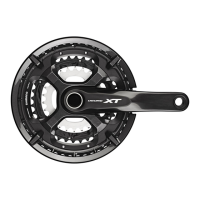
This document serves as a Dealer's Manual for Shimano Cranksets, covering models like DEORE XT FC-T8000 and DEORE FC-T6010, along with their corresponding bottom brackets (BB-MT800, BB-MT801, BB-MT800-PA, SM-BB52, BB-MT501, BB-MT500-PA). The manual is intended primarily for professional bicycle mechanics and provides detailed instructions for installation, adjustment, and maintenance of these crankset components.
Function Description:
The Shimano cranksets and bottom brackets are integral components of a bicycle's drivetrain, responsible for transferring power from the rider's legs to the rear wheel. The crankset consists of the crank arms and chainrings, which are rotated by the pedals. The bottom bracket houses the bearings that allow the crankset to rotate smoothly within the bicycle frame's bottom bracket shell. Together, these components ensure efficient pedaling and gear shifting. The manual covers various types of cranksets and bottom brackets, including those for Road, MTB, City Touring/Comfort Bike, Urban Sport, Trekking, and E-BIKE applications, indicating their versatility across different cycling disciplines.
Usage Features:
The manual emphasizes safety and correct usage to prevent personal injury and damage to equipment. Key usage features and recommendations include:
- Professional Installation: The manual strongly advises that installation and maintenance be performed by professional bicycle mechanics. Users without professional training should not attempt to install components themselves.
- Genuine Shimano Parts: Only genuine Shimano parts should be used for installation and replacement to ensure proper function and safety.
- Regular Cleaning and Maintenance: The chain should be cleaned regularly with an appropriate chain cleaner, and the crank arm and bottom bracket should be cleaned with a neutral detergent. This helps extend the life of the components and maintain optimal performance.
- Pre-Ride Checks: Before each ride, users should check for cracks in the crank arms, any damage or abnormalities in the chain (deformation, cracks, skipping, unintended gear shifting), and ensure there is no excess play or looseness in fastening sections.
- Proper Chainring Combinations: Using specified chainring combinations is crucial for optimal shifting performance and to prevent chain jamming or damage to the bicycle.
- Eye Protection: Approved eye protection should be worn during maintenance tasks.
- Avoid Harmful Solvents: Alkali- or acid-based solvents, such as rust cleaners, should never be used on the chain as they can cause the chain to break and lead to serious injury.
- Careful Riding: Riders should be careful not to let clothing get caught in the chain and avoid touching chainring teeth to prevent injury.
Maintenance Features:
The manual provides comprehensive instructions for the installation and maintenance of cranksets and bottom brackets, including specific tools and torque values.
- Bottom Bracket Installation (Threaded):
- Spacer Installation: Instructions detail how to install spacers based on the bottom bracket shell width (68 mm or 73 mm) and the type of bicycle (Band type or Chain case stay type). Different spacer configurations (2.5 mm, 1.8 mm, 0.7 mm) are specified.
- Cup Installation: Grease is applied to the left- and right-hand cups, and Shimano original tools (TL-FC25, TL-FC32, TL-FC33, TL-FC36, TL-FC37) are used to install the right-hand cup, inner cover, and left-hand cup. Tightening torque for cups is 35-50 N·m.
- Tool Combinations: Specific tool combinations are provided for correct installation, with a warning against using impact wrenches with certain tools (TL-FC37 is recommended for impact wrenches) to prevent damage.
- Bottom Bracket Installation (PRESS-FIT BB - BB-MT800-PA / BB-MT500-PA):
- Cup and Spacer Configuration: Details are given for bottom bracket shells with 92 mm and 89.5 mm widths, including when to use the 2.5 mm spacer and the inner cover.
- Installation Process: The bottom bracket is inserted into the shell, and a Shimano original tool (TL-BB12) is used to press-fit it by tightening with a spanner. It's crucial to ensure the contact surface remains parallel during tightening.
- Removal Process: A Shimano original tool (TL-BB13) is used for removal. The flap on the tool is held down and pushed in from the opposite side until it locks. A soft face mallet is then used to tap the tool until the bottom bracket is ejected. The manual explicitly states not to reuse cups after removal as they can be damaged.
- Crank Arm Installation:
- Right Crank Arm: The right crank arm unit is fully inserted until it touches the bottom bracket.
- Left Crank Arm: The wide groove area of the left crank arm is aligned with the wide groove area of the right crank arm unit's axle. Grease is applied, and a Shimano original tool (TL-FC16 or TL-FC18) is used to tighten the cap to 0.7-1.5 N·m.
- Stopper Plate and Screws: The stopper plate is pushed in, ensuring the plate pin is securely in place. The two screws of the left crank arm are then tightened alternately in stages to a torque of 12-14 N·m. The correct direction for setting the stopper plate is also illustrated.
- Chainring Replacement:
- Chain Guard Installation: The chain guard is attached to the largest chainring with the marked side facing outward, aligning flat areas with the holes. Tightening torque for the chain guard is 1.5-2 N·m.
- Chainring Installation (FC-T8000):
- Largest Chainring: The largest chainring is set with its marked side outward and the hole positioned under the crank arm.
- Middle and Largest Chainrings: The middle chainring is set with its marked side inward and the alignment tab under the crank arm. Both are installed using decorative nuts and mounting bolts. Tightening torque for the largest/middle chainring is 10-12 N·m.
- Smallest Chainring: The smallest chainring is set with its marked side inward and the alignment tab under the crank arm. Tightening torque for the smallest chainring is 16-17 N·m.
- Chainring Installation (FC-T6010):
- Largest Chainring: Similar to FC-T8000, the largest chainring is set with its marked side outward and the hole under the crank arm.
- Middle and Smallest Chainrings: The middle and smallest chainrings are set with their marked sides inward and alignment tabs under the crank arm. Tightening torque for the smallest chainring is 16-17 N·m, and for the largest/middle chainring, it's 12-14 N·m.
- Periodic Checks: After riding approximately 100 km (60 miles), tightening torques for crank arm screws should be re-checked. Periodic checks of all tightening torques are important.
- Bearing Looseness: If looseness is felt in the bearings, the bottom bracket should be replaced.
- Squeaking Noise: If a squeaking noise comes from the bottom bracket axle and left crank arm connector, grease should be applied to the fastening section and tightened to the specified torque.
- Waterproofing: When installing cups, grease should be applied, and the inner cover installed correctly to prevent rust and damage due to water ingress. High-pressure jets of water should not be used to wash the bottom bracket.
The manual emphasizes the importance of following all instructions to ensure safety and optimal performance, and recommends Shimano lubricants and maintenance products for maximum performance.

 Need help?
 General
 Weight and Dimensions






 To Next Page