Need help?
Do you have a question about the Shure BETA57A and is the answer not in the manual?
Essential guidelines for optimal microphone performance and handling.
Guidance on common applications and placement techniques for the microphone.
Microphone Clip, 5/8" to 3/8" Threaded Adapter, Zippered Carrying Bag.
Black Locking Foam Windscreen, Shock Stopper Isolation Mount, XLR Cable.
Cartridge, Grille, Plug (Connector) Assembly for various Shure microphone models.
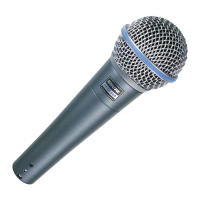
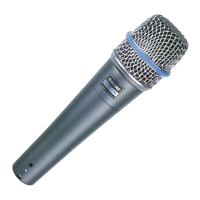
The Shure BETA57A is a precision-engineered, supercardioid dynamic instrument microphone designed for professional live sound reinforcement and studio recording. Its robust construction and tailored frequency response make it particularly well-suited for capturing the nuances of amplified and acoustic instruments, especially in high sound pressure level (SPL) environments.
The BETA57A's primary function is to convert sound waves into electrical signals with high fidelity and excellent isolation. Its supercardioid polar pattern is a key feature, providing maximum gain before feedback and superior rejection of off-axis sound. This means the microphone is highly sensitive to sounds directly in front of it while effectively minimizing pickup from the sides and rear. This characteristic is crucial in live performance settings where unwanted stage noise or feedback can be problematic. The microphone's dynamic (moving coil) transducer design ensures durability and reliability, making it a workhorse for demanding applications.
The tailored frequency response of the BETA57A is specifically shaped to accentuate the fine details of various instruments. This makes it an excellent choice for miking guitars, drums, and even vocals, delivering a clear and articulate sound. The inclusion of a neodymium magnet enhances sensitivity, resulting in higher output and a stronger signal-to-noise ratio. This allows for a cleaner sound even when the microphone is used with longer cable runs or in environments with lower input gain.
An advanced pneumatic shock mount system is integrated into the microphone's design. This system effectively minimizes the transmission of mechanical noise and vibration, such as handling noise or stand-borne rumble, ensuring that only the intended sound source is captured. This is particularly beneficial in live settings where accidental bumps or movements can introduce unwanted noise.
The BETA57A is designed for versatile use across a wide range of applications. For optimal performance, users should aim the microphone directly at the desired sound source, whether it's a talker, singer, or instrument, and position it away from unwanted sources like monitors or loudspeakers. Working close to the microphone is recommended for an enhanced bass response, a phenomenon known as the proximity effect. This effect can be leveraged to create a warmer, more powerful sound, especially for instruments that benefit from a fuller low-end presence.
When miking instruments, specific placement techniques are suggested to achieve desired tone qualities. For guitar and bass amplifiers, placing the microphone 2.5 cm (1 in.) from the speaker, on-axis with the center of the cone, yields a sharp attack and emphasized bass. Moving it to the edge of the speaker cone at the same distance provides a sharp attack with a higher frequency sound. For a more balanced sound, positioning the microphone 15 to 30 cm (6 to 12 in.) away from the speaker, on-axis, results in a medium attack and full, balanced tone. For a softer attack and reduced bass, placing it 60 to 90 cm (2 to 3 ft.) back from the speaker, on-axis, is recommended.
For snare drums, placing the microphone 2.5 to 7.5 cm (1 to 3 in.) above the rim of the top head, aimed at the drum head, captures the most "snap" from the drumstick. When miking tom-toms, one microphone can be used on each tom, or between each pair, positioned 2.5 to 7.5 cm (1 to 3 in.) above the drum heads and aimed at the top heads. For double-head toms, removing the bottom head and placing a microphone inside pointing up toward the top head can also be an effective technique. These placements generally result in a medium attack and full, balanced sound.
For brass instruments, a bright, clear sound can be achieved by placing the microphone 30 to 90 cm (1 to 3 ft.) away, on-axis with the bell of the instrument. For woodwinds, a similar bright, clear sound is obtained by positioning the microphone 2.5 to 15 cm (1 to 6 in.) away, on-axis with the bell. To achieve a softer, more mellow sound for instruments, placing the microphone 90° off-axis from the front of the mic, relative to the bell, is recommended.
To minimize feedback and ensure optimum rejection of unwanted sound, especially from monitors and loudspeakers, the supercardioid pattern's rejection points at 120° toward the rear of the microphone should be utilized. Users should position the microphone so that unwanted sound sources are at these angles, not directly behind it. Testing microphone placement before a performance is always advised to fine-tune the setup.
General rules for use also include avoiding covering any part of the microphone grille with a hand, as this can adversely affect performance. Using only one microphone per sound source helps maintain clarity and prevents phase issues. For better gain before feedback, using fewer microphones is generally more effective. The "three to one rule" suggests keeping the distance between microphones at least three times the distance from each microphone to its source. Additionally, placing microphones as far as possible from reflective surfaces and adding a windscreen when using the microphone outdoors can further enhance sound quality and reduce unwanted noise.
The BETA57A is built to withstand the rigors of daily use in demanding environments. Its construction features a dent-resistant steel mesh grille and an enamel-coated die-cast metal body. This robust design ensures durability and longevity, resisting wear and abuse that can occur during frequent setup, teardown, and transport. The hardened, matte-finished steel mesh grille not only protects the internal components but also maintains the microphone's aesthetic appeal over time.
While the microphone is designed for durability, avoiding excessive handling is recommended to minimize the pickup of mechanical noise and vibration. Regular cleaning of the grille and body with a soft, dry cloth can help maintain its appearance and prevent the buildup of dust or debris. In case of damage or wear, replacement parts such as the cartridge, grille, and plug (connector) assembly are available, allowing for easy repair and extended product life without needing to replace the entire unit. This modularity contributes to the microphone's long-term usability and cost-effectiveness.
 General
| Type | Dynamic |
|---|---|
| Frequency Response | 50 Hz to 16 kHz |
| Polar Pattern | Supercardioid |
| Output Impedance | 150 Ohms |
| Sensitivity | -51 dBV/Pa (2.8 mV) |
| Connector | XLR |
| Weight | 275 g |

 To Next Page