Need help?
Do you have a question about the Shure BETA52A and is the answer not in the manual?
Guidelines for positioning the microphone to optimize sound capture.
Table detailing common applications and recommended microphone placement techniques.
List of accessories provided with the microphone for immediate use.
Statement of compliance with European Union directives and CE marking requirements.
Statement of compliance with UKCA marking requirements for the United Kingdom.
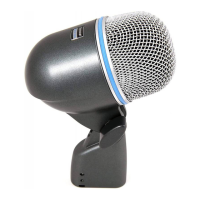
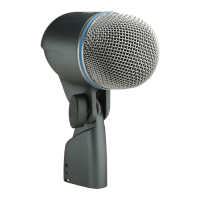
The Shure BETA52A is a precision-engineered dynamic supercardioid microphone specifically designed for kick drums and other bass instruments, delivering superb attack and "punch" with studio-quality sound even at extremely high sound pressure levels (SPL). This microphone is built to withstand the rigors of touring sound reinforcement, featuring a hardened steel mesh grille and die-cast metal construction that ensures years of abuse resistance.
The BETA52A is a dynamic microphone, meaning it uses a moving coil transducer to convert sound waves into electrical signals. Its tailored frequency response is optimized for the unique characteristics of kick drums and bass instruments, capturing their full sonic range with clarity and impact. The modified supercardioid pickup pattern is a key feature, providing maximum gain before feedback and excellent rejection of off-axis sound. This means the microphone focuses on the desired sound source while minimizing pickup of unwanted ambient noise or other instruments on stage, which is crucial for live performance and studio recording.
The microphone's design incorporates a neodymium magnet, contributing to greater sensitivity and higher output. This allows the BETA52A to capture subtle nuances and powerful transients with fidelity, even when faced with the extreme sound pressure levels generated by kick drums. An advanced pneumatic shock mount system is integrated to minimize the transmission of mechanical noise and vibration. This is particularly beneficial in live settings where stage vibrations or accidental bumps could otherwise introduce unwanted noise into the audio signal.
The BETA52A is designed for ease of use and flexibility in various applications. Its integrated, locking stand adapter simplifies mounting and adjustments, allowing users to quickly and securely position the microphone. This adapter resists slipping even when struck or bumped, yet permits adjustments without needing to loosen a separate knob, streamlining setup. To use the stand adapter, simply thread the microphone onto the stand, adjust the stand height and position as necessary before tightening the adjustment knob, and then tighten the knob to lock the microphone in place. It's important not to use tools or overtighten the knob to prevent damage.
When placing the microphone for kick drums, several general rules apply to achieve optimal sound. It's crucial to ensure the microphone does not touch the drum head or any damping material inside the drum. Aiming the microphone toward the desired sound source and away from unwanted sources is fundamental. For a sharper attack, place the microphone closer to the beater head; for more resonance, position it further away. Working close to the microphone will yield extra bass response due to the proximity effect, a phenomenon where unidirectional microphones progressively boost bass frequencies at close distances. To create a tighter sound with more "punch," placing a pillow or blanket on the bottom of the drum against the beater head can be effective.
For guitar and bass amplifiers, the BETA52A can be placed 2.5 cm (1 inch) from the speaker, on-axis with the center of the speaker cone for sharp attack and emphasized bass, or at the edge of the speaker cone for a sharper attack and higher frequency sound. For a softer attack and reduced bass, positioning the microphone 60 to 90 cm (2 to 3 feet) back from the speaker, on-axis with the speaker cone, is recommended.
The supercardioid pattern offers the greatest sound rejection at points 120° toward the rear of the microphone. To minimize feedback and ensure optimum rejection of unwanted sound sources like monitors and loudspeakers, the microphone should be placed so these sources are at these 120° angles, not directly behind it. Always test microphone placement before a performance to ensure the best possible sound.
The BETA52A is built for durability and longevity, minimizing the need for frequent maintenance. Its dent-resistant, steel mesh grille and enamel-coated die-cast metal construction are designed to resist wear and abuse, making it a robust choice for demanding environments like touring. The microphone's components are designed for reliability, ensuring consistent performance over time.
In terms of replaceable parts, Shure offers specific components to extend the life of the microphone. The cartridge for the BETA52 and BETA52A is available as R175. The grille for the BETA52A can be replaced with RK321, and the plug (connector) assembly is available as 90J1984. These replacement parts allow for easy repair of common wear-and-tear items, ensuring the microphone can continue to perform optimally for many years. A storage bag (95A2324) is also available to protect the microphone during transport and storage, further contributing to its longevity.
 General
| Type | Dynamic |
|---|---|
| Frequency Response | 20 Hz - 10 kHz |
| Polar Pattern | Supercardioid |
| Output Impedance | 150 ohms |
| Connector | XLR |
| Weight | 605 g |
| Dimensions | 162 mm |
| Sensitivity | -64 dBV/Pa (0.6 mV) |

 To Next Page