Need help?
Do you have a question about the Shure VP88 and is the answer not in the manual?
Overview of the VP88 stereo condenser microphone's design and application.
Key characteristics and capabilities of the VP88 microphone.
Instructions on how to properly mount the VP88 microphone.
Details on phantom power and battery operation for the VP88.
Guide to installing, replacing, and managing the microphone's battery.
How to connect the VP88 to mixers or consoles using the provided cable.
Explanation of different stereo output modes (L, M, H) and MS mode.
Settings for minimizing noise and low-frequency rolloff.
Guidance on monitoring and using external stereo matrixes.
Detailed technical data including sensitivity, SPL, and impedance.
Graphs illustrating frequency response and directional pickup patterns.
List of furnished and optional accessories for the VP88.
Information regarding product certifications and compliance.
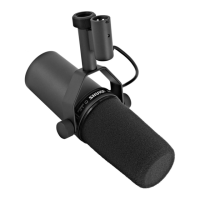
The Shure Model VP88 is a stereo condenser microphone designed for both studio broadcasting and electronic news gathering (ENG) applications. Its core function is to capture high-quality stereo audio through a unique mid-side (M-S) microphone cartridge configuration. This design incorporates two condenser cartridges within a single housing: a "Mid" cartridge facing forward to capture on-axis sound in a cardioid pattern, and a "Side" cartridge that is bi-directional, capturing sound from either side. This time-coherent M-S design is crucial for optimal stereo imaging.
One of the VP88's key usage features is its built-in stereo matrix, which offers direct control over the stereo spread. Users can select from three settings—High (H), Medium (M), or Low (L)—to determine the strength or width of the stereo effect. The "L" (Low) setting, where the side level is 6.0 dB lower than the mid level, results in a small stereo image spread. This is ideal for distant miking or situations where precise microphone directionality is challenging, such as handheld use. It also minimizes ambient sound from the sides, making it useful for reducing high ambient noise or reverberation, especially in already wide miking areas. However, the stereo effect may be compromised in narrow performance spaces. The "M" (Medium) setting, with the side level 1.9 dB lower than the mid level, provides increased side ambience pickup and stereo spread, making it suitable for most applications. The "H" (High) setting, with the side level 1.6 dB higher than the mid level, offers the most side ambience pickup and the widest stereo spread. This setting is best used when a high degree of ambience pickup is acceptable and the performing area is not excessively wide. When operating in stereo mode (H, M, or L), it's important to keep the left and right signals fully separated and at equal levels to maintain a balanced stereo effect.
Alternatively, the VP88's internal M-S matrix can be bypassed, allowing for direct M-S outputs. This "MS Output Mode" is particularly useful if an external matrix is preferred or if stereo imaging will be handled during post-production. In this mode, the signal from the mid cartridge is sent to the red connector (M) on the Y-splitter cable, and the side cartridge output is sent to the green connector (S). The side on-axis sensitivity (90° from the front axis) is 1.6 dB higher than the mid output's on-axis sensitivity, with sensitivities of both mid and side outputs being equal at 45° off the front axis. The left lobe of the side output matches the polarity of the mid output, while the right lobe has opposite polarity. When using an external stereo matrix (e.g., a transformer or active circuitry), the VP88 should be set to MS mode. The mid and side outputs can then be processed through a sum-and-difference matrix to generate left and right stereo signals (Left = Mid + Side, Right = Mid - Side). A 1:1 ratio of Mid to Side produces stereo signals identical to the High (H) setting, while results similar to the Medium (M) and Low (L) settings can be achieved by attenuating the side signal before matrixing. This flexibility is a significant advantage for recording, as it defers decisions on stereo imaging to the post-production stage.
The microphone also features external switches for controlling output mode, stereo imaging, low-frequency roll-off settings, and battery on/off. A switch-selectable low-frequency roll-off (12 dB/octave below 80 Hz) is available to reduce the pickup of ambient noise and stand vibration. This feature can be set to one of two positions depending on whether phantom or battery power is in use.
For power, the VP88 can operate on an internal 6V battery or phantom power (9 to 52 Vdc) from a mixer, console, or dedicated phantom power supply. When using phantom power, each balanced audio cable pair (pins 2 and 3 for Mid/Left; pins 4 and 5 for Side/Right) carries the supply current, with the cable shield (pin 1) serving as the ground return. The Mid or Side output can be used independently with either phantom or battery power. In Stereo mode without a battery, both Mid/Left and Side/Right outputs must be phantom powered.
Maintenance features include an integrated heavy-duty "pop" screen to reduce breath and wind sounds. For high-intensity wind or speaking conditions, a removable foam windscreen is included. The microphone also boasts an internal shock mount to minimize stand vibration and handling noise, contributing to cleaner audio capture. Its construction is impact-resistant and durable, featuring brass and nickel-plated aluminum with a stainless steel grille, finished in satin black vinyl enamel.
Connecting the VP88 involves using the supplied Y-splitter cable to two inputs of a mixer or console. The red connector (M/L) carries the Mid signal (in MS mode) or left signal (in stereo mode), while the green connector (S/R) carries the Side signal (in MS mode) or right signal (in stereo mode). For stereo operation, the left (L) splitter connector connects to Channel 1 and the right (R) splitter connector to Channel 2, with Channel 1's pan pot set to full left and Channel 2's to full right. An optional Shure C110 Extension Cable is available for longer cable runs.
Monitoring is also a key aspect of its usage. To check the balance for a mono listener, sound can be monitored in both mono and stereo modes. In mono mode, the side signal is canceled, meaning the mono output will only reflect the cardioid Mid cartridge signal, irrespective of the side level control setting. Additionally, a second (mono) microphone can be used for interviewing or close miking, with its channel pan pot centered and its level set independently.
Battery management is straightforward. If phantom power is unavailable, the Battery switch can be moved to the "Batt On" position. An adjacent LED will flash, indicating at least five hours of useful battery life. If the LED does not flash, the battery needs replacement. The battery does not drain when phantom power is applied. The VP88 uses a 6V cylindrical camera battery, offering approximately 70 hours of life for silver oxide/lithium batteries and 40 hours for alkaline batteries. Replacing the battery involves disconnecting the microphone cable, unscrewing the lower handle to expose the compartment, inserting the new battery with correct polarity, and re-tightening the handle.
Overall, the Shure VP88 is a versatile stereo condenser microphone offering robust performance, flexible stereo imaging options, and practical features for various professional audio applications.
 General
| Type | Studio microphone |
|---|---|
| Voice coil type | Condenser |
| Microphone frequency | 40 - 20000 Hz |
| Microphone direction type | Bidirectional microphone |
| Sound pressure level | 129 dB |
| Headphone out | No |
| Device interface | XLR-3 |
| Connectivity technology | Wired |
| Product color | Black |
 Weight and Dimensions
| Height | 290 mm |
|---|---|
| Diameter | 39.7 mm |
| Microphone weight | 417 g |

 To Next Page