User’s Manual 7
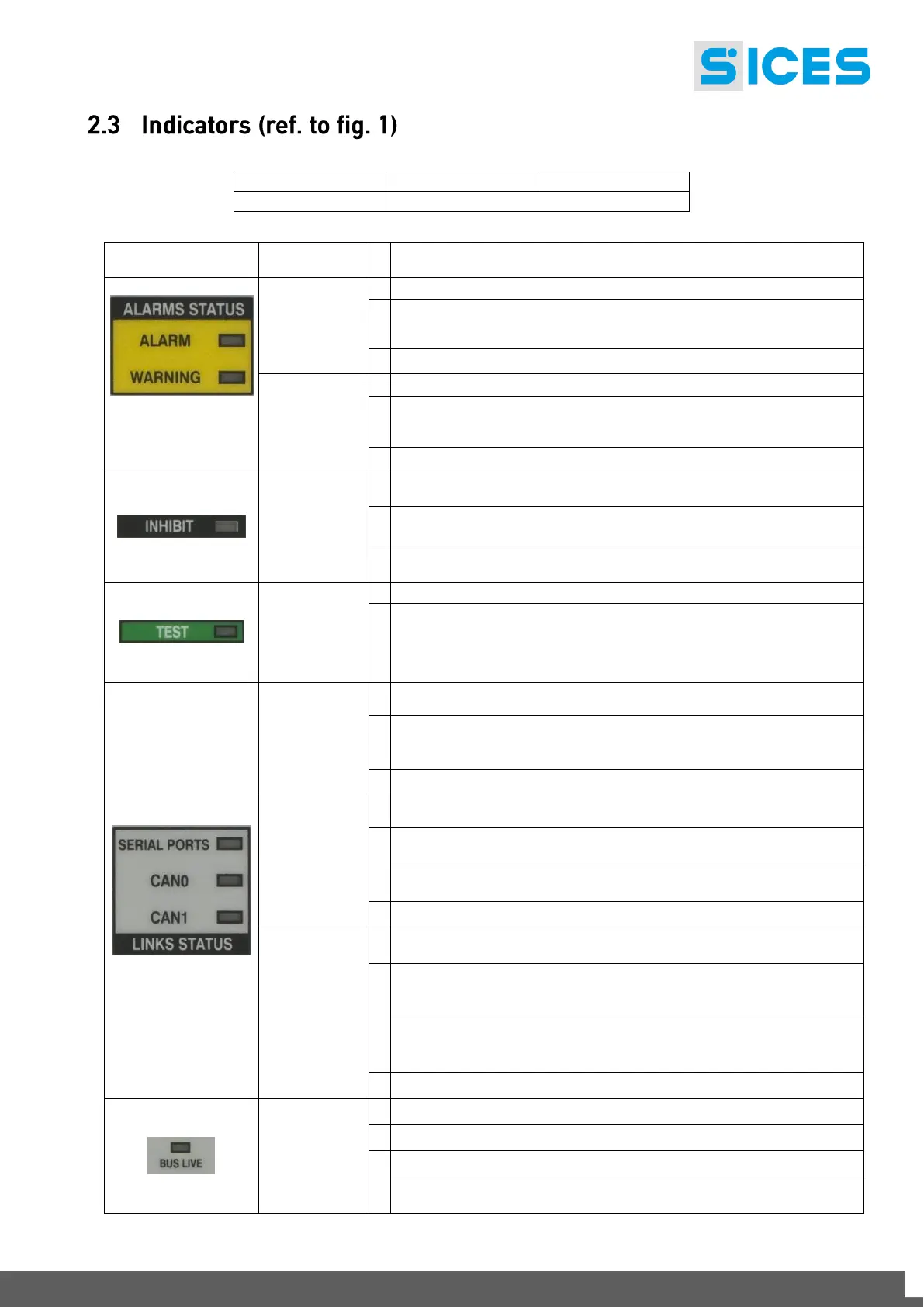
Signals at least one lockout or deactivation or unload anomaly.
Signals at least one lockout or deactivation which has not yet been
acknowledged with the “MODE/ACK” button
No lockouts, deactivations, or unload functions.
There is at least one active warning.
Signals at least one lockout or warning, which has not yet been
acknowledged with the “MODE/ACK” button
Signals an active inhibit command from digital input, clock/calendar
or load function
It means that the input status is active, but the set waiting time
hasn't elapsed.
It means that an inhibition command is active.
The TEST is enabled by a serial command, SMS, the REMOTE
TEST input function or the clock/calendar
Indicates at least one of the two serial ports is active.
Signals that a command is being sent from one of the serial ports
(the second serial port is managed in signalling only if configured
as the COM port and not the I/O) expansion.
Indicates at least one of the two serial ports isn't active.
Signals that the CAN0 interface is active and in ERROR-ACTIVE
mode. (J1939 or MTU)
Flashing at 25% ON signals a COM error (J1939 or MTU): the port
is in ERROR-PASSIVE mode.
Flashing at 75% ON signals a COM error (J1939 or MTU): the port
is in BUS-OFF mode.
Signals that CAN0 has been disabled.
Signals that the CAN1 interface is active and in ERROR-ACTIVE
mode. Power Management Communication Bus (PMCB)
Flashing at 25% ON signals a COM error (J1939 or MTU): the port
is in ERROR-PASSIVE mode.
Power Management Communication Bus (PMCB)
Flashing at 75% ON signals a COM error (J1939 or MTU): the port
is in BUS-OFF mode.
Power Management Communication Bus (PMCB)
Signals that CAN1 has been disabled.
Flashes at 50% if the BUS line voltage is out of tolerance range.
Flashes at 50% during the synchronization phase (opposite
sequence to MCB or GCB).


 To Next Page
 Loading...