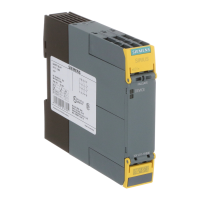
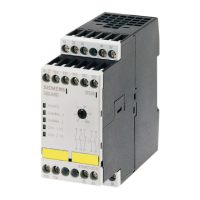
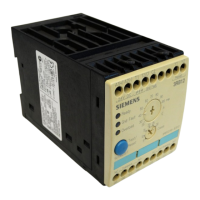
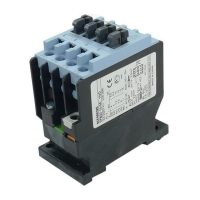
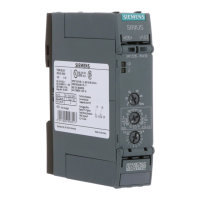
This document describes the SIRIUS 3SK1 safety relay, a device designed for safety-related applications in industrial environments. It is available in various models, including 3SK1111, 3SK1112, 3SK1120, 3SK1121, 3SK1122, 3SK1211, 3SK1220, and 3SK1230, each with specific configurations and capabilities. The manual provides comprehensive information for installation, operation, and maintenance, ensuring safe and efficient use of the device.
Function Description
The SIRIUS 3SK1 safety relay is a crucial component in safety circuits, designed to monitor safety functions and ensure that machinery operates within safe parameters. Its primary function is to detect faults in safety-related inputs (e.g., emergency stop buttons, safety gates, light curtains) and safely shut down or prevent the start-up of hazardous machinery. The device supports various safety functions, including emergency stop, safety gate monitoring, and two-hand control.
The relay offers different operating modes, such as automatic start, monitored start, and manual start, allowing flexibility in integrating it into diverse safety systems. Some models support cross-fault detection, which enhances safety by identifying short circuits between input channels. The device is designed to comply with relevant safety standards, including EN ISO 13849-1, EN 62061, and EN 60947-5-1, making it suitable for applications up to Safety Integrity Level (SIL) 3 according to IEC 61508 or Performance Level (PL) e according to EN ISO 13849-1.
The 3SK1 series includes models with different input and output configurations. For instance, some models feature multiple safety inputs (IN1, IN2, IN3, IN4) and safety outputs (Q1, Q2, Q3), allowing for complex safety logic. Certain variants also offer auxiliary outputs (INF, INS) for diagnostic purposes, providing status information without affecting the safety function. The device can be used for single-channel or dual-channel monitoring, depending on the required safety level and application.
Important Technical Specifications
The SIRIUS 3SK1 safety relay operates within a wide temperature range, from -25 °C to +60 °C, making it suitable for various industrial environments. It has an IP20 degree of protection, indicating protection against solid objects larger than 12.5 mm but no protection against liquids. This means it should be installed in an enclosure that provides adequate environmental protection.
Electrical Specifications:
- Torque for screw terminals (3SK1..-1....): 0.6 to 0.8 Nm (5.2 to 7 lb.in)
- Wire cross-sections for screw terminals (3SK1..-1....):
- Single wire: 1 x 0.5 ... 2.5 mm²
- Two wires: 2 x 1.0 ... 1.5 mm²
- Fine-stranded wire with end sleeve: 1 x 0.5 ... 2.5 mm²
- Two fine-stranded wires with end sleeve: 2 x 0.5 ... 1.0 mm²
- AWG for screw terminals (3SK1..-1....): 1 x 20 to 14, 2 x 18 to 16
- Wire cross-sections for spring-loaded terminals (3SK1...-2...., using 3RA2908-1A):
- Single wire: 1 x 0.5 ... 1.5 mm²
- Two wires: 2 x 0.5 ... 1.5 mm²
- Fine-stranded wire with end sleeve: 1 x 0.5 ... 1.0 mm²
- Two fine-stranded wires with end sleeve: 2 x 0.5 ... 1.0 mm²
- AWG for spring-loaded terminals (3SK1...-2....): 1 x 20 to 16, 2 x 20 to 16
Dimensions:
- Width: 17.5 mm or 22.5 mm, depending on the model.
- Height: Approximately 100 mm.
- Depth: Approximately 91.6 mm or 121.6 mm, depending on the model.
The device is designed for DIN rail mounting, ensuring easy integration into control cabinets. The compact design allows for space-saving installation.
Usage Features
The SIRIUS 3SK1 safety relay is designed for user-friendly installation and operation.
- Mounting: The device can be easily mounted on a DIN rail. The manual illustrates a simple "click" mechanism for securing the relay to the rail. For models requiring a secure connection to adjacent modules (e.g., for expansion), a connecting element (e.g., 3RA2908-1A) is used, which also snaps into place.
- Wiring: Both screw-type and spring-loaded terminals are available, offering flexibility based on user preference and application requirements. The screw terminals require a specific torque for secure connection, while the spring-loaded terminals provide quick and tool-free wiring for certain wire types. The manual provides detailed instructions for connecting wires, including recommended wire cross-sections and torque values.
- Configuration: The device features rotary switches or DIP switches (depending on the model) for configuring various operating modes and safety functions. These settings typically include selecting between automatic start, monitored start, or manual start, and enabling or disabling cross-fault detection. The configuration options are clearly mapped out in tables, showing the corresponding settings for different models (e.g., 3SK1111, 3SK1112, 3SK1121, 3SK1122, 3SK1211, 3SK1120, 3SK1220, 3SK1230).
- LED Indicators: The front panel of the device includes LED indicators that provide visual feedback on the operational status, input states, and output states. These indicators are essential for quick troubleshooting and monitoring of the safety function.
- Expandability: Some models are designed to be expandable, allowing for the connection of additional modules to increase the number of inputs or outputs, or to add specialized functions. The manual shows how to connect these modules using specific connecting elements.
Maintenance Features
The SIRIUS 3SK1 safety relay is designed for minimal maintenance, but certain aspects are important for ensuring long-term reliability and safety.
- Installation and Wiring: Proper installation and wiring are critical for the device's performance and safety. The manual emphasizes that installation and maintenance work must only be carried out by authorized electricians. This ensures that all connections are made correctly, and the device is integrated into the safety circuit according to applicable standards.
- Troubleshooting: The LED indicators on the front panel serve as primary diagnostic tools. By observing the status of these LEDs, users can quickly identify potential issues with inputs, outputs, or the internal state of the relay.
- Replacement: The modular design of the 3SK1 series facilitates easy replacement of individual modules if necessary. The manual illustrates the process of removing and installing modules from the DIN rail, which typically involves releasing a latch and sliding the module out. This modularity helps minimize downtime during maintenance or repair.
- Documentation: The manual itself is a key maintenance feature, providing detailed information on technical specifications, wiring diagrams, configuration settings, and safety instructions. It also refers to the Siemens Industry Support website (support.industry.siemens.com) and a specific entry ID (67585885) for additional resources and updated information, ensuring that users have access to the latest documentation.
- Compliance: Regular checks to ensure compliance with safety standards and directives are part of ongoing maintenance. The EU Declaration of Conformity included in the manual confirms that the product meets relevant European directives and standards, such as the Machinery Directive, EMC Directive, and RoHS Directive. This declaration is crucial for maintaining the safety integrity of the overall system.

 Need help?

 To Next Page
 General