
 Need help?
Do you have a question about the Siemens ACC-APM-2420 and is the answer not in the manual?
Follow all device warnings and instructions, and keep this document for reference.
Do not make changes to the device; use only manufacturer-approved spare parts and accessories.
Details on the CR2032 battery type, mounting, and function for Audit Trail data.
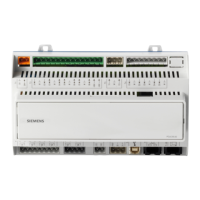
Visual representation of the ACC-AP controller board with numbered components.
Detailed explanations for each numbered component shown in the ACC-AP controller diagram.
Guidance for connecting OSDP readers via terminal blocks, including EOL jumper usage.
Instructions for connecting Wiegand readers, including pull-up resistors and data line mapping.
Instructions for mounting the unit, specifying clearance and dimension requirements.
Explanation of tamper switches for lid opening and unit removal from the wall.
Guidance on configuring the ACC-AP locally for communication with the SiPass integrated computer.
The Siemens ACC-AP SiPass integrated IP Door Controller is a key component in modern access control systems, designed for robust and flexible management of secure entry points. It can be ordered as a standalone unit or as part of an ACC-APM PSU (Power Supply Unit) in either 12V or 24V voltage options, catering to diverse installation requirements. The controller integrates seamlessly with the SiPass integrated software bundle, working in conjunction with SiPass Firmware and Aperio Wireless Locks. For comprehensive understanding and proper installation, it is recommended to consult the ACC-AP Technical Manual (this document), SiPass integrated Firmware Configuration Guide, SiPass integrated Configuration Client User Guide, and the Aperio Wireless Lock Support Guide.
The ACC-AP controller serves as the central intelligence for managing door access, supporting both OSDP and Wiegand reader technologies. It processes access requests, controls door locking mechanisms, and monitors various inputs and outputs related to door status and security. The device is designed to maintain audit trail data for approximately 30 days during power failures, thanks to its internal CR2032 battery. This ensures that critical access event logs are preserved even in the absence of main power. The controller also incorporates tamper detection features to enhance physical security, alerting the system if the unit's lid is opened or if it is removed from its mounting. Configuration of the ACC-AP is performed locally, setting up communication parameters with the SiPass integrated computer, which then manages the overall system settings. Once configured, a connected reader and a valid card or tag can be used to verify the system's functionality.
The ACC-AP controller offers flexible reader connectivity, supporting both OSDP V1 or V2 encrypted readers and Wiegand readers. For OSDP connections, End of Line (EOL) jumpers are available to terminate communication wires, crucial for daisy-chaining Aperio HUBs. When connecting Wiegand readers, specific considerations apply, such as the need for an external 330 ohm pulldown resistor for certain reader types (e.g., Siemens AR6111-MX) to ensure proper signal integrity. The EOL jumpers for readers MUST be DISABLED when Wiegand readers are connected.
The controller's inputs and outputs are highly configurable. General inputs (1-4) can be software-defined for various monitoring tasks. Relay outputs (1 and 2) provide control over door locking mechanisms, with Relay 1 typically assigned to Door 1 and Relay 2 to Door 2 for Wiegand and OSDP door sets. Open-collector outputs (1-4) are software-defined and can be used for auxiliary functions. For Wiegand door sets, outputs 1-4 are specifically reserved for LED control of the Wiegand Readers (Green/Red LEDs for Reader 1 and Reader 2). Input point allocation for Wiegand and OSDP door sets includes functions like Door 1 Passback, Door 1 Door Frame, Door 2 Passback, and Door 2 Door Frame.
The device includes an Ethernet port (RJ45) for network connectivity and RS485 communication bus for other devices. USB-A ports (Full-speed and Hi-speed) are designated for future use, while a USB-B connection is provided for computer setup. A Micro-SD card slot is available for system restore or updates, though no card is supplied with the unit. Factory settings can be restored by pressing a non-metal stick for at least five seconds.
An LED indicator provides visual feedback on the controller's status:
The ACC-AP is designed with maintenance in mind. The CR2032 battery ensures audit trail data integrity for approximately 30 days during power outages, minimizing data loss. The unit incorporates two types of tamper switches for enhanced security: one for detecting when the lid is opened (item 17 in the diagram) and another for detecting removal from the wall (item 25 in the diagram). The removal tamper requires a screw to be mounted to fulfill the tamper feature; if the unit is removed, a plastic plug breaks, activating the tamper alarm.
For installation, the unit should be mounted to allow easy access to wiring and connectors, with a minimum of 10 mm free area around the housing for lid removal. Firmware configuration and updates are managed through the SiPass integrated software bundle, providing a structured approach to system maintenance and upgrades. The availability of a Micro-SD card slot facilitates system restore and update processes. Regular checks of the LED indicator can help in quickly diagnosing the operational status of the controller.
 General
| Brand | Siemens |
|---|---|
| Model | ACC-APM-2420 |
| Category | Control Systems |
| Language | English |


 To Next Page