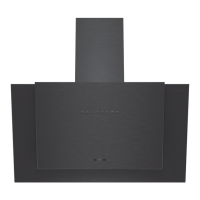
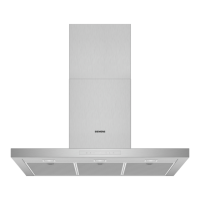
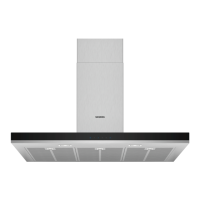
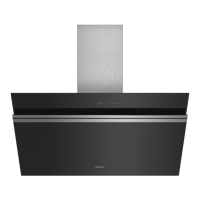
This document describes an extractor hood, a kitchen appliance designed to remove smoke, steam, and odors from the cooking area. It can be operated in two primary modes: exhaust air mode and circulating air mode, each with distinct functionalities and requirements.
Function Description:
The extractor hood functions by drawing in air from the cooking area. In exhaust air mode, the drawn-in air is cleaned by grease filters and then expelled to the exterior through a pipe system. This mode requires a flue duct to be fitted and connected to an external vent. It's crucial that the exhaust air is not conveyed into a functioning smoke or exhaust gas flue or a shaft used for ventilating rooms with heat-producing appliances without proper consent from a heating engineer. For through-the-outer-wall exhaust, a telescopic wall box is recommended.
In circulating air mode, the air is cleaned by both grease filters and an activated carbon filter before being recirculated back into the kitchen. This mode is particularly useful where external venting is not feasible or desired. An activated carbon filter is essential for odor removal in this mode. The appliance offers various options for circulating air operation, and accessories like activated carbon filters can be obtained from specialist retailers, customer service, or the online shop.
The appliance is designed for domestic use and is suitable for operation up to a maximum height of 2000 meters above sea level. It can be used by children over 8 years old and persons with reduced physical, sensory, or mental capacities, or lack of experience, if supervised or instructed on safe use and understanding of risks. Children under 8 should be kept away from the appliance and power cable.
Usage Features:
The extractor hood features a control panel, which may vary slightly between models (Model 1 and Model 2 are described). Common controls include:
- Fan On/Off (①): Activates or deactivates the fan. The fan typically starts at a default setting (e.g., setting 2).
- Light On/Off/Dimming ( ): Controls the lighting independently of the fan. Press and hold to adjust brightness.
- Intensive Mode (b): Used for large amounts of steam, fumes, or odors. After a preset time (e.g., 6 minutes), it automatically reverts to a lower fan setting.
- Automatic Mode (auto): Utilizes an air quality sensor to detect cooking odors and automatically adjusts the fan speed for optimal performance. The sensitivity of the sensor can be adjusted.
- Fan Run-on Time (→I): Allows the fan to continue operating for a set period (e.g., 10 minutes) after cooking to clear residual odors, then switches off automatically. This function is not available if intensive mode is active.
- Home Connect ( ): Enables networking and control via a mobile device using the Home Connect app. This allows for remote operation and access to additional features like color temperature settings for lighting (if available).
- powerBoost position: On some models, the glass front can be adjusted to an intermediate position to enhance the elimination of strong cooking smells and large amounts of steam.
Saturation Display: The appliance indicates when the metal grease filters ( ) or activated charcoal filters ( ) are saturated and require cleaning or replacement. These indicators flash after the appliance is switched off. The display can be reset.
Audible Signal: An audible signal can be activated or deactivated to confirm button presses.
Connecting to a Hob: The extractor hood can be connected to a compatible hob, allowing control of hood functions directly from the hob. This connection can be direct or via the home network using the Home Connect app.
Software Update: The appliance's software can be updated via the Home Connect app for optimization, troubleshooting, or security enhancements.
Maintenance Features:
Regular maintenance is crucial for the appliance's efficiency and safety.
- Cleaning the Metal Grease Filter: Fatty deposits in the grease filter can catch fire, so regular cleaning is essential. It is recommended to clean the grease filters every two months. They can be cleaned by hand using hot soapy water and a brush, or in a dishwasher using normal domestic dishwashing detergents at a temperature of no more than 70°C. When cleaning the filters, the filter holder in the appliance should also be wiped with a damp cloth.
- Replacing the Activated Charcoal Filter: In circulating air mode, the activated carbon filter needs to be replaced when saturated, as indicated by the saturation display.
- General Cleaning:
- Stainless Steel: Clean with hot soapy water and a soft cloth, drying in the direction of the grain. Special stainless steel cleaning products can also be used.
- Painted Surfaces: Clean with hot soapy water and a damp dish cloth.
- Aluminium and Plastic: Clean with hot soapy water and a soft cloth.
- Glass: Use glass cleaner and a soft cloth. Avoid glass scrapers.
- Controls: Clean with a damp dish cloth and then dry with a soft cloth. Never use a wet cloth on controls to prevent moisture ingress into electronic circuitry.
- Cleaning Agents: Avoid harsh, abrasive, or high-alcohol content cleaning agents, hard scouring pads, pressure washers, steam cleaners, limescale dissolvers, aggressive all-purpose cleaners, and oven spray. New sponge cloths should be thoroughly washed before use.
- Suffocation Risk: Packaging material is dangerous for children.
- Danger of Death (Flue Gases): Ensure adequate fresh air supply when operating the extractor hood in exhaust air mode simultaneously with room air-dependent heat-producing appliances (e.g., gas, oil, wood heaters) to prevent toxic flue gases from being drawn back into the living space. Consult a Master Chimney Sweep. Unrestricted operation is only possible in circulating air mode.
- Risk of Fire: Regularly clean grease filters. Never operate without a grease filter. Avoid naked flames near the appliance. Do not install near solid-fuel heat-producing appliances without a closed, non-removable cover. Never leave hot fat or oil unattended. Extinguish burning oil/fat with a lid or fire blanket, not water. Operate gas burners with cookware on them to prevent heat buildup.
- Risk of Burns: Accessible parts become very hot during operation.
- Risk of Injury: Components inside may have sharp edges (wear protective gloves). Items placed on the appliance may fall. LED lights are dazzling (risk group 1); avoid looking directly at switched-on lights for over 100 seconds. Be cautious of trapping body parts when opening/closing the glass front.
- Hazard due to Magnetism: Permanent magnets in the appliance front may affect electronic implants; maintain a distance of at least 10 cm.
- Electric Shock Risk: Do not operate a defective appliance. Unplug it or switch off the circuit breaker. Repairs must only be carried out by trained after-sales technicians. Do not use high-pressure or steam cleaners.
- Corrosion Damage: Always switch on the appliance during cooking to prevent condensation, which can cause corrosion.
- Damage from Condensate: Install the exhaust duct with a slight downward slope (1°) away from the appliance.

 Need help?
 General

 To Next Page