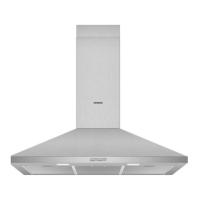
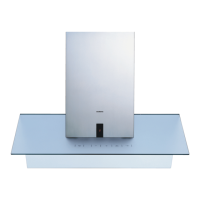
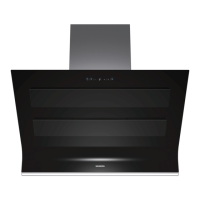
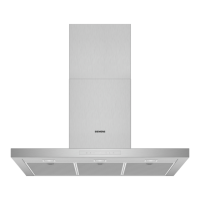
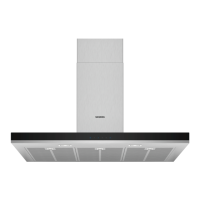
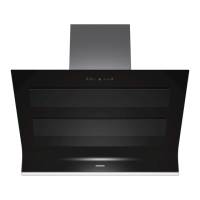
This document is an instruction manual for a Siemens extractor hood, providing comprehensive details on its installation, operation, and maintenance.
Function Description
The Siemens extractor hood is designed for domestic use to remove cooking fumes and odors from the kitchen environment. It can operate in two primary modes:
- Exhaust Air Mode: In this mode, the air drawn in by the hood is cleaned by grease filters and then conveyed to the exterior of the building through a pipe system. This mode requires proper ventilation to the outside.
- Circulating Air Mode: Here, the drawn-in air is cleaned by both grease filters and an activated carbon filter before being recirculated back into the kitchen. This mode is suitable when external ventilation is not feasible and requires the installation of an activated carbon filter to bind odors.
The appliance is controlled via a simple panel with buttons for fan settings and lighting. It is recommended to switch on the extractor hood at the start of cooking and keep it running for several minutes after cooking to effectively remove kitchen fumes.
Important Technical Specifications
- Maximum Operating Height: The appliance is intended for use up to a maximum height of 2000 meters above sea level.
- Weight: The maximum weight of the extractor hood is 40 kg, which is an important consideration for installation.
- Electrical Connection: The appliance requires a protective contact socket for connection. The connecting cable is approximately 1.30 m long. For fixed connections, an energy-isolating device in the phases must be provided in the permanent electrical installation, wired by a professional electrician. A residual-current circuit breaker (RCCB) is recommended.
- Exhaust Duct Diameter: For optimal performance, an inner diameter of 150 mm for round pipes is recommended, with a minimum of 120 mm. For flat ducts, the inner cross-section should correspond to the diameter of round pipes (e.g., dia. 150 mm ≈ 177 cm², dia. 120 mm ≈ 113 cm²).
- Safety Clearances: Specific safety clearances must be maintained to prevent heat build-up, especially when operating with gas and electric hobs simultaneously. The largest specified clearance applies in such cases.
- LED Lighting: The appliance features LED lights. These are classified under risk group 1 due to their dazzling nature, and direct viewing for longer than 100 seconds is advised against. Defective LED lights should only be replaced by the manufacturer, customer service, or a qualified technician.
Usage Features
- Fan Settings: The hood offers multiple fan settings (1, 2, 3) to adjust to the intensity of cooking fumes. If multiple buttons are pressed, the highest selected fan setting applies.
- Lighting Control: The lighting can be switched on and off independently of the ventilation system.
- Energy Saving Tips:
- Ensure adequate air supply during cooking for efficient operation and low noise.
- Adjust fan speed to cooking intensity, using intensive mode only when necessary.
- Switch off the extractor hood and lighting when no longer needed.
- Regularly clean and replace filters to maintain effectiveness and prevent fire risk.
- Safety During Operation:
- Never operate the appliance without a grease filter.
- Avoid working with naked flames near the appliance.
- Do not install near solid-fuel heat-producing appliances unless a closed, non-removable cover is available.
- Never leave hot fat or oil unattended due to fire risk.
- Always use cookware on gas burners to prevent damage or fire from excessive heat.
- Limit simultaneous operation of multiple gas burners, especially high-power ones, to prevent overheating.
- Accessible parts can become very hot; avoid touching them during operation.
- Always switch on the appliance while cooking to prevent condensation and corrosion.
Maintenance Features
- Cleaning the Metal Mesh Grease Filters:
- Grease filters should be cleaned regularly (recommended every 2 months) to prevent fire hazards from fatty deposits.
- They can be cleaned by hand using hot soapy water and a brush, or in a dishwasher at a temperature of no more than 50 °C.
- When cleaning in a dishwasher, avoid washing heavily soiled filters with cookware and ensure ample space.
- Slight discoloration may occur in the dishwasher but does not affect performance.
- A special degreaser can be used for stubborn dirt.
- The grease filter holder in the appliance should also be cleaned with a damp cloth.
- General Cleaning:
- Stainless Steel: Clean with hot soapy water and a soft cloth, drying thoroughly. Clean in the direction of the grain. Special stainless steel cleaning products can be used.
- Painted Surfaces: Clean with hot soapy water and a damp cloth, then dry with a soft cloth. Do not use stainless steel cleaner.
- Aluminium and Plastic: Clean with hot soapy water and a soft cloth.
- Glass: Use glass cleaner and a soft cloth. Do not use a glass scraper.
- Controls: Clean with hot soapy water and a damp cloth, then dry with a soft cloth. Never clean controls with a wet cloth to prevent damage to electronics.
- Prohibited Cleaning Agents: Avoid harsh, abrasive, high-alcohol content, or strong cleaning agents (e.g., scouring powder, steam cleaners, oven spray) to prevent surface damage.
- Protective Film: Remove all protective film from the appliance parts before first use to prevent surface damage.
- Troubleshooting: The manual includes a troubleshooting table for common issues like the appliance not working, lighting failure, or button illumination failure, along with possible causes and solutions. For defective LED lights or control units, professional service is required.
The manual emphasizes safety throughout, particularly regarding fire risks from grease, electric shock from faulty components or improper cleaning, and injury risks from sharp edges or falling parts during installation and maintenance. It also highlights the importance of consulting a Master Chimney Sweep for exhaust air systems to ensure adequate fresh air supply and prevent flue gas backflow.



 To Next Page
 General