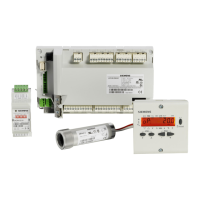
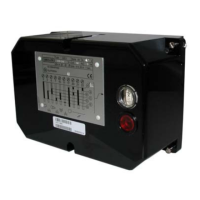
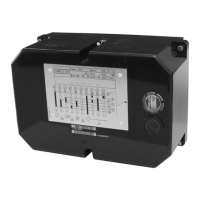
The Siemens LFE1... burner control is designed for fully automatic control and supervision of single-stage, multi-stage, or modulating gas and dual-fuel burners in intermittent operation. It is suitable for use with expanding flame and interrupted pilot type gas burners. Flame supervision is achieved using an ionization probe or a QRA... UV flame detector. The device also supports ignition spark proving with a UV flame detector. When integrated with a gas valve proving system LDU11..., the LFE1... can extend its control sequence to include automatic gas valve proving. All LFE1... burner controls comply with relevant European standards for gas and oil burners of any capacity.
Function Description
The LFE1... controls various burner plant components, including the fan motor, flue gas fan, air damper, ignition transformer, 1 to 3 fuel valves, a load controller, and an external lockout warning device.
The burner can only start if its sequence switch is in the start position, it has not locked out (e.g., due to a defective UV tube), all control and safety devices between terminals 8 and 9 are closed, and the air pressure switch does not indicate air pressure. Defects in the flame supervision circuit or the burner control itself will prevent startup or lead to lockout during the startup sequence.
Upon startup, the fan motor is activated via terminal 3, and the actuator is controlled via terminal 22. Once the air damper reaches its fully open position, the sequence switch begins running, and the prepurge time starts. The minimum air pressure, set on the air pressure switch, must be reached within 10 seconds (5 seconds for LFE1.1) or 7 seconds (3.5 seconds for LFE1.1 with postpurging) and maintained until controlled shutdown. Failure to do so will result in lockout. A flame signal during the prepurge time also causes lockout. After the prepurge time, the damper returns to the fully closed position, and the sequence switch remains stationary during this travel time.
Once the minimum air signal contact is operated by the actuator, the sequence switch resumes running, continuing with the burner's program sequence, which is no longer externally influenced. This sequence includes preignition (3 seconds / 1.5 seconds for LFE1.1), release of the first fuel valve at terminal 5 (for a pilot burner, which must shut off after the second safety time, connected to terminal 10), and completion of the set safety time. If no flame is established within this period, lockout will occur. After an 11-second interval (5.5 seconds for LFE1.1) for the first fuel valve, the second fuel valve is released. The pilot burner, if connected to terminal 10, is then shut off. The load controller is switched on after a further 12-second interval (6 seconds for LFE1.1), reaching the burner's operating position. The load controller then modulates the burner's output based on heat demand, either stepwise or continuously. Loss of flame during operation always leads to lockout.
With ignition spark supervision, the program sequence is similar, but if the UV flame detector does not receive an input signal during preignition, lockout occurs before gas release (safety time TSA = 0 seconds). The safety time for the pilot burner can be adjusted between 0 and 6 seconds.
Controlled shutdown occurs when any control or monitoring device in the control loop between terminals 8 and 9 opens its contacts. Fuel valves immediately shut, and the sequence switch restarts for postpurging, if scheduled. After postpurging, the sequence switch returns to its start position. Flame supervision is active during postpurging, and any flame signal will cause lockout.
After a lockout reset, the sequence switch returns to its start position. Only the fan motor (terminal 17) is switched on. If the control thermostat or pressurestat still calls for heat, the burner control immediately triggers a new start.
Important Technical Specifications
- Mains Voltage: AC 220 V -15%...AC 240 V +10% or AC 100 V -15%...AC 110 V +10%
- Mains Frequency: 50...60 Hz ±6%
- Unit Fuse (built-in): T6.3H250V to DIN EN 60127 (5 x 20 mm)
- Primary Fuse (external): Max. 16 A (slow)
- Weight: Approx. 2 kg
- Power Consumption: Approx. 9 VA (startup), Approx. 6 VA (operation)
- Degree of Protection: IP40 (when built in, with the exception of the connection area)
- Safety Class: II
- Perm. Loading of Control Outputs: Max. 4 A per terminal, Max. 5 A total (to VDE 0660 AC3)
- Ambient Temperature: -20...+60 °C (storage, operation), -50...+60 °C (transport)
- Humidity: < 95% r.F. (storage, transport, operation)
- Installation Altitude: Max. 2,000 m above sea level
- Ionization Probe Operating Voltage: 460 Vpeak
- Required Ionization Probe Detector Current: Min. 8 µA (AC 100/220 V), Min. 9 µA (AC 110/240 V)
- QRA... Operating Voltage: 460 Vpeak
- Required QRA... Detector Current: Min. 150 µA (AC 100/220 V), Min. 200 µA (AC 110/240 V)
- Perm. Length of Connection Cable (laid separately): 20 m (for both ionization probe and QRA...)
- Designed Lifetime: 250,000 burner startup cycles or 10 years of usage.
Usage Features
- Adjustable Prepurge Time: Between 8 and 63 seconds (4 to 31.5 seconds for LFE1.1).
- Postpurging: Operation with or without postpurging.
- Air Damper Control: Fully automatic, independent of actuator running time.
- Air Pressure Check: Can be combined with a functional check of the air pressure switch prior to startup.
- Ignition Options: Direct ignition, with pilot burner, without or with ignition spark proving.
- Adjustable Safety Time: First and second safety time adjustable between 0 and 9 seconds (0 to 4.5 seconds for LFE1.1).
- UV Flame Detector Test: Automatic test during burner off periods and purging times.
- Start and Operation: Optional semi-automatic start and operation.
- Lockout Warning: Built-in lockout warning lamp.
- Program Indicator: Continuously shows the program sequence with symbols and remaining prepurge time.
- Sequence Switch Motor: Can be switched off for easier burner adjustments.
- Camshaft: Can be turned manually.
- Remote Lockout Reset: Optional electrical remote reset.
- Plug-in Design: For easy installation and replacement.
- Impact-proof Plastic Housing: Made of black, heat-resistant plastic.
- Mounting: Optional mounting position at burner, on control panels, or in control cabinets.
- Large Connection Area: With 4 extra terminals for earth, 4 for neutral, and 4 auxiliary terminals.
Maintenance Features
- Setting Facilities: Prepurge time, first safety time (TSA), first safety time with ignition spark supervision (TSA'), and second safety time (t9) are adjustable via red cams on the sequence switch.
- Access for Settings: Requires disconnecting from mains, loosening 6 retaining screws, and removing the unit cover.
- Camshaft Manipulation: Can be manually turned to any position for adjustments.
- Lockout Reset Button: Integrated with a viewing window for the lockout warning lamp.
- Unit Cover Protection: Secured by 2 sealing screws to prevent tampering.
Warning Notes
- Only qualified staff should open, interfere with, or modify the unit.
- Before wiring changes, completely isolate the burner control from the mains supply (all-polar disconnection) to prevent electric shock.
- Ensure adequate protection against electric shock for terminals.
- After any work, check wiring and perform safety checks as described in "Commissioning notes."
- Press the lockout reset button/operation button extension manually (max. 10 N force) without tools.
- Do not press the lockout reset button for more than 10 seconds, as this damages the lockout relay.
- Units that have fallen or been shocked should not be put into operation, even if they appear undamaged.
- Sealing screws may only be loosened and factory settings changed by authorized staff.
- Condensation, ice formation, and water ingress are not permitted, as they compromise safety functions and pose an electric shock risk.
- If the air damper is not controlled by the burner control, terminals 20, 21, and 22 must be interconnected.
- Ignition can impact ionization current; interchanging ignition transformer primary connections may be a remedy.
- These devices may only be used as replacements within the EU and EFTA countries.
- Do not use for new designs.

 Need help?
 General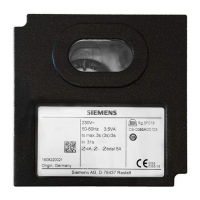



 To Next Page