EasyManua.ls Logo

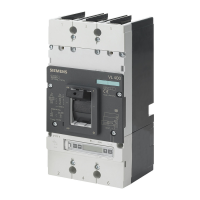
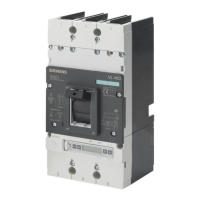
Siemens SENTRON 3VL800 - User Manual

Siemens SENTRON 3VL800
318 pages
Print Icon
To Next Page IconTo Next Page
Loading...
System Manual
SENTRON
Protection devices
3VL IEC molded case circuit breakers
11/2013Edition
Answers for Infrastructure & Cities.

Table of Contents

Questions and Answers

  • J
    John WiseAug 9, 2025
    Why does my Siemens SENTRON 3VL800 circuit breaker keep tripping due to overload?
    • K
      Kelly McdanielAug 9, 2025
      If your Siemens Protection Device circuit breaker trips due to overload, it indicates the circuit breaker is working as intended. First, verify if the operating current exceeds the thermal tripping limit. Inspect the terminals for discoloration, as cables may loosen due to vibration or cold flow. High ambient temperatures can also cause tripping; consider derating the In or IR values if temperatures in enclosures are too high. Finally, if none of the above apply, inspect the overcurrent release for discoloration and ensure tightening torque values are correct.
  • C
    Christopher Perez Jr.Aug 17, 2025
    What to do if Siemens Protection Device circuit breaker trips due to short-circuit?
    • T
      Tanner MooreAug 18, 2025
      If the Siemens Protection Device circuit breaker trips because of a short-circuit, it could be due to excessive making current, such as from a motor. Try adjusting the magnetic trip rating to a higher setting until the breaker stops tripping when the motor starts. High current peaks, like those during star-delta starter transitions, can also cause this. In such cases, the short-circuit release "I" must be set to a higher value; however, note that this might reduce motor protection.
  • J
    James RamseyDec 1, 2025
    Why are the mechanical and electrical functions of my Siemens SENTRON 3VL800 Protection Device affected?
    • R
      Rhonda ReyesDec 1, 2025
      If the mechanical and electrical functions of your Siemens Protection Device are affected, high humidity or corrosion could be the cause. The molded case circuit breakers must not be used in environments with high humidity since this can cause dielectric and insulation problems. In such environments, appropriate measures need to be taken, such as placing the circuit breaker in an enclosure. Also, the molded case circuit breakers are not designed to be used in aggressive environments and should be installed in a housing. If the issue relates to internal accessories, determine the type installed by removing the circuit breaker cover and checking the order number. Then, verify their correct function. Ensure the correct voltage is connected to the undervoltage release, and that voltage is not ...

Summary

Configuration

Functional principle

Explains the mechanical design, trip-free mechanism, and current limiting principle of the circuit breakers.

Thermal-magnetic overcurrent trip units

Describes the components and functioning of thermal-magnetic overcurrent releases.

Electronic overcurrent trip unit (ETU)

Explains the operation and components of electronic trip units using current transformers and microprocessors.

Motorized operating mechanisms (optional)

Motorized operating mechanism with stored energy mechanism (SEO)

Explains the SEO mechanism for synchronization tasks, its operation, and manual actuator handle location.

Motorized operating mechanism (MO)

Describes the MO mechanism for remote switching, its status indicators, and operational modes (LOCAL, MANUAL, AUTO).

Functions

Protection functions

Introduces protection functions like overcurrent release and explains the magnetic repulsion principle.

Function overview of the overcurrent release

Provides a table summarizing the functions and release types for various order supplements.

Setting options of the overcurrent release

Presents a detailed table of setting options for overload, short-circuit, and ground-fault protection across different releases.

Differential current protection with RCD module

Explains the use of RCD modules for double function protection against overload, short-circuit, and ground faults.

Ground-fault protection

Explains ground fault trip 'G' for capturing fault currents to ground, time-graded discrimination, and measurement methods.

Application planning

Use with frequency converters

Explains the use of 3VL molded case circuit breakers as protection devices in systems with frequency converters and variable-speed drives.

Transformer protection on the primary side

Covers transformer protection on the primary side, addressing inrush currents and short-circuit limitations.

Use in motor protection

Details the application and protection functions for motors, including trip classes and thermal image.

Use in unusual environments:

Covers factors to consider when using circuit breakers outside control cabinets or in difficult conditions, like altitude and temperature.

Use in series connection

Explains selectivity and time selectivity for molded case circuit breakers connected in series.

Installing;mounting

Installation methods

Overviews the available installation methods: fixed-mounted, plug-in, and withdrawable versions.

Mounting and safety clearances

Specifies permissible mounting positions (unlimited and limited) and required safety clearances.

Locking devices

Connecting

Displays and operator controls

Parameter assignment; addressing

Setting the parameters

Guides on setting parameters on the ETU, including adjusting settings and understanding tripping characteristic curves.

Setting the protection parameters for motor protection (ETU10 M, ETU30 M and LCD-ETU 40 M)

Details setting overload release IR, short-circuit release Ii, and trip classes for motor protection.

Service and maintenance

Preventive measures

Outlines preventive measures and inspection intervals, emphasizing the need for qualified personnel.

Troubleshooting

Notes on troubleshooting

Offers a table with common circuit breaker issues, their causes, and corrective actions.

Technical data

Motor Protection

Lists characteristic values for motor protection with different trip classes (ETU10M, ETU30M, ETU40M).

Undervoltage release

Provides technical data for undervoltage releases, including operating voltage, power consumption, and opening time.

Shunt release

Details technical data for shunt releases, including response voltage, power consumption, and opening time.

Circuit diagrams

Siemens SENTRON 3VL800 Specifications

General IconGeneral
Rated Current800 A
Rated Voltage690 V
Breaking Capacity Icu at 415 V100 kA
Breaking Capacity Icu at 440 V100 kA
Overload ProtectionYes
Short-Circuit ProtectionYes
Trip UnitElectronic
MountingFixed
StandardsIEC 60947-2
Protection ClassIP20
TypeSENTRON 3VL800
Number of Poles3
SizeSize III

Related product manuals