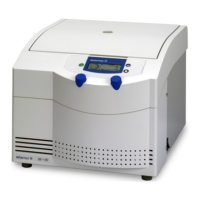
This document is the operating manual for the Sigma 6-16KS refrigerated centrifuge, from serial number 146304. It provides comprehensive information for the safe and trouble-free operation, maintenance, and service of the device.
Function Description
The Sigma 6-16KS is a power-driven refrigerated centrifuge designed for the separation of heterogeneous mixtures of substances (suspensions, emulsions, or gas mixtures) into their components by centrifugal force. This process relies on centripetal acceleration, which causes particles or media with higher density to travel outwards, displacing lower-density components towards the center. The centripetal acceleration is directly proportional to the distance from the axis of rotation and quadratically proportional to the angular velocity.
The centrifuge is intended for laboratory use, specifically for applications in clinical, biological, or biochemical contexts, such as separating cellular material from liquids for analysis, or isolating particles like viruses in ultracentrifugation. It is crucial to adhere to all safety instructions, hazard warnings, and care/cleaning/maintenance guidelines provided in this manual to ensure proper and safe operation.
Important Technical Specifications
General Data:
- Type: Sigma 6-16KS (and Sigma 6-16KHS for heated versions).
- Order Numbers: 10395, 10396, 10397, 10398, 10399, 90905, 91025, 91035.
- Manufacturer: Sigma Laborzentrifugen GmbH, An der Unteren Söse 50, 37520 Osterode am Harz, Germany.
- Year of Manufacture: (Indicated on the name plate).
Connection Requirements:
- Electrical Connection: See name plate.
- Protection Class: I.
- IP Code: 20.
- Connected Load (kVA): 2.8.
- Power Consumption (kW): 2.3.
- Max. Current Consumption (A): 14.0 (at 220-240 V / 50 Hz).
- Input Fuse (AT): 16.0 (at 220-240 V / 50 Hz), temperature fuses.
Performance Data:
- Max. Speed (rpm): 15,000.
- Max. Capacity (ml): 3,200.
- Max. Gravitational Field (x g): 25,155.
- Max. Kinetic Energy (Nm): 152,497.
Other Parameters:
- Time Range: 10 seconds to 99 hours 59 minutes, short run, continuous run.
- Temperature Range: -20°C to +40°C.
- Storage Locations: 60 programs.
Physical Data:
- Height: 485 mm.
- Height with Open Lid: 990 mm.
- Width: 790 mm.
- Depth: 711 mm.
- Weight: 158 kg.
- Noise Level (dB(A)): < 68 (at maximum speed).
Special Equipment (Water Cooling System):
- Tap Connections: 2 x ¾ inch.
- Inlet Pressure (bar): 1.5 to 5.0.
- Max. Flow Rate (m³/h): < 0.5.
- Max. Temperature at Water Inlet: 20°C.
Ambient Conditions:
- Operating Temperature: +5°C to +35°C.
- Storage Temperature: -20°C to +60°C.
- Max. Relative Humidity: 80% up to 31°C, linearly decreasing to 67% at 35°C.
- Maximum Altitude: 2,000 m above sea level.
- Installation Site: Must be in closed, dry rooms with sufficient ventilation, maintaining a safety distance of at least 30 cm around the centrifuge.
Usage Features
The centrifuge is operated via a "Spincontrol S" control system, featuring three buttons with integrated light-emitting diodes and one function knob. The display shows various parameters such as speed, RCF, temperature, runtime, and rotor information.
Starting a Centrifugation Run:
- The lid key must be illuminated, indicating the centrifuge is ready.
- Press the start key to begin.
Interrupting a Centrifugation Run/Deceleration:
- Press the stop key for more than three seconds for a quick stop with maximum deceleration.
- A quick stop can also be triggered during normal deceleration.
- The lid can only be opened once the rotor is at a complete standstill.
Rotor and Accessories Installation:
- Rotors are secured onto the motor shaft with a tie-down screw, tightened with a rotor wrench.
- For angle rotors with hermetically sealed lids, the cover is screwed onto the rotor before installation.
- All buckets of swing-out rotors must be installed when spinning, and axial symmetrically loaded with identical accessories and fill to avoid imbalance.
- Adapters are used for different tube sizes and blood bag systems, ensuring balanced loading.
- For blood bag systems, opposite buckets must have equal weight, and blood bags must be inserted mirror-inverted.
- Special acceleration and deceleration curves (e.g., curve no. 12) are recommended for human blood centrifugation.
Control System Features:
- Manual Mode: Allows direct input and modification of parameters like speed, RCF, temperature, and runtime.
- Program Mode: Up to 60 programs can be stored, loaded, executed, and deleted. Programs can be automatically rotated.
- Process Library: Provides an overview of stored processes, including name, RCF, runtime, and temperature.
- Parameters Menu: Configures settings such as standstill cooling, centrifugation monitoring, temperature monitoring, and spin-out from a set speed.
- Setup Menu: Allows configuration of functions like "Open lid after run," "Programme rotation," "Runtime as of set speed," "Start delay," "Display deceleration time," and display settings (temperature unit, language, speed/RCF fine, time fine, invert, buzzer, external signal).
- Curve Menu: Used to create and edit customised acceleration and deceleration curves.
- Help Menu: Provides context-sensitive help for control elements.
- Lock Function: Prevents unauthorised use by blocking functions like saving programs, short runs, or starting the centrifuge, requiring a four-digit code.
Maintenance Features
Regular maintenance is crucial for the centrifuge's operational safety and longevity.
General Maintenance:
- Clean the centrifuge, rotor, and accessories with soap water or other water-soluble, mild cleaning agents with a pH value between 6 and 8.
- Avoid corrosive and aggressive substances, solvents, and abrasive particles.
- Do not expose the centrifuge or rotors to intensive UV radiation or thermal stress.
- Inspect electrical equipment regularly for defects.
- Ensure all repairs are performed by authorized and specialized personnel.
Centrifuge:
- Unplug the mains power plug before cleaning.
- Carefully remove all liquids, acids, and alkaline solutions from the rotor chamber to prevent corrosion.
- If contaminated with toxic, radioactive, or pathogenic substances, clean the rotor chamber immediately with a suitable decontamination agent.
- Grease the motor shaft slightly after cleaning (grease for load-bearing bolts, part no. 70284).
Condenser (Refrigerated Centrifuges Only):
- Check the condenser at least once a month for dirt and clean if necessary to ensure efficient cooling.
Accessories (Rotors, Buckets, Carriers, Plastic Accessories):
- Immediately rinse rotors, buckets, or accessories under running water if they come into contact with corrosive liquids.
- Clean accessories outside the centrifuge weekly or after each use; remove, clean, and dry adapters.
- Do not clean accessories in a dishwasher as it can damage the anodized coating.
- If contaminated with hazardous substances, clean immediately with a suitable decontamination agent.
- Dry accessories with a soft cloth or in a drying chamber at approx. 50°C.
- Grease load-bearing bolts (part no. 70284) after each cleaning.
- Service Life: Rotors and accessories have a limited service life. Regular checks (at least monthly) for corrosion, cracks, or material abrasion are required. After 10 years, they must be inspected by the manufacturer. After 50,000 cycles, rotors must be scrapped for safety reasons. Specific service life data may be engraved on the parts.
Sterilization and Disinfection:
- The rotor chamber and accessories can be sterilized and disinfected.
- Autoclaving is possible for certain accessories, but plastic parts (lids, carriers) may deform if not screwed on during autoclaving. Max. temperature and time for autoclaving are specified for different materials.
Disposal:
- The centrifuge and packaging must be disposed of according to directive 2002/96/EC and local regulations, not as domestic waste.
- A declaration of decontamination is required for returning defective parts.

 Need help?
 General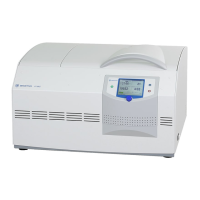

 To Next Page