
 Need help?
Do you have a question about the Simder MIG 140 and is the answer not in the manual?
Ensures safe operation by adhering to electrical standards, proper grounding, and avoiding contact with charged parts.
Highlights the importance of ventilation and respiratory protection when welding to avoid toxic fumes.
Details protective measures against arc rays, sparks, hot materials, and potential explosions from containers.
Advises users to stay clear of moving machine components and to disconnect power before maintenance.
Emphasizes removing flammable materials, checking for fires post-welding, and avoiding welding on sealed containers.
Warns about potential interference of magnetic fields with pacemakers and electronic equipment.
Addresses electromagnetic compatibility issues for systems installed in domestic locations.
Discusses power supply requirements and potential impact on the power network quality.
Outlines the non-toxic materials used and mandates proper recycling of the equipment at end-of-life.
Provides safety guidelines for handling gas cylinders and regulators during welding operations.
Congratulates the user and provides an overview of the operating manual's importance for safe and economical use.
Introduces the MIG welding machine as an inverter-based power source with MMA function for professional steel welding.
Details the technical parameters, models, input/output specifications, duty cycle, and physical dimensions of the welder.
Provides a visual guide to the front panel controls and components, along with size and weight information.
Instructions for checking packaging for damage and carefully removing the machine.
Guidance on selecting a suitable, well-ventilated position for the machine, avoiding hazardous environments.
Details on ensuring correct power supply availability and connection by qualified personnel.
Specifies correct connections for electrode holder and ground clamp for both ARC and MIG welding modes.
Guides the user on setting up and performing welding using the MMA mode, including amperage selection.
Explains how to set up and operate the machine in MIG welding mode, adjusting voltage and wire feed speed.
Daily checks for welding and power cords, ensuring they are undamaged and compliant with regulations.
Instructions for cleaning the interior, fan grill, and checking electrical connections, with safety warnings.
Details tasks performed by authorized service agents, including cleaning, inspection, and calibration.
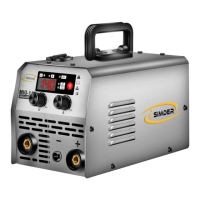
The SIMDER MIG 140 is an inverter-based MIG welding machine designed for professional use, primarily for welding steels. This compact and lightweight unit, weighing 11 lbs and measuring 12.9" x 6" x 6.5", offers both MIG and MMA (Manual Metal Arc) welding functionalities, making it a versatile tool for various welding tasks. Its core technology is built around innovative IGBT Inverter Technology, which contributes to its excellent reliability and high duty cycle.
The primary function of the SIMDER MIG 140 is to provide a stable and controlled power source for welding. In MIG mode, it is specifically designed to work with Flux-cored wires, eliminating the need for external shielding gas, which enhances its portability and ease of use in different environments. The machine's control panel allows for intuitive adjustment of welding parameters, ensuring precise control over the welding process.
For MMA welding, the machine delivers a very stable welding current, coupled with excellent arc ignition characteristics. This allows it to be used with a wide variety of welding electrodes, catering to different material types and thicknesses. The inclusion of an LED Digital Display provides clear feedback on the selected settings and operational status, enhancing user experience and accuracy.
A key feature of the SIMDER MIG 140 is its closed-loop feedback control system, which maintains a constant voltage output. This design allows the machine to operate effectively even with significant fluctuations in the main power supply, tolerating variations within ±15%. This stability is crucial for consistent weld quality, especially in environments where power supply might be less than ideal.
The front panel of the machine is equipped with several indicators and controls:
Before any welding activity, users are strongly advised to wear suitable eye protection and protective clothing, and to ensure the safety of anyone in the vicinity.
MMA Welding Mode: To use the MMA mode, the electrode holder is connected to the negative terminal on the front panel, and the ground clamp to the positive terminal, which is then clamped to the workpiece. After powering on the machine, the ARC Welding Mode is selected. The amperage is then set according to the electrode being used, with a guide provided for common electrode diameters and their corresponding current ranges (e.g., 1.0mm electrode for 20-60A, up to 5.0mm for 180-220A). Correct electrode polarity is essential for proper operation.
MIG Welding Mode: For MIG welding, the flux-cored wire is installed on the spindle adapter. The ground clamp is connected to the positive terminal and then to the workpiece. The MIG torch is connected to the negative terminal, and the two-core control switch is plugged into its connector. After powering on, the appropriate MIG welding mode (0.8mm or 1.0mm flux core) is selected based on the wire diameter.
A crucial aspect of MIG welding with this machine is the adjustment of voltage and current. For beginners, it is suggested to start with the "Voltage knob" at 50% and the "Current knob" (which adjusts wire feeding speed) at 30%. The welding current should be set according to the wire diameter, with recommended ranges provided (e.g., 0.8mm wire for 50-120A, 1.0mm for 70-180A).
Welding Speed and Wire Stick-out: The quality and productivity of welding are influenced by welding speed. Increasing speed can reduce protection effectiveness and quicken cooling, potentially affecting weld bead shaping. Conversely, excessively slow speed can lead to burn-through and poor weld beads. A practical guideline suggests not exceeding 50cm/min.
Wire stick-out, the length of the wire extending from the contact tip, also plays a role. Increasing stick-out can improve productivity, but excessive length may cause spatter, wire breakage, and unstable welding. Generally, the stick-out should be approximately 10 times the welding wire diameter.
Regular maintenance is crucial for ensuring the longevity and trouble-free operation of the SIMDER MIG 140. The frequency of maintenance should consider the machine's usage level and working environment.
Cables: Daily inspection of welding cables and the power cord is recommended. Damaged cables should not be used, and all extension cables must be in proper condition and compliant with regulations. Any repairs to power cords must be performed by authorized electrical contractors.
Power Source: Before cleaning the interior, the machine's case must be removed by unscrewing mounting screws. It is critical to wait approximately two minutes after disconnecting the mains cable before opening the machine to prevent damage. Cleaning and maintenance should be performed at least every six months.
The interior of the machine and the fan grill's net should be cleaned of dust and stains using a soft brush and vacuum cleaner. Pressurized air should not be used as it can compress stains into cooler grooves, and pressure-washing devices are prohibited.
Electrical connections should be checked, cleaned of any oxidation, and tightened if loose. The right tension should be verified before repairing connections. All repairs to the machine must be carried out by authorized electrical contractors or installers.
Regular Maintenance by Authorized Service Agents: For comprehensive maintenance, authorized service agents can perform regular tasks, including:
Safety Rules: The manual emphasizes several safety rules, including the importance of using the equipment only for its intended purpose, by trained and certified welders. Prevention against electric shock involves proper grounding, not touching electrically charged parts, turning off equipment when not in use, and regularly checking cables. Protective clothing, gloves, and eye protection are mandatory. Welding in hazardous conditions (damp environments, wet clothing, metal structures) should be avoided or approached with extreme caution.
Safety against fumes requires good ventilation, avoiding breathing fumes, and using respirators if ventilation is poor. Welding near degreasing, cleaning, or spraying operations is prohibited, and welding on coated metals requires prior removal of the coating and adequate ventilation due to toxic fumes.
Prevention against burns and radiation highlights the need for approved welding helmets with proper filter lenses, safety glasses, and protective screens for bystanders. Flame-resistant clothing is essential to prevent burns from sparks and spatter. Welding on closed containers is extremely dangerous due to explosion risk.
Protection from moving parts advises staying clear of motors and fans during operation. For maintenance, the power supply must be disconnected before removing covers. When loading wire, fingers should be protected from pinching, and the torch should not be pointed at people.
Precautions against fire and explosion include having fire safety devices available, removing flammable materials from the welding zone, and allowing materials to cool before touching. Welding in atmospheres with high concentrations of combustible fumes or gases is forbidden.
Risks due to magnetic fields caution individuals with pacemakers or electronic medical equipment to consult their physician before welding, and to keep sensitive electronic equipment away from welding machinery to prevent damage.
RF and LF Declarations: The manual addresses electromagnetic compatibility, noting that difficulties may arise in domestic settings. Users are responsible for resolving such issues, potentially through shielding and filters. For LF declaration, it advises consulting the data plate for power supply requirements and acknowledging that high power systems can affect power quality. Users are responsible for ensuring proper connection and consulting electricity providers if necessary.
Materials and Disposal: The equipment is manufactured from non-toxic materials. When scrapped, components should be separated by material type. The machine should not be disposed of with normal waste; instead, it must be collected separately and returned to an environmentally compatible recycling facility in accordance with European Directive 2002/96/EC.
Handling of Compressed Gas Cylinders and Regulators: All cylinders and pressure regulators must be handled with care. The electrode or any "hot" parts should never touch a cylinder. Users should keep their head and face away from the cylinder valve outlet when opening the valve. Cylinders must always be secured safely, and never defaced or altered.
 General
| Type | MIG welder |
|---|---|
| Frequency | 50/60Hz |
| Duty Cycle | 60% at 140A |
| Protection Class | IP21S |
| Welding Process | MIG |
| Applicable Wire Diameter | 0.6-0.9 mm |

 To Next Page