Need help?
Do you have a question about the Simrad RS35 and is the answer not in the manual?
Owner's responsibility for safe installation and use, liability disclaimers, and governing language.
Key points regarding DSC functions, radio channels, licensing, DSC warning labels, and distress call range.
Requirements for obtaining and entering a user MMSI and potential need for radio station/operator licenses.
Information on RF exposure limits, FCC rules, and troubleshooting interference.
List of all items to check before starting the installation process.
Required tools for performing the installation of the radio.
Criteria for selecting an appropriate installation location, considering spacing and access.
Guidance on ensuring the display is visible from the desired viewing angles.
Step-by-step instructions for installing the radio using the provided mounting bracket.
Instructions for recessing the radio into a bulkhead for a flush-mount appearance.
Detailed physical dimensions of the RS35 VHF unit and handset.
Procedure for mounting the handset microphone wall hanger.
Overview of connecting the radio using NMEA 0183 or NMEA 2000 connectors.
Guidelines for mounting and connecting the VHF antenna.
Details on connecting the radio to an NMEA 2000 network.
Information on connecting the GPS via the dedicated connector and cable.
Instructions for wiring a hailer horn to the radio.
Procedure for connecting an external speaker to the radio.
Wiring instructions for powering the radio from a 12V DC source.
Guidance on establishing a proper ground connection for the radio.
Diagram illustrating NMEA 2000 network connections.
Diagram showing wiring for external speaker and hailer.
Diagram illustrating NMEA 0183 connections to a GPS plotter.
Steps to install the mounting bracket for the HS35 handset.
Connecting the handset's DC power wire to a 12V DC source.
Requirement to enter a user MMSI for DSC transmission functionality.
Warning about potential high temperatures of the rear heat-sink during operation.
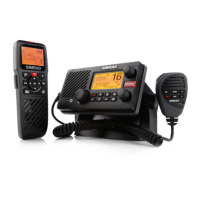
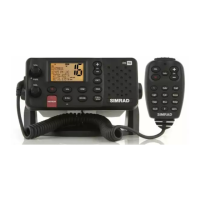
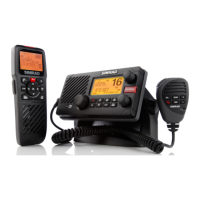
The Simrad RS35 VHF and HS35 Handset are a marine communication system designed for reliable and safe operation on the water. This system provides essential VHF radio capabilities, including Digital Selective Calling (DSC) functions, and extends communication flexibility with a wireless handset.
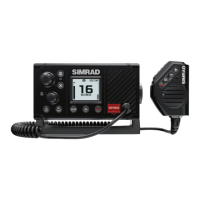
The Simrad RS35 VHF is a fixed-mount marine VHF radio that serves as the primary communication hub. Its core function is to enable two-way voice communication on VHF marine channels, crucial for safety, navigation, and general communication between vessels and shore stations. The RS35 integrates advanced DSC capabilities, which are vital for distress alerting and routine calling. DSC allows for automated digital calls to specific vessels or groups, transmitting important information such as the vessel's MMSI (Maritime Mobile Service Identity) and GPS position. This feature significantly enhances safety by enabling quick and efficient distress calls, even if the operator is incapacitated.
The radio is equipped with a large LCD screen, providing clear visibility of channel information, GPS data, and other operational parameters. The user interface is designed for intuitive control, featuring dedicated buttons for common functions like channel selection, volume, squelch, and distress calls. The RS35 also supports NMEA 2000 and NMEA 0183 connections, allowing it to integrate seamlessly with other marine electronics on board, such as GPS plotters and multifunction displays. This integration enables the radio to receive GPS position data, which is essential for accurate DSC distress calls.
A notable feature of the RS35 is its hailer horn capability. When connected to an external hailer speaker, the radio can function as a public address system, allowing the operator to broadcast messages to other vessels or people on the dock. It also includes a fog horn function, which can transmit various fog horn sounds, enhancing safety in low-visibility conditions. The hailer horn is designed to "listen back" when not transmitting, providing a two-way audio link.
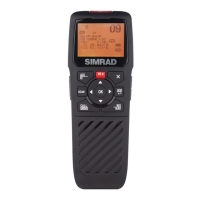
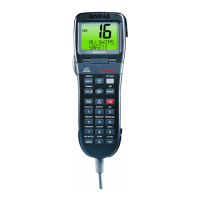
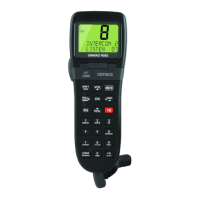
The Simrad HS35 Handset is a wireless companion to the RS35 VHF, offering remote control and communication capabilities. This handset provides the freedom to move around the vessel while maintaining full access to the radio's functions. It mirrors the essential controls of the main unit, allowing users to change channels, adjust volume, make calls, and even initiate DSC distress calls from a remote location. The HS35 features its own display, providing critical information directly to the user's hand. This wireless functionality is particularly useful on larger vessels where the main radio might be located at the helm, but communication is needed from the deck, flybridge, or cabin. The handset operates within a certain range from the base station, ensuring reliable connectivity.
The RS35 and HS35 system is designed for ease of use and maximum operational flexibility. The fixed-mount RS35 offers a choice of installation types: a mounting bracket for deck or overhead installation, which allows for adjustable viewing angles and easy removal for storage, or a recessed installation for a more permanent, flush-mount appearance. The mounting bracket option provides a 20° tilt range for optimal display visibility. The radio's front panel controls are easily accessible, and the microphone is attached to the base station for convenient use.
The HS35 Handset enhances the user experience by providing wireless control. Its charging cradle can be installed in a convenient location, ensuring the handset is always charged and ready for use. The handset's design includes a display and intuitive buttons, making it straightforward to operate. The ability to make DSC calls from the handset adds a layer of safety, as a distress call can be initiated from anywhere on the boat within range of the base station.
Both units are designed with safety in mind. The RS35 requires a user MMSI to be entered before DSC functions can be activated, ensuring proper identification in case of an emergency. The system also includes important safety information and warnings regarding installation and operation, emphasizing the user's responsibility for safe boating practices. The radio's ability to integrate with GPS systems means that accurate position data is automatically transmitted with DSC calls, significantly aiding search and rescue efforts.
The hailer function, with its public address and fog horn capabilities, is another practical usage feature. It allows for clear communication to external parties and provides an important safety tool in adverse weather conditions. The external speaker connection further expands audio output options, allowing for clearer reception of radio transmissions in noisy environments.
Maintenance of the Simrad RS35 VHF and HS35 Handset system primarily involves ensuring proper installation and regular checks of connections. The installation instructions provide detailed guidance on mounting the RS35 base station and the HS35 charging cradle, including recommendations for location to optimize performance and safety. For instance, the VHF antenna should be mounted as high as possible and at a specified distance from the base station to ensure optimal signal transmission and reception. The GPS connector on the radio is provided with a protective cover, which should be fitted if the connector is not in use, to prevent damage and maintain integrity.
Electrical installation diagrams are provided for various connections, including NMEA 2000, NMEA 0183, external speaker, and hailer, ensuring that users can correctly wire the system. The power supply cable includes a 7 A fuseholder, and a spare fuse is provided, indicating a built-in protection mechanism that simplifies troubleshooting in case of power issues.
The manual also highlights the importance of checking the radio operating licensing requirements in the user's country, ensuring compliance with local regulations. It also advises users to obtain a user MMSI and enter it into the RS35 for DSC functions to operate correctly. This is a critical setup step that ensures the system is fully functional for safety purposes.
For the HS35 Handset, the charging cradle ensures that the handset's battery is maintained, ready for use. While specific battery maintenance instructions are not detailed, the design implies that keeping the handset in its cradle when not in use is the primary method of maintaining its operational readiness.
The system is designed for durability in a marine environment, but users are advised to ensure that the chosen installation location is clean and dry, especially for the DSC warning label, which must be clearly visible. The radio's robust construction and the provision of a dust cover suggest a design intended to withstand typical marine conditions. The manual also includes a warning about potential high temperatures on the rear heat-sink under extreme operating conditions, advising caution to prevent skin burns, which is an important safety consideration for maintenance and handling.
 General
| Frequency Range | 156.000 - 163.425 MHz |
|---|---|
| GPS | Yes |
| DSC | Yes |
| Waterproof Rating | IPX7 |
| Type | VHF Marine Radio |
| Power Output | 25W |
| Channels | USA, International, and Canadian channels |
| Display | LCD |

 To Next Page