HEIGHT
When
machine is
set
for longest
stich,
approximate
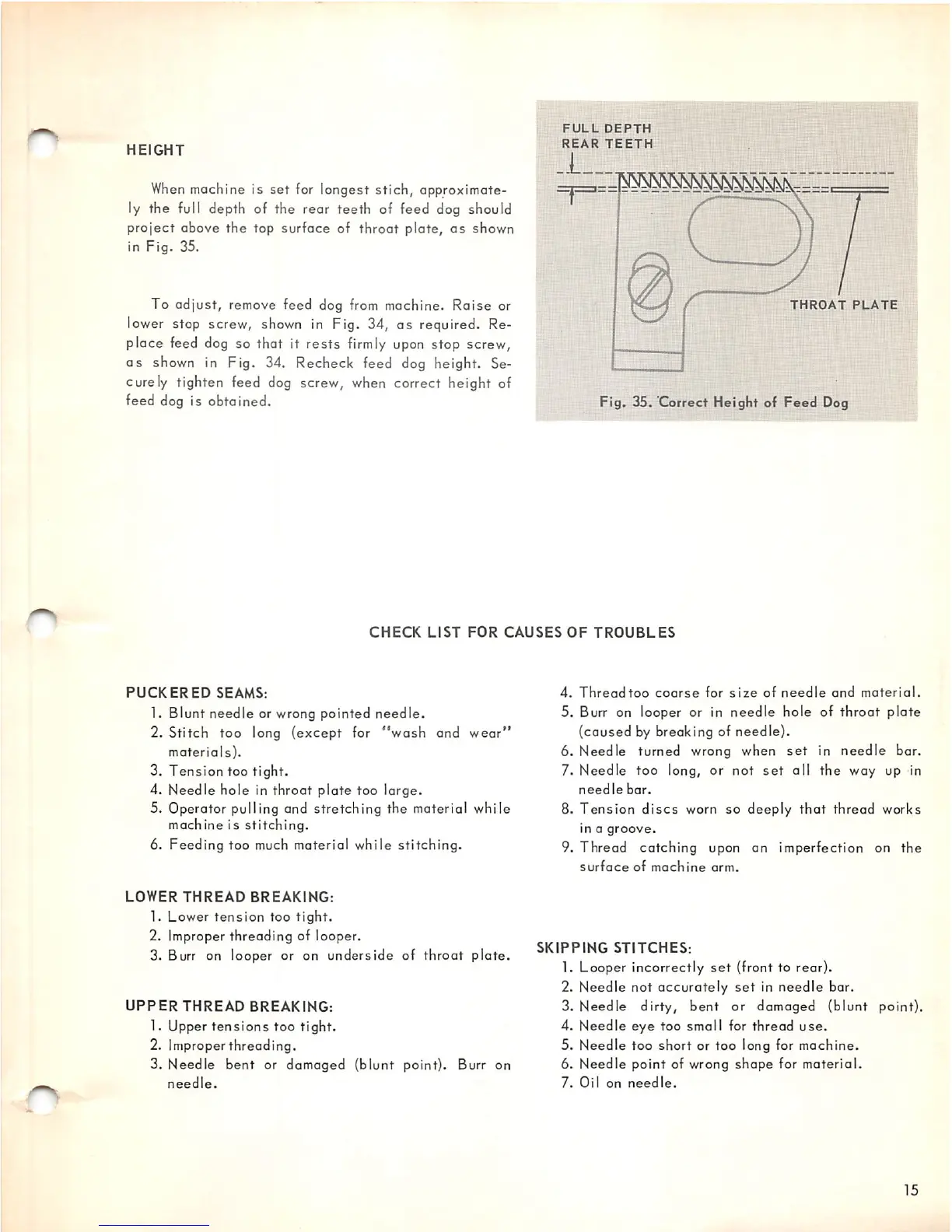
ly the full depth of the rear teeth of feed dog should
project
above
the
top surface of throat plate,
as
shown
in
Fig.
35.
To
adjust,
remove feed dog from machine.
Raise
or
lower stop screw, shown in Fig. 34, as required. Re
place feed dog so that it
rests
firmly upon stop screw,
as
shown in Fig. 34. Recheck feed dog height. Se
curely tighten feed dog screw, when correct height of
feed dog is
obtained.
FULL
DEPTH
REAR
TEETH
THROAT
PLATE
Fig. 35. Correct Height of
Feed
Dog
CHECK
LIST
FOR
CAUSES
OF
TROUBLES
PUCKERED
SEAMS:
1. Blunt
needle
or wrong pointed
needle.
2. Stitch too long
(except
for
"wash
and
wear"
materials).
3.
Tension
too
tight.
4. Needle hole in throat
plate
too large.
5. Operator pulling and
stretching
the material while
machine is
stitching.
6. Feeding too much material while
stitching.
LOWER
THREAD
BREAKING:
1.
Lower
tension
too
tight.
2. Improper
threading
of looper.
3. Burr on looper or on underside of
throat
plate.
UPPERTHREAD
BREAKING:
1. Upper
tensions
too tight.
2. Improperthreading.
3.
Needle
bent
or
damaged
(blunt
point). Burr on
needle.
4.
Thread
too
coarse
for
size
of
needle
and
material.
5. Burr on looper or in
needle
hole of
throat
plate
(caused
by breaking of needle).
6. Needle turned wrong when
set
in
needle
bar.
7. Needle too long, or not
set
all
the
way up in
needle
bar.
8.
Tension
discs
worn so deeply
that
thread works
in a
groove.
9.
Thread
catching
upon an
imperfection
on
the
surface
of
machine
arm.
SKIPPING
STITCHES:
1. Looper incorrectly
set
(front to rear).
2. Needle not
accurately
set
in
needle
bar.
3. Needle dirty,
bent
or damaged (blunt point).
4.
Needle
eye
too
small
for
thread
use.
5.
Needle
too
short
or
too
long for
machine.
6.
Needle
point
of wrong
shape
for
material.
7.
Oil
on
needle.
15



 To Previous Page