EasyManua.ls Logo

Singer 9800 - Standard Sewing: Repairs and Hems; Mending, Darning, and Terry Cloth Sewing; Blind Hem and Belt Loop Sewing

Singer 9800
35 pages
Print Icon
To Next Page IconTo Next Page
To Previous Page IconTo Previous Page
Loading...
Standard
Sewing
‘-r’
darning
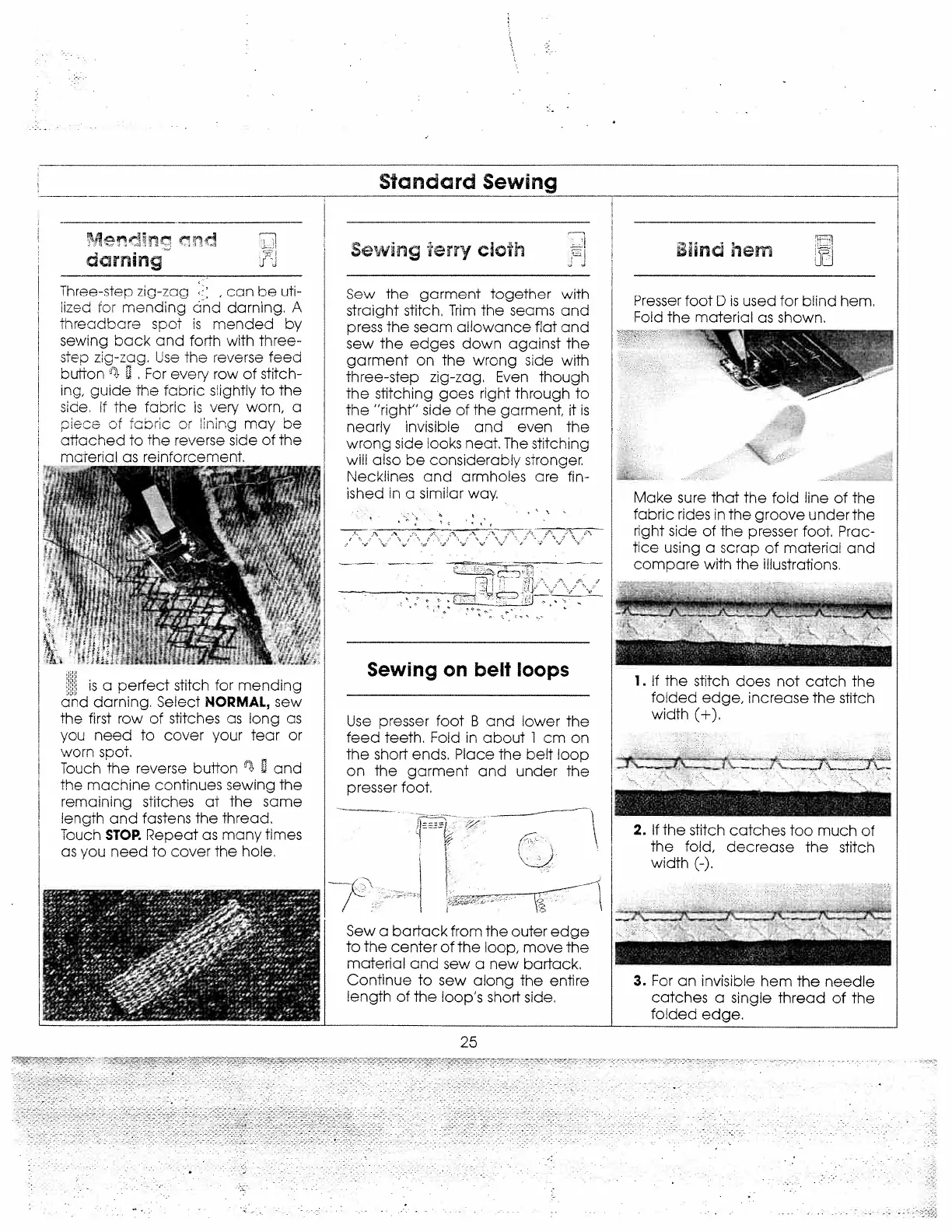
Three-step
zig-zag
,
can
be
uti
zed
for
mending
and
darning.
A
threadbare
spot
is
mended
by
sewing
back
and
forth
with
three
ste
zig-zag.
Lse
the
reverse
feea
bufton
For
every
row
of
stitch
ing,
guide
the
fabric
slightly
to
the
side
if
the
fabric
s
very
worn,
a
piece
of
fcorc
or
Thing
may
be
aftached
to
the
reverse side
of
the
material
as
reinforcement.
is
a
perfect
stitch
for
mending
and
darning. Select
NORMAL,
sew
the
first
row
of
stitches
as
long
as
you
need
to
cover
your
tear
or
worn
spot,
Touch
the
reverse
butron
II
ana
the
macnine
continues
sewing
the
remaining
stitches
at
the
same
length
and
fastens
the
thread.
Touch
STOR
Repeat
as
many
times
as
you
need
to
cover
the
hole.
Sewing
terry
cloth
Sew
the
garment together
with
straight
stitch.
Trim
the
seams
and
press
the
seam
allowance
flat
and
sew
the
edges
down
against
the
garment
on
the
wrong side
with
three-step
zig-zag.
Even
though
the
stitching
goes
right
through
to
the
“right”
side
of
the
garment,
it
is
nearly
invisible
and
even
the
wrong
side
looks
neat.
The
stitching
will
also
be
considerably
stronger
Necklines
and
armholes
are
fin
ished
in
a
similar
way.
-
Sewing
on
belt
loops
Use
presser
foot
B
and
lower
the
feed
teeth.
Fold
in
about
1
cm
on
the
short
ends.
Place
the
belt
loop
on
the
garment
and
under
the
presser
foot.
C
Sew
a
bartack
from
the
outer
edge
to
the
center
of
the
loop,
move
the
material
and
sew
a
new
bartack.
Continue
to
sew
along
the
entire
length
of
the
loop’s short side.
..,‘‘
,,
&nc
nem
Presser
foot
D
is
used
for
blind
hem.
Fold
the
material
as
shown.
Make
sure
that
the
fold
line
of
the
fabric
rides
in
the
groove
under
the
right
side
of
the
presser
foot.
Prac
tice
using
a
scrap
of
material
and
compare
with
the
illustrations.
1.
If
the
stitch
does
not
catch
the
folded
edge,
increase
the
stitch
width
(+).
2.
If
the
stitch
catches
too
much
of
the
fold,
decrease
the
stitch
width
(-).
wJ_J
1
3.
For
an
invisible
hem
the
needle
catches
a
single
thread
of
the
folded
edge.
25

Related product manuals