-12-
Note: Most minor imperfec-
tions in the stitch can be cor-
rected by adjusting the nee-
dle tension only.
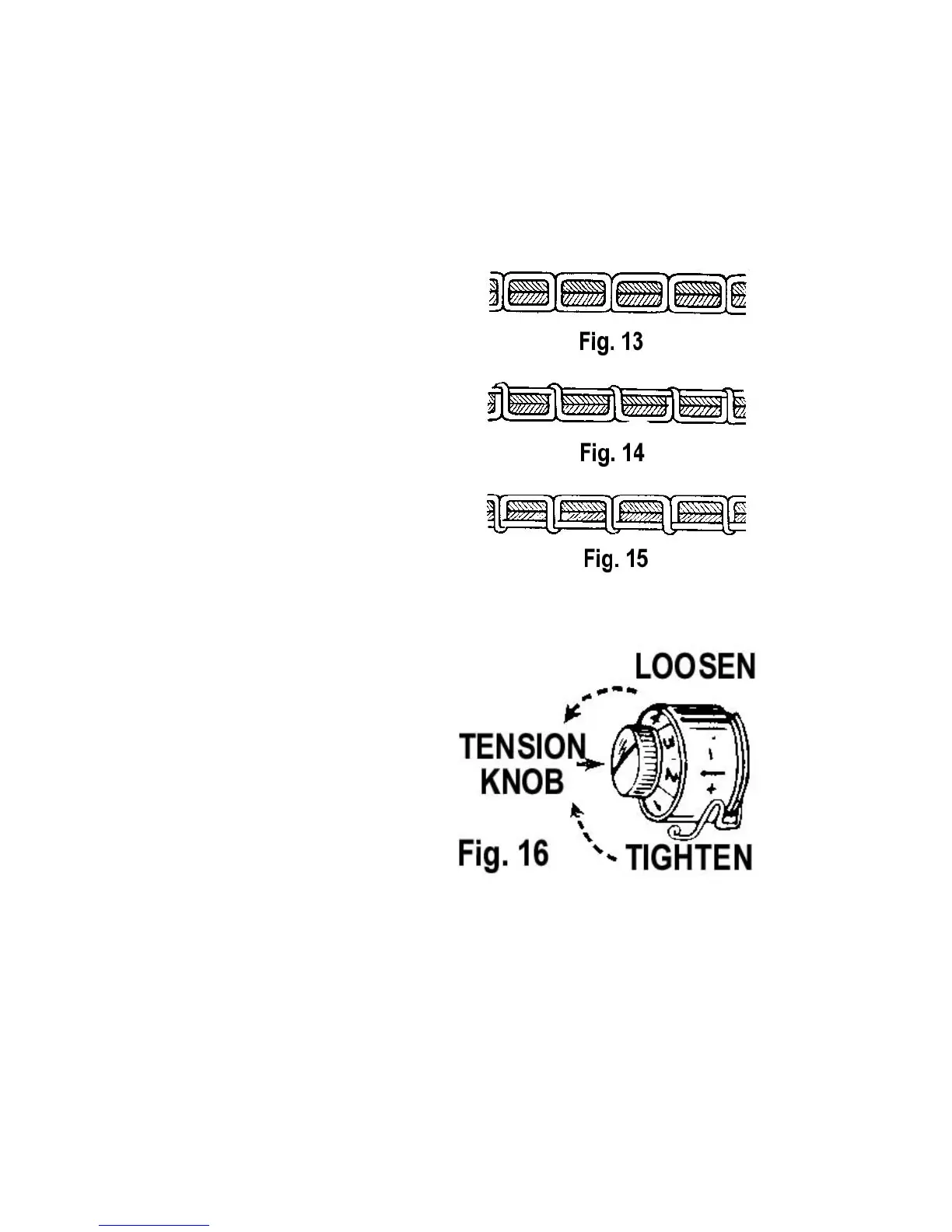
To increase the upper ten-
sion, turn the tension knob
clockwise. To decrease it,
turn counterclockwise. All adjustments should be made gradually,
no more than one number at a time. When the presser foot is in the
raised position, the upper tension is released, so if you pull on the
thread to feel the amount of tension, the foot must be down.
If it becomes necessary to adjust the bobbin tension, this is ex-
plained on pg. 6, Fig. 7.
TENSIONS
For ideal stitching, the ten-
sion on the upper and lower
threads should be equal, and
just sufficiently strong to
lock both threads in the cen-
ter of the work. (Fig. 13)
If the upper tension is too
tight or the lower too loose,
the needle thread will lay
straight on the upper surface.
(Fig. 14)
If the lower tension is too
tight or the upper too loose,
the bobbin thread will lay
straight on the underside of
the material. (Fig. 15)



 To Next Page