-8-
PLUNGE CUTTING
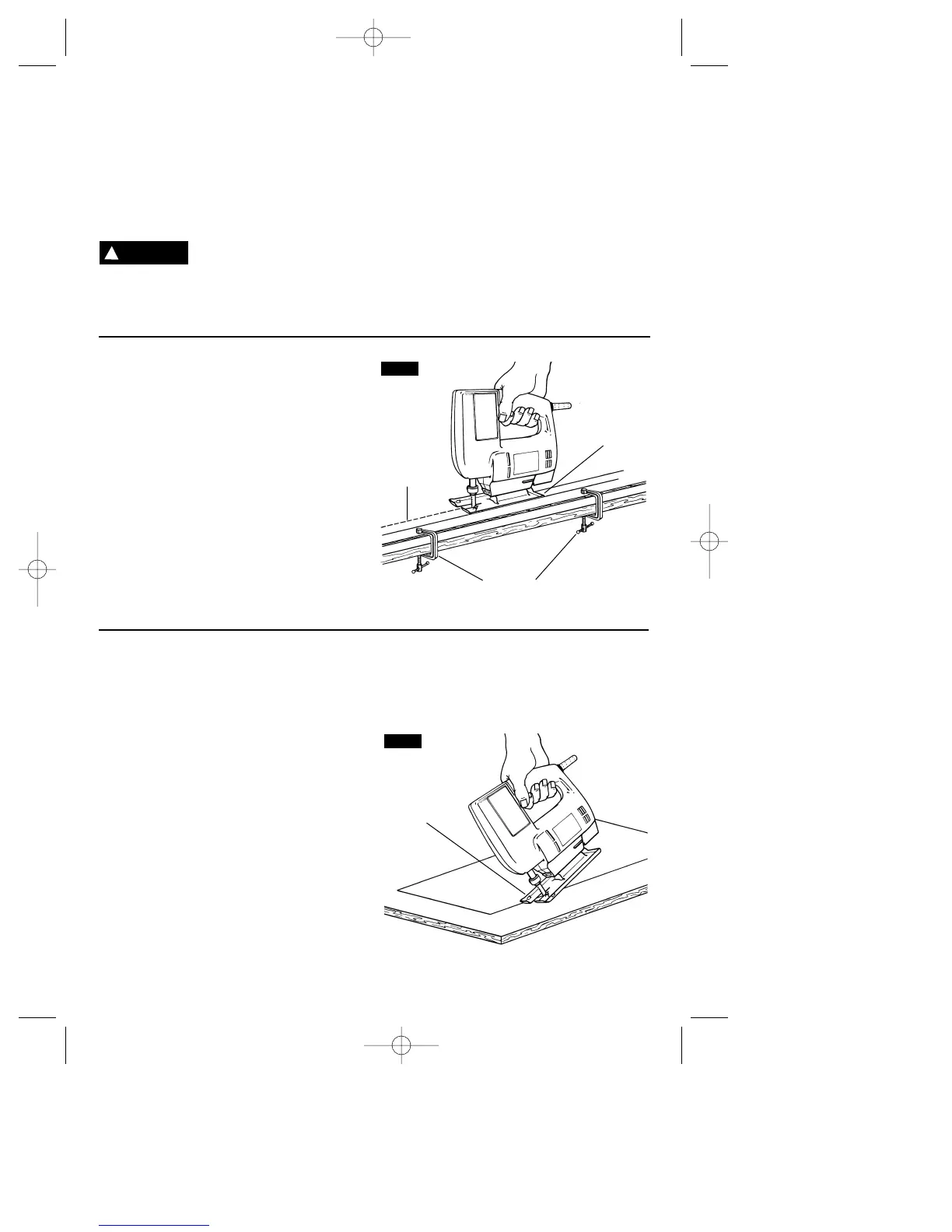
Plunge cutting is useful and time-saving in
making rough openings in softer materials. It
is not necessary to drill a hole for an inside or
pocket cut. Draw lines for the opening, hold
the saw firmly, tilt it forward so that the toe of
the saw foot rests on the work, but with the
blade well clear of the work. Start the motor,
and then very gradually lower the blade.
When it touches, continue pressing down on
the toe of the saw foot slowly pivoting the
saw like a hinge until the blade cuts through
and the foot rests flat on the work. Then saw
ahead on the line of cut. We do not
recommend plunge cutting with a scroll blade
(Fig. 5).
To make sharp corners, cut up to the corner,
then back up slightly before rounding the
corner. After the opening is complete, go
back to each corner and cut it from the
opposite direction to square it off. Do not try
to plunge cut into hard materials such as
steel.
Always disconnect the plug from power
source before making adjustments. Your saw
has an adjustable foot for doing reduced
splinter cutting. To adjust: loosen the foot
adjustment screw in the bottom of foot with a
flat tip screwdriver, and slide the foot forward
so the slot in foot surrounds the blade on
both sides and securely tighten foot
adjustment screw.
The foot must be moved
backward when using the
bevel adjustment, or any other blade than
hollow or smooth cutting blades.
If finished materials must be cut face up, use
splinter free setting and reverse tooth blade
available at your dealer. Note: Do not use the
blade provided with your jigsaw during
reduced cutting since it is not hollow ground
or smooth cutting blade. These blades can be
purchased from your dealer.
BLADE STORAGE COMPARTMENT
Your saw is equipped with a blade storage
area (Fig. 3) on the backside of your saw. To
open, slide door up in direction of arrow. To
close, slide slide door in opposite direction.
Be sure door is closed to prevent blades from
falling out.
CUTTING WITH A STRAIGHTEDGE
Always use a rough-cut blade when possible.
Clamp a straightedge on the work parallel to
the line of cut and flush with the side of the
saw foot. (Either first mark the line of cut and
then position the straightedge parallel and at
the same distance as between the blade and
the side edge of the foot, or first mark the
side edge of the foot and then clamp the
straightedge on the mark and parallel to the
line of cut Fig. 4)
As you cut, keep the saw foot edge flush
against the straightedge and flat on th work
(Fig. 4).
FIG. 5
TOE
OF
FOOT
FIG. 4
LINE
OF
CUT
FOOT AGAINST
STRAIGHTEDGE
CLAMPS
!
CAUTION
SM 2610995772 8/00 9/14/00 8:53 AM Page 8



 To Next Page