This document is an instruction manual for a 607AZ telescope, providing detailed guidance on assembly, operation, and observation techniques.
Function Description:
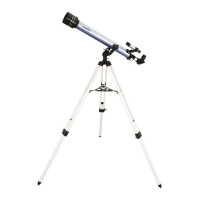
The 607AZ telescope is designed for astronomical observation, allowing users to view celestial objects with adjustable magnification. It features an Alt-Azimuth mount for controlling telescope movements, enabling both up-down (altitude) and left-right (azimuth) adjustments. The telescope is equipped with a finderscope for easily locating objects, and a focuser for achieving sharp images. It supports the use of various eyepieces and a Barlow lens to alter magnification and field of view. The manual emphasizes safe viewing practices, particularly regarding solar observation, and offers advice on optimizing observing conditions.
Important Technical Specifications:
- Optical Tube: 60mm aperture / 700mm focal length
- Mount Type: Alt-Azimuth (AZ)
- Objective Lens: Gathers light from celestial objects.
- Dew Cap / Sun Shade: Protects the objective lens from dew and direct sunlight.
- Dust Cap / Mask: Covers the objective lens when not in use; must be removed before viewing.
- Finderscope: A small, low-magnification scope with crosshairs for locating objects.
- Eyepiece: Inserts into the diagonal to provide magnification.
- Diagonal: Redirects the light path for comfortable viewing.
- Barlow Lens: A negative lens that increases the magnifying power of an eyepiece.
- Focus Tube: Houses the eyepiece and diagonal, moving in and out for focusing.
- Focus Knob: Used to adjust the focus of the image.
- Altitude Fine-adjustment Control: Allows for precise up-down adjustments of the telescope.
- Azimuth Lock Knob: Secures the telescope's left-right position.
- Yoke Locking Knob: Secures the telescope tube to the yoke mount.
- Altitude Lock Knob: Secures the telescope's up-down position.
- Tripod: Three-legged stand for stability, with adjustable height.
- Accessory Tray: Provides a convenient place to store eyepieces and other small accessories.
Usage Features:
- Assembly: The manual provides step-by-step instructions for assembling the tripod, attaching the mount to the tripod legs, securing the accessory tray, and mounting the main telescope tube. It also covers the assembly and insertion of the finderscope and eyepieces.
- Finderscope Alignment: Crucial for quickly locating objects, the finderscope must be aligned with the main telescope. This involves pointing the main telescope at a distant object (at least 500 yards away) and then adjusting the finderscope's crosshairs to center on the same object using its alignment screws.
- Operating the AZ Mount: The Alt-Azimuth mount allows for easy manual control of the telescope's direction. Users loosen the azimuth lock knob for left-right movements and the altitude lock knob for up-down changes. Fine altitude adjustments can be made using the knurled wheel on the altitude fine adjustment rod.
- Using the Barlow Lens: A Barlow lens can be inserted between the diagonal and the eyepiece to increase magnification. The manual notes that placing it in front of the diagonal can yield even greater magnification. Benefits include improved eye relief and reduced spherical aberration.
- Focusing: Images are sharpened by slowly turning the focus knobs. Refocusing is often necessary due to temperature changes, flexures, or when changing eyepieces or using a Barlow lens.
- Pointing the Telescope: The Alt-Azimuth mount allows users to swivel the telescope parallel to the horizon (azimuth) and then tilt it up and down (altitude) to target celestial objects. Due to Earth's rotation, continuous small adjustments in both azimuth and altitude are required to track objects.
- Calculating Magnification (Power): Magnification is determined by dividing the telescope's focal length by the eyepiece's focal length. The manual provides an example: 800mm (telescope) / 10mm (eyepiece) = 80X magnification. It also advises that usable magnification is typically about 2X per mm of aperture under good conditions.
- Calculating Field of View: The true field of view is calculated by dividing the eyepiece's apparent field of view (provided by the manufacturer) by the magnification. This helps users understand how much of the sky they will see.
- Calculating Exit Pupil: The exit pupil (diameter of the light cone leaving the telescope) is calculated by dividing the primary mirror's diameter (in mm) by the magnification. This value indicates how much light reaches the eye and is important for matching the telescope's output to the observer's pupil dilation.
- Observing the Sky: The manual offers advice on choosing an observing site (away from city lights, upwind from pollution, higher elevation), selecting the best time to observe (still air, clear view, early morning hours, when objects cross the meridian), and cooling the telescope (allowing 10-30 minutes for the telescope to reach ambient temperature to minimize heat wave distortion).
- Using Your Eyes: Recommendations include exposing eyes to only red light for 30 minutes before observing to maximize pupil dilation and light adaptation, observing with both eyes open to avoid fatigue, and using averted vision for faint objects (looking slightly to the side of the object).
Maintenance Features:
- Dust Cap / Mask: The manual explicitly states to remove the dust cap/mask before viewing, implying its use for protection when the telescope is not in operation.
- Finderscope Protection: When observing the sun (with a proper solar filter on the main telescope), a dust cap should be placed over the finderscope to protect it from exposure.
- General Care: While not explicitly detailed as "maintenance," the instructions for careful assembly (e.g., "Be careful not to over-tighten the wingnuts and damage tripod legs") imply a need for gentle handling to prevent damage. The advice on cooling the telescope also contributes to maintaining optical performance by preventing internal heat build-up that could damage optical elements.
- Solar Filter Warning: A critical safety and maintenance note warns against using the telescope to look directly at the sun without a proper solar filter, as this can cause permanent eye damage and internal heat build-up that will damage the telescope's optical elements. Eyepiece-type solar filters are also explicitly forbidden.

 Need help?
 General


 To Next Page