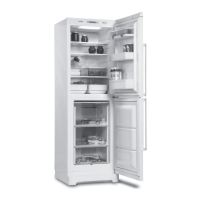
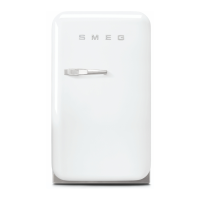
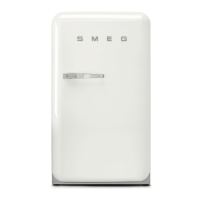
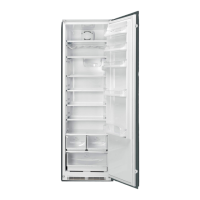
This document is a user manual for a Smeg Fridge Freezer, model D72302P. It provides comprehensive information on safety, operation, installation, maintenance, and troubleshooting for the appliance.
Function Description:
The Smeg Fridge Freezer is designed for household and similar applications, including farmhouses, staff kitchen areas in shops and offices, hotels, motels, bed and breakfast establishments, and other residential environments. It features separate compartments for refrigeration and freezing, allowing for the storage of fresh and frozen foods. The freezer compartment is suitable for freezing fresh food and storing frozen and deep-frozen food for extended periods.
Important Technical Specifications:
- Climate Class: The appliance is designed to operate within specific ambient temperature ranges:
- SN: +10°C to +32°C
- N: +16°C to +32°C
- ST: +16°C to +38°C
- T: +16°C to +43°C
- Note: Functional problems might occur outside these ranges, and correct operation is only guaranteed within the specified temperature range.
- Refrigerant: The appliance uses isobutane (R600a), a natural gas with high environmental compatibility, which is flammable.
- Electrical Connection: The appliance must be earthed, and the electrical information on the rating plate must match the power supply (230-240 Volts).
- Dimensions:
- Height: 1446 mm
- Width: 560 mm
- Depth: 550 mm
- Rising Time: 20 Hours (This refers to the time it takes for the temperature in the freezer to rise to a level where defrosted food must be consumed or re-frozen in case of a power failure).
- Freezing Capacity: The maximum amount of food that can be frozen in 24 hours is specified on the rating plate.
Usage Features:
- Temperature Regulation: The temperature is regulated automatically. A medium setting is generally recommended, but the exact setting should consider room temperature, door opening frequency, food quantity, and appliance location. Turning the regulator towards lower settings provides minimum coldness, while higher settings provide maximum coldness.
- Movable Shelves: The refrigerator walls are equipped with runners, allowing shelves to be positioned at various heights to accommodate different food package sizes. However, the glass shelf above the vegetable drawer and the bottle shelf should not be moved to ensure correct air circulation.
- Freezing Fresh Food: To freeze fresh food, it is recommended to activate the freezing function at least 24 hours before placing food in the freezer compartment. The freezing process lasts 24 hours, during which no other food should be added.
- Temperature Indicator: The refrigerator includes a temperature indicator on the side wall to show the coldest area. An "OK" display (A) indicates proper storage conditions; if not (B), the temperature controller should be adjusted to a colder setting, and checked again after 12 hours.
- Ice-Cube Production: The appliance is equipped with trays for making ice cubes. Metallic instruments should not be used to remove trays from the freezer.
- Thawing: Deep-frozen or frozen food can be thawed in the refrigerator compartment or at room temperature. Small pieces can be cooked directly from frozen, though cooking time will be longer.
- Storage of Frozen Food: For optimal performance, ensure commercially frozen foodstuffs are adequately stored by the retailer, transfer them quickly to the freezer, avoid frequent door openings, and do not exceed the storage period indicated by the manufacturer. Defrosted food should not be re-frozen.
- Hints for Fresh Food Refrigeration: To achieve the best performance, avoid storing warm food or evaporating liquids, cover or wrap food (especially strong-flavored items), and position food for free air circulation. Bananas, potatoes, onions, and garlic should not be kept in the refrigerator unless packed.
- Hints for Freezing: Freeze only top-quality, fresh, and thoroughly cleaned foodstuffs. Prepare food in small portions for rapid freezing and easier thawing. Wrap food in airtight aluminum foil or polythene. Avoid contact between fresh and already frozen food. Lean foods store better and longer than fatty ones; salt reduces storage life. Water ices consumed immediately after removal from the freezer can cause freeze burn. It is advisable to note the freezing date on packs to track storage time.
Maintenance Features:
- General Cleaning: The appliance and its accessories should be cleaned regularly with lukewarm water and neutral soap. Door seals should be checked and wiped clean. After rinsing, dry thoroughly. If accessible, the condenser and compressor at the back of the appliance should be cleaned with a brush to improve performance and save electricity.
- Defrosting the Refrigerator: Frost is automatically eliminated from the refrigerator evaporator during normal use. Defrost water drains into a special container at the back of the appliance, where it evaporates. The defrost water drain hole in the refrigerator compartment channel should be periodically cleaned to prevent overflow.
- Defrosting the Freezer: The freezer should be defrosted when the frost layer reaches 3-5 mm thickness. Before defrosting, set a lower temperature for about 12 hours to build up chill reserve. To defrost, switch off the appliance or unplug it, remove stored food and place it in a cool place, leave the door open, and insert a plastic scraper into the bottom center seating with a basin underneath to collect water. Warm water in a pot can speed up the process. After defrosting, dry the interior thoroughly, then switch on the appliance and reload food after three hours.
- Replacing the Lamp: Disconnect the appliance from the mains. Remove the screw and cover from the lamp, then replace the used lamp with a new one of the same power, specifically designed for household appliances. Reinstall the cover, tighten the screw, and reconnect the plug.
- Door Reversibility: The manual provides detailed instructions for reversing the door swing, including loosening and removing pins, hinges, and spacers, and then reassembling them on the opposite side.
- Installation: The appliance should be installed in a dry, well-ventilated indoor area corresponding to its climate class. Ensure sufficient airflow behind the appliance (minimum 200 cm² at the top and bottom). The appliance must be earthed. The manual includes detailed steps for installing the appliance into a niche, attaching it with screws, and aligning the appliance and kitchen furniture doors.
- Periods of Non-Operation: For long periods of non-use, disconnect the appliance, remove all food, defrost and clean the appliance and accessories, and leave the door(s) open to prevent unpleasant smells.
The manual emphasizes several safety precautions:
- Children aged 8 years and above and persons with reduced capabilities can use the appliance with supervision and instruction. Children should not play with the appliance or perform cleaning/maintenance without supervision.
- Keep packaging away from children.
- Do not use mechanical devices or other means to accelerate defrosting, other than those recommended by the manufacturer.
- Do not damage the refrigerant circuit.
- Do not use electrical appliances inside food storage compartments unless recommended by the manufacturer.
- Do not use water spray or steam for cleaning. Clean with a moist soft cloth and neutral detergents; avoid abrasive products, solvents, or metal objects.
- Do not store explosive substances or flammable propellants.
- If the supply cord is damaged, it must be replaced by the manufacturer, an authorized service center, or similarly qualified persons.
- Installation must be performed by a qualified person. Remove all packaging, do not use a damaged appliance, and follow installation instructions.
- Wear safety gloves when moving the appliance due to its weight.
- Ensure air circulation around the appliance.
- Wait at least 4 hours before connecting to power to allow oil to flow back to the compressor.
- Do not install near radiators, cookers, ovens, hobs, or in direct sunlight, or in excessively humid/cold areas.
- Lift the appliance by its front edge when moving to avoid scratching the floor.
- The appliance must be earthed using a shockproof socket. Do not use multi-plug adapters or extension cables.
- Do not damage electrical components; contact an authorized service center if needed.
- Do not pull the mains cable to disconnect the appliance; always pull the mains plug.
- Do not change the appliance's specifications.
- Do not put electrical appliances (e.g., ice cream makers) in the appliance unless specified by the manufacturer.
- Be careful not to damage the refrigerant circuit, as R600a is flammable. In case of damage, ensure no flames or ignition sources are present and ventilate the room.
- Do not let hot items touch plastic parts.
- Do not put soft drinks in the freezer compartment, as this can create pressure.
- Do not store flammable gas or liquid.
- Do not put flammable products or items wet with flammable products in, near, or on the appliance.
- Do not touch the compressor or condenser as they are hot.
- Do not remove or touch items from the freezer compartment with wet or damp hands.
- Do not refreeze thawed food.
- The internal lamp is not suitable for household room illumination.
- Before maintenance, deactivate the appliance and disconnect the mains plug.
- Only qualified persons should perform maintenance and recharging of the cooling unit.
- Regularly examine and clean the drain.
- For disposal, disconnect from mains, cut off the cable, remove the door, and contact municipal authorities for correct disposal methods, as the appliance contains ozone-friendly refrigerant and flammable insulation foam. Do not damage the cooling unit near the heat exchanger.

 Need help?
 General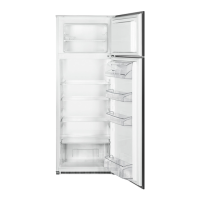

 To Next Page