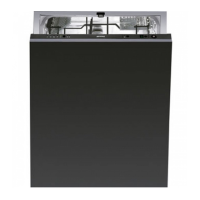
This document provides installation and operating instructions for the Smeg STA945-3 fully-integrated dishwasher.
Function Description
The Smeg STA945-3 is a fully-integrated dishwasher designed for washing dishes. It offers various washing programs and features to ensure effective cleaning and user convenience. The dishwasher is equipped with a water softening system to adjust to different water hardness levels, and it includes indicators for salt and rinse aid levels. It is designed to be energy-efficient and environmentally conscious, with recommendations for optimal loading and detergent usage.
Important Technical Specifications
- Model: STA945-3
- Width: 447 - 449 mm
- Depth measured flush with the outer edge of the control panel: 570 mm
- Height: from 820 mm to 870 mm
- Capacity: 9 standard place settings
- Water Supply Pressure: min. 50 – max. 900 KPa (min. 0.5 – max. 9 bar)
- Electrical Characteristics: See rating plate
- Reference Program (EN 50242): BIO
- Load (EN 50242): 9 place-settings
- Type of Detergent (EN 50242): F
- Amount of Detergent (EN 50242): 25 g
- Rinse Aid Setting (EN 50242): Depending on the model 3/4 or 4/6
The dishwasher requires a hot water supply not exceeding 60°C. The appliance must be connected to an electrical power supply and a water supply, and it must have a proper drain connection. The drain hose should be placed at a maximum height of 85 cm from the ground.
Usage Features
The dishwasher features an upper panel with controls for ON/OFF, program selection, salt warning light, and rinse aid warning light.
Washing Programs:
The dishwasher offers several washing programs to suit different needs:
- SOAK: Cold prewash for pans and dishes awaiting a further wash.
- DELICATE: Washes immediately after use for dishes with light dirt. Wash at 45°C, cold rinse, rinse at 67°C, dry.
- BIO (*) EN 50242: Washes immediately after use for dishes with normal dirt. Wash at 55°C, cold rinse, rinse at 67°C, dry. This is the reference program for certification bodies.
- NORMAL: For dishes with normal dirt. Cold prewash, wash at 65°C, cold rinse, rinse at 67°C, dry.
- INTENSIVE: For very dirty pans and dishes (except delicate items). Prewash at 45°C, wash at 67°C, cold rinse, rinse at 70°C, dry.
Program Selection and Operation:
- To select a program, press the PROGRAM SELECTION button (3) repeatedly until the indicator light corresponding to the desired program illuminates.
- The machine will automatically begin the washing program when the door is closed.
- To cancel a program, open the door and hold down the PROGRAM SELECTION (3) button for a few seconds until the indicator lights for programs 4 and 5 illuminate simultaneously.
- After approximately 1 minute, the dishwasher will advance to the end of cycle.
- To change a program in progress, simply open the door and select a new program. When the door is closed, the dishwasher will automatically select the new program.
Loading the Dishwasher:
- Lower Basket: Receives the full force of the lower spray arm. Pans, pots, and plates are arranged with the soiled surfaces exposed to the water jets coming from the bottom. Some models have tilting plate supports for larger loads.
- Cutlery Basket: Cutlery should be arranged in an orderly manner inside the basket, with the handles pointing downwards. Care should be taken to avoid injury from the knife blades. Wooden spoons and cooking knives can be placed in the cutlery basket, making sure that the knife blades do not protrude from the basket.
- Upper Basket: Recommended for small- or medium-sized items such as glasses, small plates, tea or coffee cups, shallow bowls, and light objects made from heat resistant plastic. If the upper basket is used in the uppermost position, it can also be loaded with serving dishes, provided they are only slightly soiled. The upper basket can be adjusted in two positions according to the user's needs and the height of the dishes in the lower basket. To adjust, turn the retainer E on both runners, right and left, through 90°, remove the basket, lift the basket, and fit the smaller pairs of wheels in the runners; then return the retainers E to their original position.
Water Softening System:
The dishwasher is equipped with an automatic water softening system. The salt container should be refilled with approximately 1.5 Kg of salt (20 washing cycles). The water hardness level can be set from 0-7 French degrees (°dF) to 61-80 French degrees (°dF), corresponding to settings N. 1 (NO SALT) to N. 5.
Rinse Aid Dispenser:
The rinse aid dispenser is located on the inner part of the door. The rinse aid helps the dishes dry faster and prevents the formation of scale deposits and streaks. The rinse aid level can be checked by an optical level indicator. To add rinse aid, open the door, turn the container cap anticlockwise by ¼ of a turn, and remove it. Fill the rinse aid until the container is full (approximately 140 cc).
Detergent Dispenser:
The detergent dispenser is located on the inner part of the door. The amount of detergent depends on the program selected and the degree of soiling. For an INTENSIVE program, it may be necessary to add an additional amount inside compartment H. Only detergents specially formulated for dishwashers should be used.
Maintenance Features
Cleaning and Maintenance:
- General Recommendations: Clean the outer surfaces and door-lining of the dishwasher regularly using a soft cloth moistened with water or with a normal detergent suitable for painted surfaces. Clean the door gaskets with a damp sponge. Periodically (once or twice a year), it is advisable to clean the tank and gaskets, using a soft cloth and water to remove any deposits.
- Cleaning the Water Intake Filter: The water intake filter A, located at the outlet of the water supply tap, needs to be cleaned periodically. After having closed the water supply tap, unscrew the end of the water intake hose, remove the filter, and clean it delicately under running water. Reassemble filter A in its seat and carefully screw the water intake hose back into place.
- Cleaning the Spray Arms: The spray arms can be easily removed for periodic cleaning of the nozzles to prevent possible clogging. To remove the upper spray arm, unscrew locking ring R. To remove the lower spray arm, simply lift it up, pulling by the central part. To remove the orbital spray arm assembly, take hold of the longer arm and pull the orbital arm upward. Wash the spray arms under running water and return them carefully to their seat. After reassembly, check that the spray arms turn freely.
- Cleaning the Filter Unit: The filter H should be periodically removed and inspected, and if necessary, cleaned. To remove the filter, take hold of the handle and turn clockwise, then lift upwards. Then separate parts L and M and separate the two parts of the plastic filter by pressing gently in the points shown, lifting it upwards to extract it. Remove the centre filter by lifting it upwards.
- General Warnings and Recommendations for Correct Maintenance: Filters should be cleaned under running water using a stiff brush. It is essential to thoroughly clean the filters according to the above instructions; the dishwasher cannot function if the filters are clogged. Carefully replace the filters in their seats to avoid damaging the wash pump.
Troubleshooting:
The manual provides a troubleshooting guide for minor problems, referring to the following instructions:
- If the program fails to start: Check electrical connection, power supply, water tap, and if the dishwasher door is properly closed.
- If water remains inside the dishwasher: Check if the drain hose is kinked, the drain siphon is not obstructed, and the dishwasher filters are not clogged.
- If the dishes are not being cleaned properly: Check for correct amount of detergent, regenerating salt inside the special container, proper loading of dishes, selected program, clean and positioned filters, and unobstructed spray arms.
- If the dishes fail to dry or remain dull: Check rinse aid inside the special container, rinse aid dispenser setting, and detergent quality.
- If the dishes show signs of streaking, staining, etc.: Check rinse aid dispenser setting.
- If there are visible traces of rust inside the tank: The tank is made of steel, but rust marks can be due to external elements (fragments of rust from water pipes, pots, cutlery, etc.). Special products are commercially available to remove such marks. Check that the amount of detergent being used is correct and that the salt container is securely closed and the water softening setting is correct.
Error Codes:
The dishwasher is capable of signalling a number of faults through the simultaneous illumination of several indicator lights.
- E1: The dishwasher's anti-flooding system has been activated (only for models equipped with the "TOTAL ACQUASTOP" device). This alarm is triggered in the event of a water leak in the dishwasher.
- E3: The dishwasher fails to heat the water. The washing program, if the problem persists, contact the customer technical service centre.
- E4: The temperature monitoring system has failed. Switch the dishwasher off, switch it back on, and restart the washing program. If the alarm recurs, call the After Sales Service.
- E5: The dishwasher fails to draw water. Ensure the plumbing connections are in order and that the water supply tap is open.
- E6: The dishwasher fails to drain. Check that the drain hose is not kinked, the siphon is not obstructed, and the filters are not clogged.
If an alarm occurs, the appliance interrupts the program in progress and signals a fault. In cases of E1, E3, and E4, the washing program must be set again to continue. In case of E5 and E6, simply open and close the door to continue (once the cause of the fault has been eliminated).

 Need help?
 General

 To Next Page