Need help?
Do you have a question about the Smithy MI-329M and is the answer not in the manual?
Welcomes the user to the MI-329M Mill and provides an overview of the manual's purpose.
Provides a general statement on machine safety and the importance of reading the manual.
Explains the meaning of warning symbols (Caution, Danger, Warning, Notice) used throughout the manual.
Lists general safety rules for the workshop environment and machine operation.
Details essential precautions before operating the machine, including clothing and personal protection.
Outlines critical safety rules for operating the machine, such as stopping before servicing and not overreaching.
Presents detailed specifications for the MI-329M Mill, including electrical, spindle, and dimensions.
Discusses the dangers of moving machine tools and advises on professional help.
Provides step-by-step instructions and considerations for safely mounting the milling machine.
Explains the importance of taking inventory of machine parts after unpacking.
Lists the specific parts shipped with the MI-329M Mill for user verification.
Instructs users on how to report missing or defective items within 30 days of receipt.
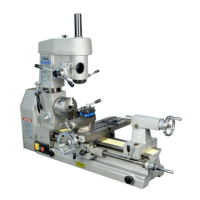
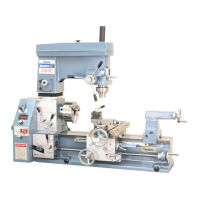
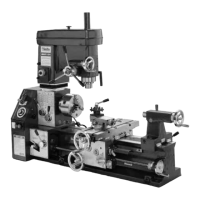
Identifies the major controls of the MI-329M Mill machine with numbered labels.
Provides detailed descriptions for each numbered control identified in the machine overview.
Emphasizes the importance of checking the machine's condition and lubrication before use.
Details the process for cleaning the machine and applying necessary lubrication for optimal performance.
Explains the objective and procedure for adjusting mill gibs to minimize play and friction.
Describes the specific process for adjusting the gibs on the Z-axis of the milling machine.
Provides basic steps for operating the milling machine, including headstock and table movement.
Explains how to turn on the spindle motor using the provided forward/reverse switch.
Details the procedure for safely changing the spindle speed using the control handles.
Discusses factors affecting milling speed and provides formulas for calculating spindle RPM.
Explains the up milling technique, its advantages, and suitable materials.
Describes the down milling technique, its benefits, and potential drawbacks like backlash.
Details how to use the depth gauge to set a precise stopping point for quill travel.
Explains how to operate the Z Axis Digital Readout (DRO) for precise measurement.
Covers the procedure for safely aligning and securing tooling in the R-8 spindle.
Details the method for safely removing tooling from the spindle using the drawbar.
Describes various methods for holding milling cutters, including arbors, collets, and adapters.
Explains the function and care of arbors used with the milling machine spindle.
Details how end mills fit into spring collets or holders and are secured.
Describes how different types of cutters are mounted using various adapters.
Presents a diagram and parts list for the bed, table, and column assembly of the mill.
Displays a diagram and parts list for the headstock assembly of the milling machine.
Shows a diagram of the spindle assembly, illustrating its components.
Illustrates the components related to the optional Digital Readout (DRO) for the machine.
Lists the parts associated with the spindle assembly and optional digital readout.


 To Next Page
 General