
 Need help?
Do you have a question about the Snap Fresh EC0601 and is the answer not in the manual?
This document is a user manual for the SnapFresh Mini Cutter, model EC0601. It provides comprehensive information on the device's function, technical specifications, usage, and maintenance.
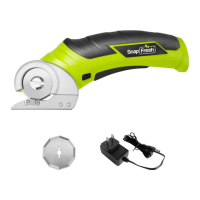
The SnapFresh Mini Cutter EC0601 is a 4.0V mini cutter designed for private domestic DIY use. It is suitable for cutting flexible, soft materials up to 6mm in thickness, such as carpet, PVC, cardboard, leather, fabrics, and similar materials. It is not intended for commercial, industrial, or trade use. The tool is equipped with an on/off switch, a lock-off button for safety, a blade guard, and a blade. It also includes a charger socket, a charging indicator light, and a charger for its 1.3Ah Li-ion battery.
The Mini Cutter is designed for ease of use with several safety features.
Removing and Installing the Blade: To remove the blade, ensure the tool is switched off and the battery cartridge is removed. Wear gloves. Rotate the blade screw counter-clockwise with a slot tip screwdriver (not supplied) and remove the blade screw. Slide the blade away from the upper guard and remove the blade. To install a new blade, slide the new blade under the upper guard with beveled edges facing you. Align the hole in the blade with the hole in the blade shaft, replace the screw, and securely tighten the blade screw clockwise.
On/Off Switch: The tool is equipped with a lock-off button (2) to prevent accidental starting. To turn the tool on, depress the lock-off button (2) and then the on/off switch (1). The tool is now on. To switch off, just release the on/off switch (1). The lock-off button (2) can be pressed from either the right or left side.
Charging the Tool: The battery charger (8) supplied matches the battery installed in the machine. Do not use other battery chargers. The battery is protected against deep discharging. When the battery is empty, the machine is switched off by means of a protective circuit; the blade will no longer move. In a warm environment or after heavy use, the battery pack may become too hot to permit charging. Allow time for the battery to cool down before recharging. To charge, plug the charger into a suitable power outlet and afterwards plug your tool into the battery charger. The charging indicator light (7) on the back of the tool will turn red during charging. When charging is done, it will turn green. Unplug the charging plug from the wall socket and then remove the tool from the battery charger. During the charging procedure, the handle of the machine warms up. This is normal. When not using for extended periods, disconnect the battery charger from the socket. Do not use the machine during the charging procedure.
Cutting: Thin materials, such as fabrics, can be pulled into the tool during cutting and become wedged. Therefore, do not apply too much pressure with these materials in order to achieve good cutting results. During cutting, apply sufficient tension while holding fabrics and cut slowly. Do not allow the foot to become wedged during cutting. The foot must be parallel to the cut. Do not touch the blade or bring the tool near the hand or face when operating. When cutting the material, never put the hand in front of the blade.
Safety Warnings: The manual emphasizes reading all safety warnings, instructions, illustrations, and specifications provided with the power tool to avoid electric shock, fire, and/or serious injury. It highlights the importance of keeping the work area clean and well lit, avoiding explosive atmospheres, and ensuring electrical safety by matching power tool plugs to outlets and avoiding body contact with earthed surfaces. Personal safety includes staying alert, wearing eye protection, preventing unintentional starting, and removing adjusting keys or wrenches before turning the power tool on. Power tool use and care guidelines include not forcing the power tool, using the correct power tool for the application, disconnecting the plug from the power source when making adjustments, and storing idle power tools out of reach of children. Maintenance of power tools involves checking for misalignment or binding of moving parts, breakage of parts, and any other condition that may affect the tool's operation. Keep cutting tools sharp and clean. Use the power tool, accessories, and tool bits according to instructions. Keep handles and grasping surfaces dry, clean, and free from oil and grease.
Battery Tool Use and Care: Recharge only with the charger specified by the manufacturer. A charger suitable for one type of battery pack may create a risk of fire when used with another battery pack. Use power tools only with specifically designated battery packs. When battery pack is not in use, keep it away from other metal objects. Shorting the battery terminals together may cause burns or a fire. Under abusive conditions, liquid may be ejected from the battery; avoid contact. If contact accidentally occurs, flush with water. If liquid contacts eyes, additionally seek medical help. Do not use a battery pack or tool that is damaged or modified. Do not expose a battery pack or tool to fire or excessive temperature. Follow all charging instructions and do not charge the battery pack or tool outside the temperature range specified in the instructions.
Service: Have your power tool serviced by a qualified repair person using only identical replacement parts. This will ensure that the safety of the power tool is maintained. Never service damaged battery packs.
Safety Warnings for Battery Cells Inside the Tool: Do not dismantle, open, or shred cells. Do not short-circuit charging terminal. Do not store power tool haphazardly in a box or drawer where charging terminal may short-circuit each other or be short-circuited by conductive materials. Do not expose power tool to heat or fire. Avoid storage in direct sunlight. Do not subject power tool to mechanical shock. In the event of battery leaking, do not allow the liquid to come into contact with the skin or eyes. Seek medical advice immediately if a cell has been swallowed. Keep power tool clean and dry. Wipe the charging terminals with a clean dry cloth if they become dirty. Power tool needs to be charged before use. Always refer to this instruction and use the correct charging procedure. Do not maintain power tool on charge when not in use. After extended periods of storage, it may be necessary to charge and discharge the power tool several times to obtain maximum performance. Recharge only with the charger specified by manufacture. Do not use any charger other than that specifically provided for use with the equipment. Keep power tool out of the reach of children. Retain the original product literature for future reference. Dispose of properly. Do not mix cells of different manufacture, capacity, size or type within a device. Do not use any cell which is not designed for use with the equipment.
General Safety Warnings for Your Battery Charger: Read all safety warnings and all instructions. This appliance can be used by children aged from 8 years and above and persons with reduced physical, sensory or mental capabilities or lack of experience and knowledge if they have been given supervision or instruction concerning use of the appliance in a safe way and understand the hazards involved. Children shall not play with the appliance. Cleaning and user maintenance shall not be made by children without supervision. If the supply cord is damaged, it must be replaced by the manufacturer, its service agent or similarly qualified persons in order to avoid a hazard.
Additional Safety Instructions for Your Battery Charger: Before charging, read the instructions. Do not charge a leaking battery. Do not use chargers for works other than those for which they are designed. Before charging, ensure your charger is matching the local AC supply. For indoor use, or do not expose to rain. The charging device must be protected from moisture. Do not use the charging device in the open. Do not short out the contacts of battery or charger. Respect the polarity "+/-" when charging. Do not open the unit and keep out of the reach of children. Do not charge the batteries of other manufactures or ill-suited models. Ensure that the connection between the battery charger and battery is correctly positioned and is not obstructed by foreign bodies. Keep battery charger's slots are free of foreign objects and protect against dirt and humidity. Store in a dry and frost-free place. When charging batteries, ensure that the battery charger is in a well-ventilated area and away from flammable materials. Batteries can get hot during charging. Do not overcharge any batteries. Ensure that batteries and chargers are not left unsupervised during charging. Do not recharge non-rechargeable batteries, as they can overheat and break. Longer life and better performance can be obtained if the battery pack is charged when the air temperature is between 18°C and 24°C. Do not charge the battery pack in air temperatures below 4°C, or above 40°C. This is important as it can prevent serious damage to the battery pack. Charge only battery pack of the same model provided by manufacture and of models recommended by manufacture.
General Maintenance: Your tool requires no additional lubrication or maintenance. There are no user serviceable parts in your power tool. Never use water or chemical cleaners to clean your power tool. Wipe clean with a dry cloth. Always store your power tool in a dry place. Keep the motor ventilation slots clean. Keep all working controls free of dust. Occasionally you may see sparks through the ventilation slots. This is normal and will not damage your power tool.
For Battery Tools: The ambient temperature range for the use and storage of tool and battery is 0°C-45°C. The recommended ambient temperature range for the charging system during charging is 4°C-40°C.
Cleaning: To avoid accidents, always disconnect the tool and/or charger from the power supply before cleaning. The tool may be cleaned most effectively with compressed dry air. Always wear safety goggles when cleaning tools with compressed air. When cutting, material residue can accumulate under the upper guard. Remove blade and clean upper guard regularly using a brush or lightly moistened cloth. Ventilation openings and switch levers must be kept clean and free of foreign matter. Do not attempt to clean by inserting pointed objects through opening. Certain cleaning agents and solvents damage plastic parts. Some of these are: gasoline, carbon tetrachloride, chlorinated cleaning solvents, ammonia and household detergents that contain ammonia.
Troubleshooting: The manual includes a troubleshooting table that lists common problems, probable causes, and suggested remedies. For example:
Environmental Protection: Waste electrical products must not be disposed of with household waste. Please recycle where facilities exist. Check with your local authorities or retailer for recycling advice.
 General
| Brand | Snap Fresh |
|---|---|
| Model | EC0601 |
| Category | Cutter |
| Language | English |

 To Next Page