OPERATING MANUAL
ENGLISH
20
21
Error Code Fault Cause Remedy
Er1 On standby, Blast Cooling/Freezing cannot be started.
During BlastCooling/Freezing, the cycle stops and the
controller returns to standby.
During storing, the cycle does not stop and the compres-
sor starts cyclically.
Room Probe Faulty Check connections and operation
of the room probe
Er2 On standby, temperature-controlled BC/F cannot be
started .
During temperature-controlled BC/F, it switches to time-
controlled cycle.
No effect during storing.
Product Probe Faulty Check connections and operation
of the product probe
Er3 On standby, during BC/F and storing, no effect.
Defrost, if any, stops through timeout.
Evaporator Probe Faulty
(only if evaporator probe
activated)
Check connection and operation
of the evaporator probe
Er4 Just signal on display Condenser Probe Faulty
(only if condenser probe
activated)
Check connection and operation
of the condenser probe
AL1 On standby and during defrost, no effect Door Open Alarm Close the door
AL2 On standby, no effect.
During BC/F and storing, the cycle stops and the card
returns to standby.
High Pressure Alarm Eliminate the alarm cause, clean
the condenser, switch off the card
and then switch on again
AL3 The running cycle stops, all outputs are de-activated, with
the exception of condenser fans
Condens. High Tempera-
ture Alarm (only if con-
denser probe activated)
Wait for condenser temperature
decrease, clean the condenser
AL4 Needle not inserted Needle not
inserted
Check for proper insertion of the
needle
ALARMS
STORAGE TIMES
After chilling or cooling, a cooked product can be kept in a refrigerator after the blast cooling process. Ensure that
the temperature during storage is always between 0°C and 4°C, depending on the type of foodstuff. Storage time
may be increased to approximately two weeks by using vacuum processing.
After blast freezing, a cooked product can be kept safely for a period of 3 to 18 months, depending on the type of
foodstuff.
During this time, the temperature must be kept at -18°C or lower. Do not store cooked products at room tempera-
ture before they are blast cooled, avoiding any loss of moisture and ensuring the foodstuff retains its freshness.
LOADING THE APPLIANCE / POSITIONING THE TRAYS
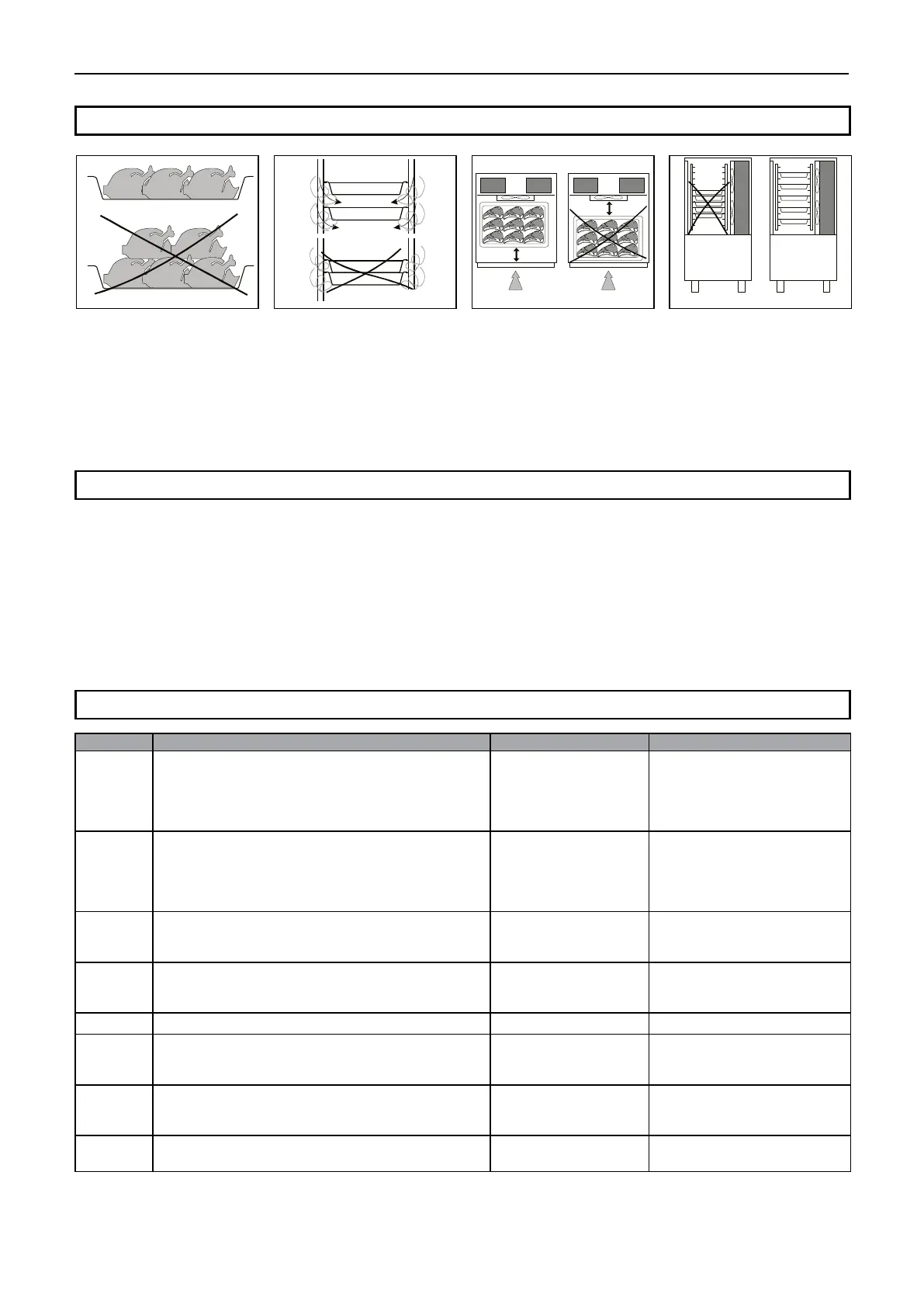
Do not place the products to be cooled one on top of the other. The thickness must be less than 50 mm for blast
freezing and less than 80 mm for blast cooling (Figure 8).
Ensure that the space left between the trays is enough to allow air to circulate properly (Figure 9).
Place the trays in the rear of the room, close to the fan (Figure 10).
If the cabinet contains less than the maximum number of trays, space out the trays at an equal distance from one
another (Figure 11).
Fig. 8
Fig. 10
Fig. 11
0.5 - 2 cm.
Fig. 9


 To Next Page