Operating and maintenance instructions
ENGLISH 14
10. Operating and maintenance
instructions
10.1 General operating and maintenance
instructions
The maintenance and the repair of modern machines
as well as their safety-relevant assemblies require
qualified specialised training and a workshop
equipped with special tools and test equipment.
Consequently the manufacturer recommends that all
tasks not described in these operating instructions be
carried out by a specialised workshop. That
specialist has the required training, experience, and
equipment at his disposal, to provide you with the
most cost-effective solution for such work. He will
provide additional help in word and deed.
After a running-in time of app. 5 hours, all accessible
screws and nuts (except the carburettor adjusting
screws) must be checked for tightness and they must
be retightened, if required.
Bear in mind when using this power tool that the
engine and its various components such as
carburetor and ignition system can become very hot,
particularly at full-throttle operation. So that no
consequential damages occur in this regard, the
motor should run for some time in idle after longer
periods of full-throttle operation. When you are
finished with the work, let the motor cool down.
It is best to store the equipment in a dry, safe
location with a full fuel tank. There should be no
open flame or similar nearby. For longer periods
without using the equipment (longer than four
weeks), see chapter "10.7 Shutdown and storage".
10.2 Carburettor adjustment
The carburettor has been adjusted optimally at the
factory. Subject to the operational altitude
(mountains or low lying areas), the carburettor may
require readjustment.
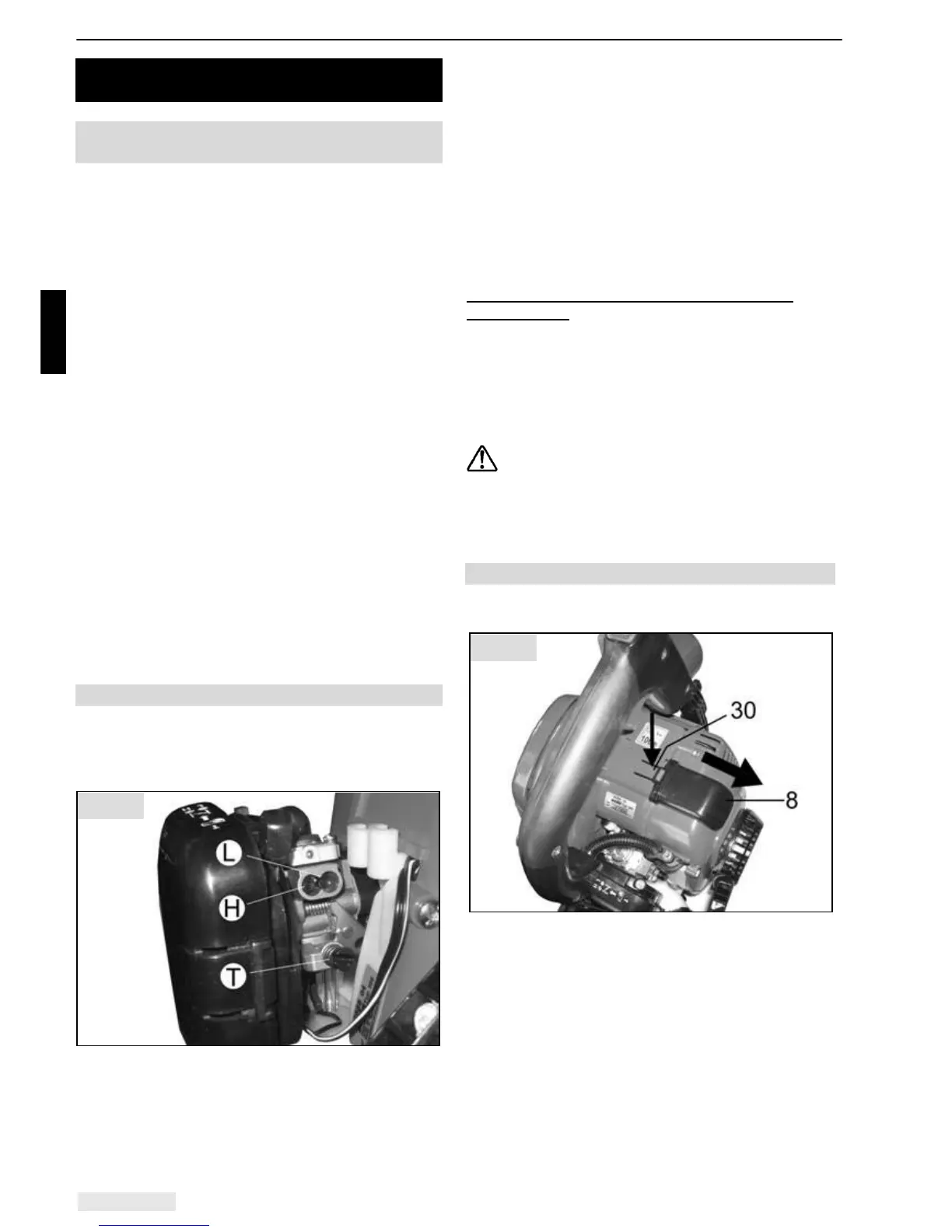
The carburettor has 3 adjusting screws:
• Idling end-stop screw "T"
• Low speed mixture screw "L"
• High speed mixture screw "H"
Only qualified mechanics must adjust the regulating
screws for idle mixture "L" and full load mixture "H".
Turn the idling end-stop screw "T" to adjust the idling
speed in accordance with the details provided in the
specification. Use an engine rev counter for this job.
• If the idling speed is too high, turn the idling end-
stop screw "T" anti-clockwise.
• If the idling speed is too low (engine stops) turn
the idling end-stop screw "T" clockwise until the
engine runs smoothly.
If the idling speed cannot be set correctly with the
idling end-stop screw "T", request an authorised
service centre to tune the carburettor.
The following instructions are for authorised
service shops
Use the D-CUT carburettor key to adjust the idle
mixture screw "L" and the full load mixture screw "H".
Clean the air filter before adjusting the low speed
screw!
Let the engine run warm before adjusting the engine
speed.
The carburettor is tuned for optimum engine
performance. Use a rev counter to tune the
carburettor correctly!
Do not adjust the engine to a higher speed.
Excessive engine speed can lead to major engine
damage!
10.3 Information about the spark plug
Check the spark plug regularly after 50 hours of
operation.
• Push in tab (30) on the standard equipment casing
and push out spark plug cap (8).
• Disconnect the spark plug cap.
• Unscrew the spark plug and dry the electrodes.
The spark plug should be replaced after 100 hours of
operation or if the electrodes are badly worn.
Do not turn the engine over while the spark plug has
been removed or the spark plug cap has been
disconnected from the high-tension ignition cable. A
spark may cause a fire!
Fig. 13
Fig. 14


 To Next Page