EasyManua.ls Logo

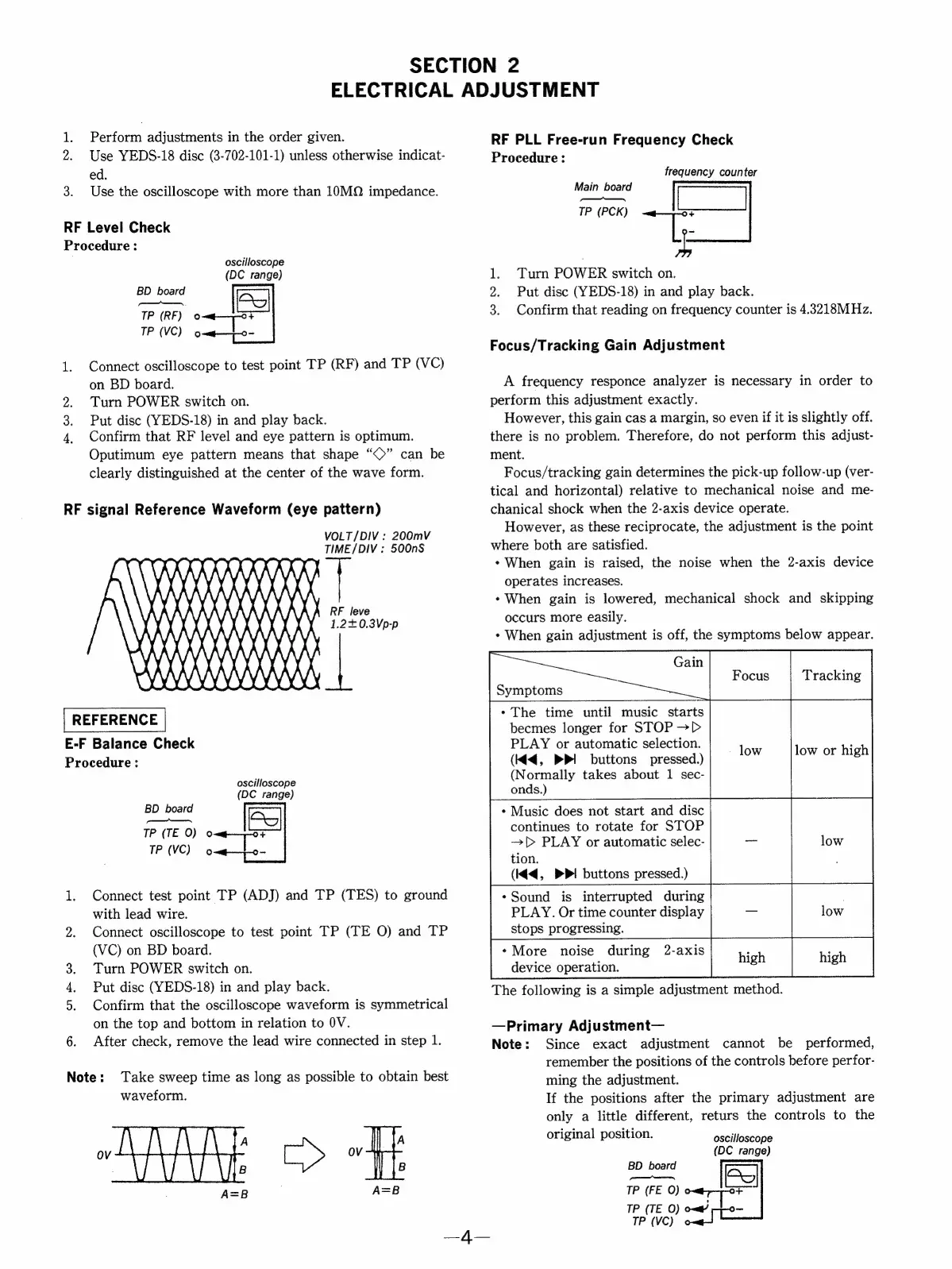
Sony CDP-790 - SECTION 2 ELECTRICAL ADJUSTMENT; RF Level Check; RF PLL Free-run Frequency Check; Focus;Tracking Gain Adjustment

Sony CDP-790
15 pages
Print Icon
To Next Page IconTo Next Page
To Previous Page IconTo Previous Page
Loading...
SECTION
2
ELECTRICAL
ADJUSTMENT
1.
Perform
adjustments
in
the
order
given.
2.
Use
YEDS-18
disc
(3-702-101-1)
unless
otherwise
indicat-
ed.
3.
Use
the
oscilloscope
with
more
than
10MQ
impedance.
RF
Level
Check
Procedure:
oscilloscope
(DC
range)
BD
board
—$—<<<—.
TP
(RF)
o
TP
(VC)
06
1.
Connect
oscilloscope
to
test
point
TP
(RF)
and
TP
(VC)
on
BD
board.
2.
Turn
POWER
switch
on.
Put
disc
(YEDS-18)
in
and
play
back.
4.
Confirm
that
RF
level
and
eye
pattern
is
optimum.
Oputimum
eye
pattern
means
that
shape
“©”
can
be
clearly
distinguished
at
the
center
of
the
wave
form.
ed
VOLT/DIV
:
200mV
TIME/DIV
:
500nS
WAY
RF
signal
Reference
Waveform
(eye
pattern)
+09
wie
\
HN
wn
XXX
We
XN
XH
NYY
XX
WY
iM
AN)
mee
Wi
Procedure
:
A)
RF
leve
1.2+0.3Vp-p
oscilloscope
(DC
range)
BD
board
mcm,
TP
(TE
QO)
o
TP
(VC)
o
1.
Connect
test
point
TP
(ADJ)
and
TP
(TES)
to
ground
with
lead
wire.
2.
Connect
oscilloscope
to
test
point
TP
(TE
O)
and
TP
(VC)
on
BD
board.
3.
Turn
POWER
switch
on.
4,
Put
disc
(YEDS-18)
in
and
play
back.
5.
Confirm
that
the
oscilloscope
waveform
is
symmetrical
on
the
top
and
bottom
in
relation
to
0V.
6.
After
check,
remove
the
lead
wire
connected
in
step
1.
Note:
Take
sweep
time
as
long
as
possible
to
obtain
best
waveform.
RF
PLL
Free-run
Frequency
Check
Procedure:
a
counter
Main
an
ere
TP
TP
(PCK)
a
1.
Turn
POWER
switch
on.
2.
Put
disc
(YEDS-18)
in
and
play
back.
3.
Confirm
that
reading
on
frequency
counter
is
4.3218M
Hz.
Focus/Tracking
Gain
Adjustment
A
frequency
responce
analyzer
is
necessary
in
order
to
perform
this
adjustment
exactly.
However,
this
gain
cas
a
margin,
so
even
if
it
is
slightly
off.
there
is
no
problem.
Therefore,
do
not
perform
this
adjust-
ment.
Focus/tracking
gain
determines
the
pick-up
follow-up
(ver-
tical
and
horizontal)
relative
to
mechanical
noise
and
me-
chanical
shock
when
the
2-axis
device
operate.
However,
as
these
reciprocate,
the
adjustment
is
the
point
where
both
are
satisfied.
*
When
gain
is
raised,
the
noise
when
the
2-axis
device
operates
increases.
*
When
gain
is
lowered,
mechanical
shock
and
skipping
occurs
more
easily.
*
When
gain
adjustment
is
off,
the
symptoms
below
appear.
low
or
high
Symptoms
*
The
time
until
music
starts
becmes
longer
for
STOP
~>
PLAY
or
automatic
selection.
(Kd,
PPI
buttons
pressed.)
(Normally
takes
about
1
sec-
onds.)
*
Music
does
not
start
and
disc
continues
to
rotate
for
STOP
—[>
PLAY
or
automatic
selec-
tion.
(Kd,
PPI
buttons
pressed.)
*Sound
is
interrupted
during
PLAY.
Or
time
counter
display
stops
progressing.
*More
noise
during
2-axis
device
operation.
The
following
is
a
simple
adjustment
method.
—Primary
Adjustment—
Note:
Since
exact
adjustment
cannot
be
performed,
remember
the
positions
of
the
controls
before
perfor-
ming
the
adjustment.
If
the
positions
after
the
primary
adjustment
are
only
a
little
different,
returs
the
controls
to
the
original
position.
oscilloscope
(DC
range)
BD
board
iene
TP
(FE
0)
TP
(TE
O)
oe’
TP
(VC)

Related product manuals