EasyManua.ls Logo

Sony PS-X7 - Page 29

Sony PS-X7
39 pages
Print Icon
To Next Page IconTo Next Page
To Previous Page IconTo Previous Page
Loading...
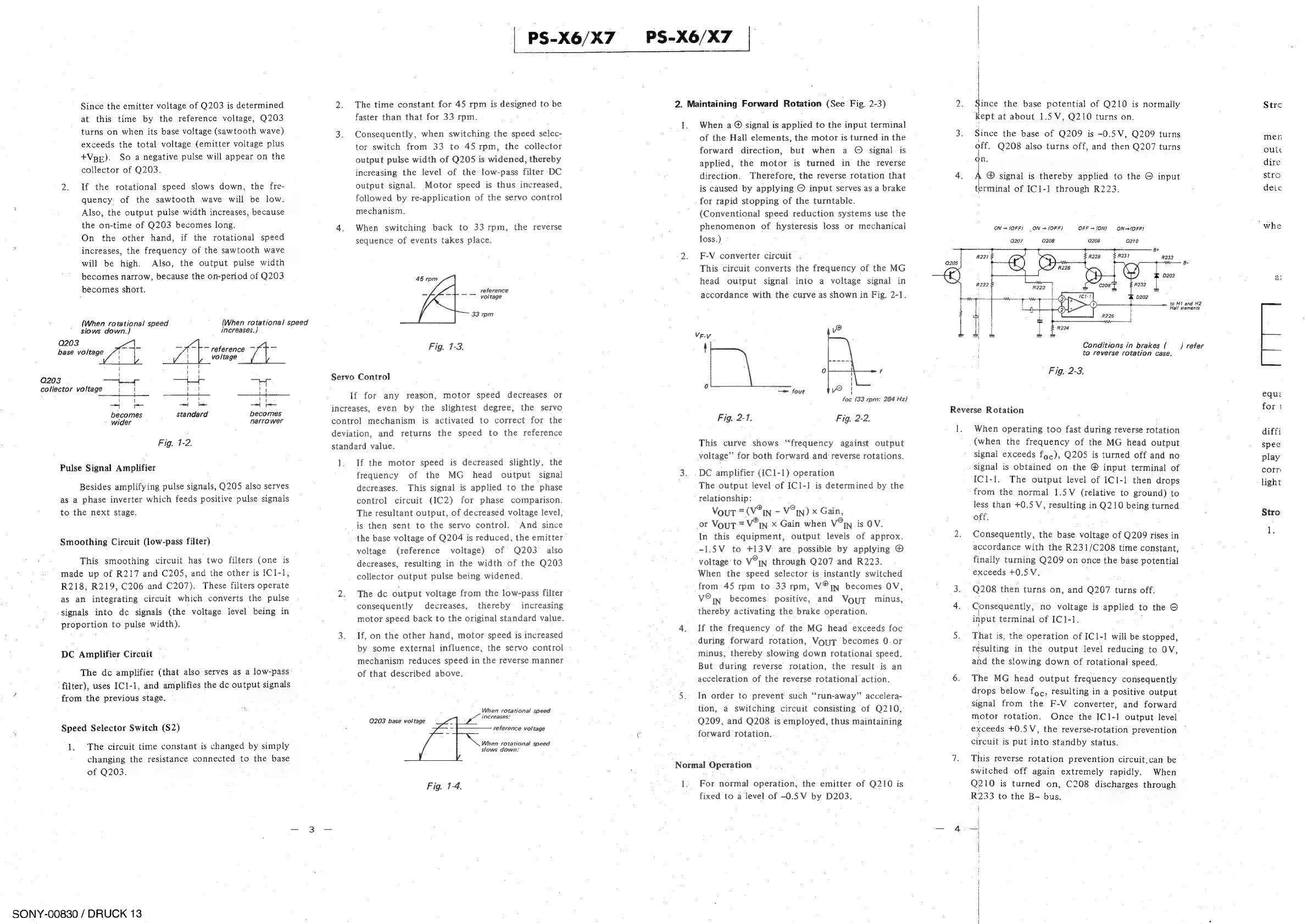
Since
the
emitter
voltage
of
Q203
is
determined
at
this
time
by.
the
reference
voltage,
Q203
turns
on
when
its
base
voltage
(sawtooth
wave)
exceeds
the
total
voltage
(emitter
voltage
plus
+Vpp).
So
a
negative
pulse
will
appear
on
the
collector
of
Q203.
2.
If
the
rotational
speed
slows
down,
the
fre-
quency
of
the
sawtooth
wave
will
be
low.
Also,
the
output
pulse
width
increases,
because
the
on-time
of
Q203
becomes
long.
Qn
the
other
hand,
if
the
rotational
speed
increases,
the
frequency
of
the
sawtooth
wave
will
be
high.
Also,
the
output
pulse
width
becomes
narrow,
because
the
on-period
of
Q203
becomes
short.
{When
rotational
speed
slows
down.)
increases.)
Q203
io).
a.
=
_
base
voltage.
1
reference
(
{
|
voltage
H
at
!
4
I
it
0203
ep
+
collector
voltage
Ie it
rat
ar
!
'
|
becomes
standard
becomes
~
wider
narrower
Fig.
1-2.
Pulse
Signal
Amplifier
Besides
amplifying
pulse
signals,
Q205
also
serves
as
a
phase
inverter
which
feeds
positive
pulse
signals
to
the
next
stage.
Smoothing
Circuit
(low-pass
filter)
This
smoothing
circuit
has
two
filters
(one
is
made
up
of
R217
and
C205,
and
the
other
is
IC1-1,
R218,
R219,
C206
and
C207).
These
filters
operate
as
an
integrating
circuit
which
converts
the
pulse
signals
into
dc
signals
(the
voltage
level
being
in
proportion
to
pulse
width).
DC
Amplifier
Circuit
The
dc
amplifier
(that
also
serves
as
a
low-pass
filter),
uses
IC1-1,
and
amplifies
the
dc
output
signals
from
the
previous
stage.
Speed
Selector
Switch
(S2)
1.
The
circuit
time
constant
is
changed
by
simply
changing
the
resistance
connected
to
the
base
of
Q203.
SONY-00830
/
DRUCK
13
(When
rotational
speed
PS-X6/X7
PS-X6/X7
|
|
2.
The
time
constant
for
45
rpm
is
designed
to
be
faster
than
that
for
33
rpm.
3.
Consequently,
when
switching
the
speed
selec-
tor
switch
from
33
to
45
rpm,
the
collector
output
pulse
width
of
Q205
is
widened,
thereby
increasing
the
level
of
the
low-pass
filter
DC
output
signal.
Motor
speed
is
thus
increased,
followed
by
re-application
of
the
servo
control
mechanism.
4.
When
switching
back
to
33
rpm,
the
reverse
sequence
of
events
takes
place.
45
rpm
reference
7
voltage
33
rpm
Fig.
1-3.
Servo
Control
If
for.
any
reason,
motor
speed
decreases
or
increases,
even
by
the
slightest
degree,
the
servo
control
mechanism
is
activated
to
correct
for the
deviation,
and
returns
the
speed
to
the
reference
standard
value.
1.
If
the
motor
speed
is
decreased
slightly,
the
frequency
of
the
MG
head
output
signal
decreases.
This
signal
is
applied
to
the
phase
control
circuit
(IC2)
for
phase
comparison.
The
resultant
output,
of
decreased
voltage
level,
is
then
sent
to
the
servo
control.
And
since
the
base
voltage
of
Q204
is
reduced,
the
emitter
voltage
(reference
voltage)
of
Q203
also
decreases,
resulting
in
the
width
of
the
Q203
collector
output
pulse
being
widened.
2.
The
de
output
voltage
from
the
low-pass
filter
consequently
decreases,
thereby
increasing
motor
speed
back
to
the
original
standard
value.
3.
If,
on
the
other
hand,
motor
speed
is
increased
by
some
external
influence,
the
servo
control
mechanism
reduces
speed
in
the
reverse
manner
of
that
described
above.
When
rotational
speed
increases:
Q203
base
voltage
reference
voltage
When
rotational
speed
slows
down:
Fig.
1-4.
2.
Maintaining
Forward
Rotation
(See
Fig.
2-3)
1.
When
signal
is
applied
to
the
input
terminal
of
the
Hall
elements,
the
motor
is
turned
in
the
forward
direction,
but
when
a
©
signal.
is
applied,
the
motor
is
turned
in
the
reverse
direction.
Therefore,
the
reverse
rotation
that
is
caused
by
applying
©
input
serves
as
a
brake
for
rapid
stopping
of
the
turntable.
(Conventional
speed
reduction
systems
use
the
phenomenon
of
hysteresis
loss
or
mechanical
loss.)
2.
F-V
converter
circuit
This
circuit
converts
the
frequency
of
the
MG
head
output
signal
into
a
voltage
signal
in
accordance
with
the
curve
as
shown
in
Fig.
2-1.
©
Ve.v
0
f
I
0
I
—=
four
v2
1
foc
(33
rpm:
284
Hz)
Fig.
2-1.
Fig.
2-2.
This
curve
shows.
“frequency
against
output
voltage”’
for
both
forward
and
reverse
rotations.
3.
DC
amplifier
(IC1-1)
operation
The
output
level
of
IC1-]
is
determined
by
the
relationship:
Vout
=
(V9
In
-
V°In)
x
Gain,
or
VouT=
IN
x
Gain
when
V°IN
is
OV.
In
this
equipment,
output
levels
of
approx.
~-1:5V
to
+13V
are
possible
by
applying
©
voltage
to
V°y
through
Q207
and
R223.
When
the
speed
selector
is
instantly
switched
from
45
rpm
to.33
rpm,
V®yy
becomes
OV,
V©in
becomes.
positive,
and
Vout
minus,
thereby
activating
the
brake
operation.
4. If
the
frequency
of
the
MG
head
exceeds
foc
during
forward
rotation,
Voyr
becomes
0.
or
minus,
thereby
slowing
down
rotational
speed.
But
during
reverse
rotation,
the
result
is
an
acceleration
of
the
reverse
rotational
action.
5.
In
order
to
prevent
such
“run-away”’
accelera-
tion,
a
switching
circuit
consisting
of
Q210,
Q209,
and
Q208
is
employed,
thus
maintaining
forward
rotation.
Norma!
Operation
1.
For
normal
operation,
the
emitter
of
Q210
is
fixed
to
a
level
of
-0.5V
by
D203.
ie)
\
\
i
!
i
Since
the
base
potential
of
Q210
is
normally
Kept
at
about
1.5
V,
Q210
turns
on.
Since
the
base
of
Q209
is
-0.5V,
Q209
turns
off.
Q208
also
turns
off,
and
then
Q207
turns
on.
>-
®
signal
is
thereby
applied
to
the
©
input
terminal
of
ICI-1
through
R223.
ON
+{OFF)
=
ON
{OFF}
OFF->
{ON}
ON->{OFF)
Q207
Q208
a209
Q210
Q205
toH
Halt
Conditions
in
brakes
(
to
reverse
rotation
case.
Fig.
2-3.
Reverse
Rotation
I.
i)
When
operating
too
fast
during
reverse
rotation
(when
the
frequency
of
the
MG
head
output
signal
exceeds
fy,),
Q205
is
turned
off
and
no
signal
is
obtained
on
the
®
input
terminal
of
ICi-1.
The
output
level
of
ICI-1
then
drops
from
the
normal
1.5V
(relative
to
ground)
to
less
than
+0.5
V,
resulting
in
Q210
being
turned
off.
Consequently,
the
base
voltage
of
Q209
rises
in
accordance
with
the
R231/C208
time
constant,
finally
turning
Q209
on
once
the
base
potential
exceeds
+0.5V.
Q208
then
turns
on,
and
Q207
turns
off.
Consequently,
no
voltage
is
applied
to
the
©
input
terminal
of
[C]-1.
,
That
is,
the
operation
of
IC1-1
will
be
stopped,
resulting
in
the
output
level
reducing
to
OV,
and
the
slowing
down
of
rotational
speed.
The
MG
head
output
frequency.
consequently
drops
below
fog,
resulting
in
a
positive
output
signal
from
the
F-V
converter,
and
forward
motor
rotation.
Once
the
IC1-1
output
level
exceeds
+0.5V,
the
reverse-rotation
prevention
circuit
is
put
into
standby
status.
This
reverse
rotation
prevention
circuit,can
be
switched
off
again
extremely
rapidly.
When
Q210
is
turned
on,
C208
discharges.
through
R233
to
the
B-
bus.
1
and
H2
elements
)
refer
Stre
men
oute
dire
stro
deie
‘whe
equé
for
1
diffi
spee
play
corr:
light
Stro

Other manuals for Sony PS-X7

Related product manuals