EasyManua.ls Logo

Sony PS-X7 - Page 30

Sony PS-X7
39 pages
Print Icon
To Next Page IconTo Next Page
To Previous Page IconTo Previous Page
Loading...
5=X6/X7
PS-X6/X7
|
o
be
slec-
ctor
‘eby
DC
sed,
itrol
erse
2rvo
the
ance
the
gnal
hase
son.
ovel,
ince
itter
also
203
ilter
sing
ilue.
ased
ttrol
aner
SONY-00830
/
DRUCK
14
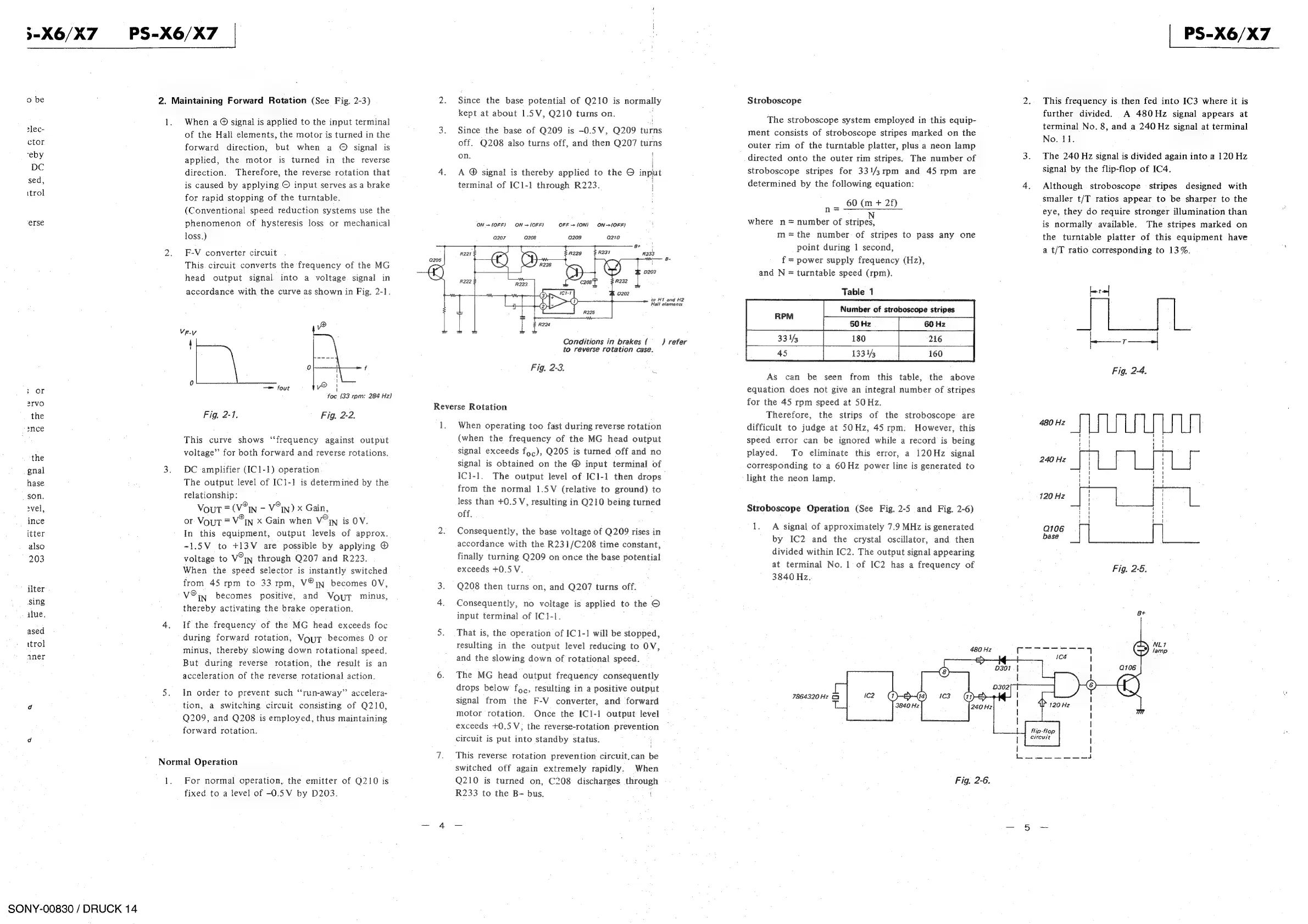
2.
Maintaining
Forward
Rotation
(See
Fig.
2-3)
1.
When
signal
is
applied
to
the
input
terminal
of
the
Hall
elements,
the
motor
is
turned
in
the
forward
direction,
but
when
a
©
signal
is
applied,
the
motor
is
turned
in
the
reverse
direction.
Therefore,
the
reverse
rotation
that
is
caused
by
applying
©
input
serves
as
a
brake
for
rapid
stopping
of
the
turntable.
(Conventional
speed
reduction
systems
use
the
phenomenon
of
hysteresis
loss
or
mechanical
loss.)
2.
F-V
converter
circuit
This.
circuit
converts
the
frequency
of
the
MG
head
output
signal
into
a
voltage
signal
in
accordance
with
the
curve
as
shown
in
Fig.
2-1.
1
1
|
4
0
——
fout
vO
i
foc (33
rpm:
284
Hz}
Fig.
2-1.
Fig.
2-2.
This
curve
shows
‘frequency
against
output
voltage’’
for
both
forward
and
reverse
rotations.
3.
DC
amplifier
(IC1-1)
operation
The
output
level
of
IC1-1
is
determined
by
the
relationship:
Vout
=(V°In
~
V°In)
x
Gain,
or
VouT
=
IN
x
Gain
when
Von
is
OV.
In
this
equipment,
output
levels
of
approx.
-1.5V
to
+13V
are
possible
by
applying
®
voltage
to
V°yn
through
Q207
and
R223.
When
the
speed
selector
is
instantly
switched
from
45
rpm
to
33
rpm,
V®qjn
becomes
OV,
Von
becomes
positive,
and
Vout
minus,
thereby
activating
the
brake
operation.
4.
If
the
frequency
of
the
MG
head
exceeds
foc
during
forward
rotation,
Vout
becomes
0
or
minus,
thereby slowing
down
rotational
speed.
But
during
reverse
rotation,
the
result
is
an
acceleration
of
the
reverse
rotational
action.
5.
In
order
to
prevent
such
“run-away”
accelera-
tion,
a
switching.
circuit
consisting
of
Q210,
Q209,
and
Q208
is
employed,
thus
maintaining
forward
rotation.
Normal
Operation
1.
For
normal
operation,
the
emitter
of
Q210
is
fixed
to
a
level
of
-O.5V
by
D203.
Q205
Since
the
base
potential
of
Q210
is
normally
kept
at
about
1.5V,
Q210
turns
on.
Since
the
base
of
Q209
is
-0.5V,
Q209
turns
off.
Q208
also
turns
off,
and
then
Q207
turns
on.
|
|
A
®
signal
is
thereby
applied
to
the
©
input
terminal
of
IC1-1
through
R223.
ON
+
(OFF)
ON
(OFF)
OFF
+
(ON)
ON-OFF)
Q207
Q208
Q209
Q210
tow
Conditions
in
brakes
(
to
reverse
rotation
case.
Fig.
2-3.
Reverse
Rotation
1.
When
operating
too
fast
during
reverse
rotation
(when
the
frequency
of
the
MG
head
output
signal
exceeds
fg,),
Q205
is
turned
off
and
no
signal
is
obtained
on
the
@
input
terminal
of
ICi-1.
The
output
level
of
IC1-1
then
drops
from
the
normal
1.5V
(relative
to
ground)
to
less
than
+0.5
V,
resulting
in
Q210
being
turned
off.
Consequently,
the
base
voltage
of
Q209
rises
in
accordance
with
the
R231/C208
time
constant,
finally
turning
Q209
on
once
the
base
potential
exceeds
+0.5V.
Q208
then
turns
on,
and
Q207
turns
off.
Consequently,
no
voltage
is
applied
to
the
}
input
terminal
of
IC1-1.
;
That
is,
the
operation
of
IC1-1
will
be
stopped,
resulting
in
the
output
level
reducing
to
OV,
and
the
slowing
down
of
rotational
speed.
The
MG
head
output
frequency
consequently
drops
below
fog,
resulting
in
a
positive
output
signal
from
the
F-V
converter,
and
forward
motor
rotation.
Once
the
ICl-1
output
level
exceeds
+0.5V,
the
reverse-rotation
prevention
circuit
is
put
into
standby
status.
This
reverse
rotation
prevention
circuit,can
be
switched
off
again
extremely
rapidly.
When
Q210
is
turned
on,
C208
discharges
through
R233
to
the
B-
bus.
i
1
and
H2
Hall
elements
)
refer
Stroboscope
The
stroboscope
system
employed
in
this
equip-
ment
consists
of
stroboscope
stripes
marked
on
the
outer
rim
of
the
turntable
platter,
plus
a
neon
lamp
directed
onto
the
outer
rim
stripes:
The
number
of
stroboscope
stripes
for
331/;rpm
and
45
rpm
are
determined
by
the
following
equation:
.
60
(m
+
2f)
where
n=
number
of
stapes
m-=the
number
of
stripes
to
pass
any
one
point
during
1
second,
f
=
power
supply
frequency
(Hz),
and
N
=
turntable
speed
(rpm).
Table
1
Number
of
stroboscope
stripes
50
Hz
60
Hz
As
can
be
seen
from
this
table,
the
above
equation
does
not
give
an
integral
number
of
stripes
for the
45
rpm
speed
at
50
Hz.
Therefore,
the
strips
of
the
stroboscope
are
difficult
to
judge
at
50Hz,
45
rpm:
However,
this
speed
error
can
be
ignored
while
a
record
is
being
played.
To
eliminate
this
error,
a
120Hz
signal
corresponding
to
a
60
Hz
power
line
is
generated
to
light
the
neon
lamp.
Stroboscope
Operation
(See
Fig.
2-5
and
Fig.
2-6)
1.
A
signal
of
approximately
7.9
MHz
is
generated
by
IC2
and
the
crystal
oscillator,
and
then
divided
within
IC2.
The
output
signal
appearing
at
terminal
No.
1
of
IC2
has
a
frequency
of
3840
Hz.
7864320
Hz
(2
Fig.
2-6.
|
PS-X6/X7
This
frequency
is
then
fed
into
IC3
where
it
is
further
divided.
A
480Hz
signal
appears
at
terminal
No.
8,
and
a
240
Hz
signal
at
terminal
No.
11.
The
240
Hz
signal
is
divided
again
into
a
120
Hz
signal
by
the
flip-flop
of
IC4.
Although
.
stroboscope
stripes
designed
with
smaller
t/T
ratios
appear
to
be
sharper
to
the
eye,
they
do
require
stronger
illumination
than
is
normally
available.
The
stripes
marked
on
the
turntable
platter
of
this
equipment
have
a
t/T
ratio
corresponding
to
13%.
Lee

Other manuals for Sony PS-X7

Related product manuals