EasyManua.ls Logo

Sony PS-X7 - Page 37

Sony PS-X7
39 pages
Print Icon
To Next Page IconTo Next Page
To Previous Page IconTo Previous Page
Loading...
4.
Hall
Motor
The
PS-X6/X7
is
equipped
with
the
newly
developed
BSL
(brush
and
slotless)
dc
servo
motor,
which
has
the
following
major
advantages.—
1.
Extremely
uniform
torque.
2.
All-electronic
switching
(no
mechanical
con-
tacts
used
at
all),
resulting
in
very
little
noise.
3.
Extremely
stable
performance,
and
long
opera-
tional
life.
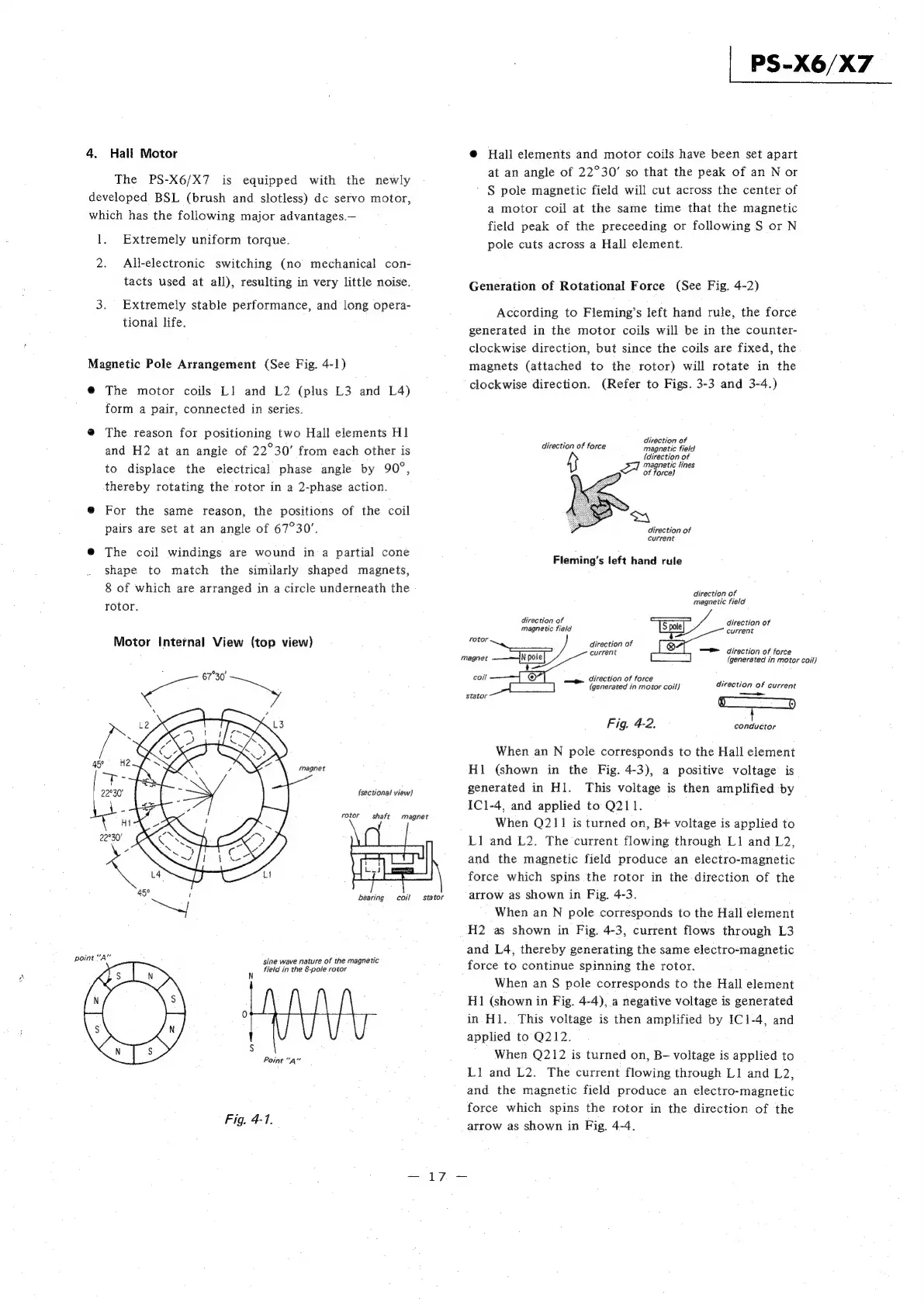
Magnetic
Pole
Arrangement
(See
Fig.
4-1)
@
The
motor
coils
LI]
and
L2
(plus
L3
and
L4)
form
a
pair,
connected
in
series.
®
The
reason
for
positioning
two
Hall
elements
H1
and
H2
at
an
angle
of
22°30’
from
each
other
is
to
displace
the
electrical
phase
angle
by
90°,
thereby
rotating
the
rotor
in
a
2-phase
action.
@
For
the
same
reason,
the
positions
of
the
coil
pairs
are
set
at
an
angle
of
67°30’.
@
The
coil
windings
are
wound
in
a
partial
cone
shape
to
match
the
similarly
shaped
magnets,
8
of
which
are
arranged
in
a
circle
underneath
the
rotor.
Motor
Internal
View
(top
view)
magnet
{sectional
view)
rotor
magnet
shaft
/
bearing
coil
stator
sine
wave
nature
of
the
magnetic
field
in
the
8-pole
rotor
Ss
Point
“Aa”
Fig.
4-7.
|
PS-X6/X7
@
Hall
elements
and
motor
coils
have
been
set
apart
at
an
angle
of
22°30’
so
that
the
peak
of
an
N
or
§
pole
magnetic
field
will
cut
across
the
center
of
a
motor
coil
at
the
same
time
that
the
magnetic
field
peak
of
the
preceeding
or
following
S
or
N
pole
cuts
across
a
Hall
element.
Generation
of
Rotational
Force
(See
Fig.
4-2)
According
to
Fleming’s
left
hand
rule,
the
force
generated
in
the
motor
coils
will
be
in
the
counter-
clockwise
direction,
but
since
the
coils
are
fixed,
the
magnets
(attached
to
the
rotor)
will
rotate
in
the
clockwise
direction.
(Refer
to
Figs.
3-3
and
3-4.)
direction
of
magnetic
field
(direction
of
x]
magnetic
lines
a
of
force)
direction
of
force
direction
of
current
Fleming’s
left
hand
rule
direction
of
magnetic
field
direction
of
direction
of
magnetic
field
pole
current
rotor
:
direction
of
———>
current
[
e7
—P
direction
of
force
magnet
IN
pote]
ae
|
(generated
in
motor
coil)
coil
direction
of
force
(generated
in
motor
coil}
direction
of
current
Stator
=
Fi
g.
4-2,
conductor
When
an
N
pole
corresponds
to
the
Hall
element
H1
(shown
in
the
Fig.
4-3),
a
positive
voltage
is
generated
in
H1.
This
voltage
is
then
amplified
by
IC1-4,
and
applied
to
Q211.
When
Q211
is
turned
on,
B+
voltage
is
applied
to
L1
and
L2.
The
current
flowing
through
L1
and
L2,
and
the
magnetic
field
produce
an
electro-magnetic
force
which
spins
the
rotor
in
the
direction
of
the
arrow
as
shown
in
Fig.
4-3.
When
an
N
pole
corresponds
to
the
Hall
element
H2
as
shown
in
Fig.
4-3,
current
flows
through
L3
and
L4,
thereby
generating
the
same
electro-magnetic
force
to
continue
spinning
the
rotor.
When
an
S
pole
corresponds
to
the
Hall
element
H1
(shown
in
Fig.
4-4),
a
negative
voltage
is
generated
in
Hl.
This
voltage
is
then
amplified
by
IC1-4,
and
applied
to
Q212.
When
Q212
is
turned
on,
B-
voltage
is
applied
to
Ll
and
L2.
The
current
flowing
through
L1
and
L2,
and
the
magnetic
field
produce
an
electro-magnetic
force
which
spins
the
rotor
in
the
direction.
of
‘the
arrow
as
shown
in
Fig.
4-4.

Other manuals for Sony PS-X7

Related product manuals