EasyManua.ls Logo

Sony PS-X7 - Page 38

Sony PS-X7
39 pages
Print Icon
To Next Page IconTo Next Page
To Previous Page IconTo Previous Page
Loading...
PS-X6/X7
|
Fig.
4-3.
ICi-3
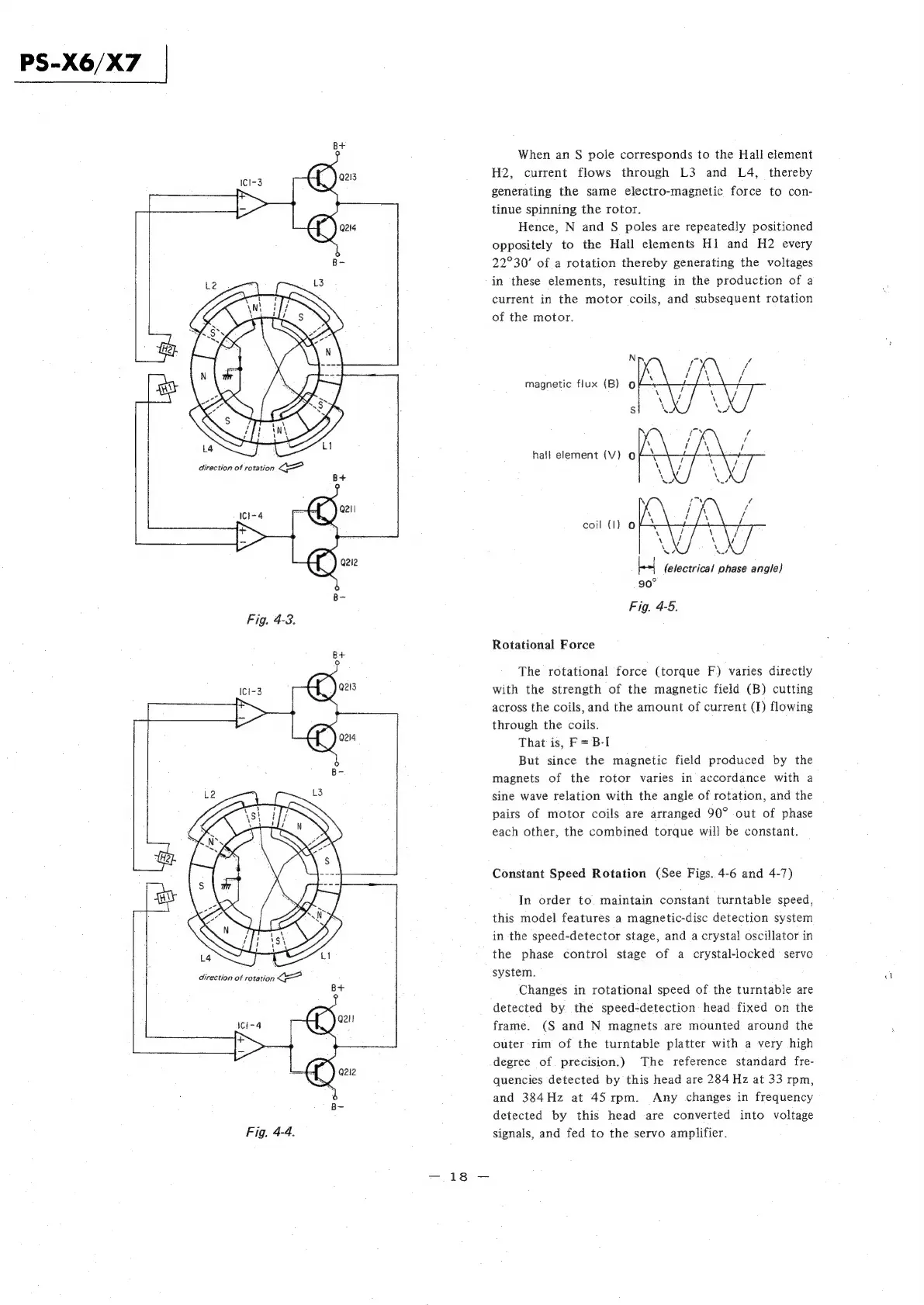
When
an
S
pole
corresponds
to
the
Hall
element
H2,
current
flows
through
L3
and
L4,
thereby
generating
the
same
electro-magnetic
force
to
con-
tinue
spinning
the
rotor.
Hence,
N
and
§S
poles
are
repeatedly
positioned
oppositely
to
the
Hall
elements
H!
and
H2
every
22°30’
of
a
rotation
thereby
generating
the
voltages
in
these
elements,
resulting
in
the
production
of
a
current
in
the
motor
coils,
and
subsequent
rotation
of
the
motor.
magnetic
flux
(B)
0
Ss
hall
element
(V)
o
coil
(1)
0
Joa
(electrical
phase
angle)
90°
Fig.
4-5.
Rotational
Force
The
rotational
force
(torque
F)
varies
directly
with
the
strength
of
the
magnetic
field
(B)
cutting
across
the
coils,
and
the
amount
of
current
(J)
flowing
through
the
coils.
That
is,
F=B-1
But
since
the
magnetic
field
produced
by
the
magnets
of
the
rotor
varies
in
accordance
with
a
sine
wave
relation
with
the
angle
of
rotation,
and
the
pairs
of
motor
coils
are
arranged
90°
out
of
phase
each
other,
the
combined
torque
will
be
constant.
Constant
Speed
Rotation
(See
Figs.
4-6
and
4-7)
In
order
to.
maintain
constant
turntable
speed,
this
model
features
a
magnetic-disc
detection
system
in
the
speed-detector
stage,
and
a
crystal
oscillator
in
the
phase
control
stage
of
a
crystal-locked
servo
system.
Changes
in
rotational
speed
of
the
turntable
are
detected
by
the
speed-detection
head
fixed
on
the
frame.
(S
and
N
magnets
are
mounted
around
the
outer
rim
of
the
turntable
platter
with
a
very
high
degree
of
precision.)
The
reference
standard
fre-
quencies
detected
by
this
head
are
284
Hz
at
33
rpm,
and
384Hz
at
45
rpm.
Any
changes
in
frequency
detected
by
this
head
are
converted
into
voltage
signals,
and
fed
to
the
servo
amplifier.

Other manuals for Sony PS-X7

Related product manuals