EasyManua.ls Logo

Sony PS-X7 - Page 5

Sony PS-X7
39 pages
Print Icon
To Next Page IconTo Next Page
To Previous Page IconTo Previous Page
Loading...
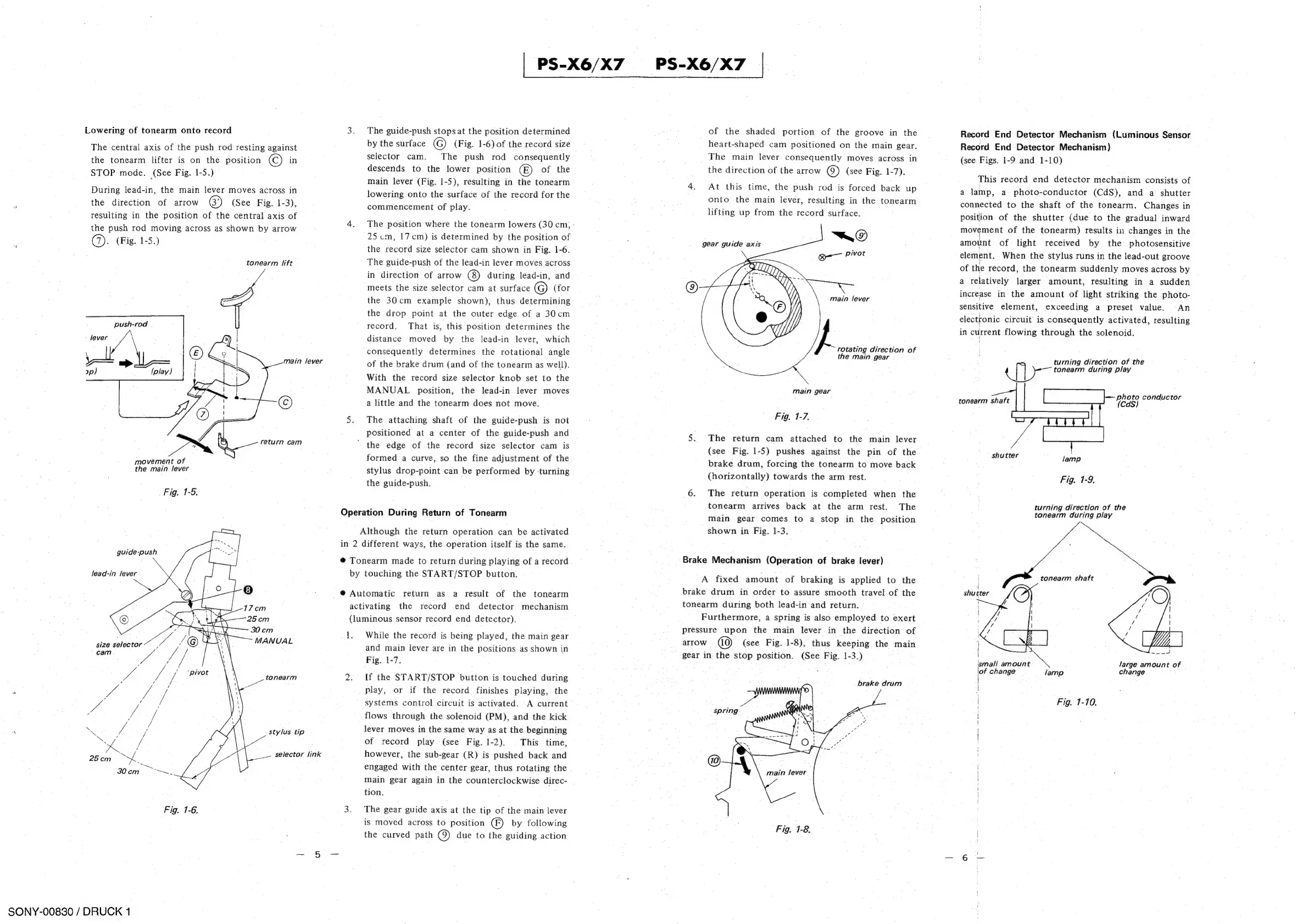
Lowering
of
tonearm
onto
record
The
central
axis
of
the
push
rod
resting
against
the
tonearm
lifter
is
on
the
position
©
in
STOP
mode.
(See
Fig.
1-5.)
During
lead-in,
the
main
lever
moves
across
in
the
direction
of
arrow
6)
(See
Fig.
1-3),
resulting
in
the
position
of
the
central
axis
of
the
push
rod
moving
across
as
shown
by
arrow
:
@).
(Fig.
1-5.)
tonearm
lift
push-rod
'
fever
main
lever
ap)
G3
2
Pa
X
return
cam
movement
of
the
main
lever
Fig.
1-5.
guide-push
lead-in
lever
18)
17cm
©
~~
25m
eo
oe
(SS
30cm
size
selector
o
7
©
MANUAL
=
stylus
tip
_-
selector
link
SONY-00830
/
DRUCK
1
|
PS-X6/X7
PS-X6/X7
|
3.
The
guide-push
stopsat
the
position
determined
by
the
surface
©
(Fig.
1-6)
of
the
record
size
selector
cam.
The
push
rod
consequently
descends
to
the
lower
position
©)
of
the
main
lever
(Fig.
1-5),
resulting
in
the
tonearm
lowering
onto
the
surface
of
the
record
for
the
commencement
of
play.
4.
The
position
where
the
tonearm
lowers
(30
cm,
-
25cm,
17cm)
is
determined
by
the
position
of
the
record
size
selector
cam
shown
in
Fig.
1-6.
The
guide-push
of
the
lead-in
lever
moves
across
in
direction
of
arrow
during
lead-in,
and
meets
the
size
selector
cam
at
surface
©
(for
the
30cm
example
shown),
thus
determining
the
drop
point
at
the
outer
edge.
of
a
30cm
record.
That
is,
this
position
determines
the
distance
moved
by
the
lead-in
lever,
which
consequently
determines
the
rotational
angle
of
the
brake
drum
(and
of
the
tonearm
as
well).
With
the
record
size
selector
knob
set
to
the
MANUAL
position,
the
lead-in
lever
moves
a
little
and
the
tonearm
does
not
move.
5.
The
attaching
shaft
of
the
guide-push
is
not
positioned
at
a
center
of
the
guide-push
and
the
edge
of
the
record
size
selector
cam
is
formed
a
curve,
so
the
fine
adjustment
of
the
stylus
drop-point
can
be
performed
by
turning
the
guide-push.
Operation
During
Return
of
Tonearm
Although
the
return
operation
can
be
activated
in
2
different
ways,
the
operation
itself
is
the
same.
@
Tonearm
made
to
return
during
playing
of
a
record
by
touching
the
START/STOP
button.
Automatic
return
as
a
result
of
the
tonearm
activating
the
record
end
detector
mechanism
(luminous
sensor
record
end
detector).
1.
While
the
record
is
being
played,
the
main
gear
and
main
lever
are
in
the
positions
as
shown
in
Fig.
1-7.
2: If
the
START/STOP
button
is
touched
during
play,
or
if
the
record
finishes
playing,
the
systems
control
circuit
is
activated.
A
current
flows
through
the
solenoid
(PM),
and
the
kick
lever
moves
in
the
same
way
as
at
the
beginning
of
record
play
(see
Fig.
1-2).
|
This
time,
however,
the
sub-gear
(R)
is
pushed
back
and
engaged
with
the
center
gear,
thus
rotating
the
main
gear
again
in
the
counterclockwise
direc-
tion.
3.
The
gear
guide
axis
at
the
tip
of
the
main
lever
is
moved
across
to
position
)
by
following
the
curved
path
Q)
due
to
the
guiding
action
of
the
shaded
portion
of
the
groove
in
the
heart-shaped
cam
positioned
on
the
main
gear.
The
main
lever.
consequently
moves
across
in
the
direction
of
the
arrow
@)
(see
Fig.
1-7).
4.
At
this
time,
the
push
rod
is
forced
back
up
onto
the
main
lever,
resulting
in
the
tonearm
lifting
up
from
the
record
surface.
gear
guide
axis
main
lever
rotating
direction
of
the
main
gear
main
gear
Fig.
1-7.
5.
The
return
cam
attached
to
the
main
lever
(see
Fig.
1-5)
pushes
against
the
pin
of
the
brake
drum,
forcing
the
tonearm
to
move
back
(horizontally)
towards
the
arm
rest.
6.
The
return
operation
is
completed
when
the
tonearm
arrives
back
at
the
arm
rest.
The
main
gear.
comes
to
a
stop
in
the
position
shown
in
Fig.
1-3.
Brake
Mechanism
(Operation
of
brake
lever)
A
fixed
amount
of
braking
is
applied
to
the
brake
drum
in
order
to
assure
smooth
travel
of
the
tonearm
during
both
lead-in
and
return.
Furthermore,
a
spring
is
also
employed
to
exert
pressure
upon
the
main
lever
in
the
direction
of
arrow
(see
Fig.
1-8),
thus
keeping
the
main
gear
in
the
stop
position.
(See
Fig.
1-3.)
brake
drum
main
lever
Fig.
1-8.
Record
End
Detector
Mechanism
(Luminous
Sensor
Record
End
Detector
Mechanism)
(see
Figs.
1-9
and
1-10)
This
record
end
detector
mechanism
consists
of
a
lamp,
a
photo-conductor
(CdS),
and
a
shutter
connected
to
the
shaft
of
the
tonearm.
Changes
in
position
of
the
shutter
(due
to
the
gradual
inward
movement
of
the
tonearm)
results
in
changes
in
the
amount
of
light
received
by
the
photosensitive
element.
When
the
stylus
runs
in
the
lead-out
groove
of
the
record,
the
tonearm
suddenly
moves
across
by
a
relatively
larger
amount,
resulting
in
a
sudden
increase
in
the
amount
of
light
striking
the
photo-
sensitive
element,
exceeding
a
preset
value.
An
electronic
circuit
is
consequently
activated,
resulting
in
current
flowing
through
the
solenoid.
n
turning
direction
of
the
Ci
tonearm
during
play
tonearm
“mal
regs)
conductor
shutter
lamp
Fig.
1-9.
turning
direction
of
the
tonearm
during
play
i
tonearm
a
i
shutter
CF}
{
i
i
i
1
|
|
ann
small
amount
farge
amount
of
lof
change
lamp
change
Fig.
1-10.
{
\
i
'
|
Hy

Other manuals for Sony PS-X7

Related product manuals