Need help?
Do you have a question about the Sony RMT-V402A and is the answer not in the manual?
Covers format, video system, tape speed, and tuner details.
Details timer functions, power requirements, and operating conditions.
Lists items included with the product.
Identifies component locations on the top and bottom views of the deck.
Details the removal procedures for various components of the main deck.
Identifies locations for tape transport system adjustments.
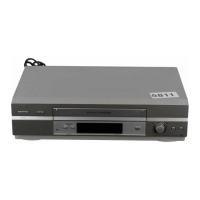
This document serves as a comprehensive service manual for the Sony SLV-N55, SLV-N77, SLV-N88, and SLV-N99 Video Cassette Recorders (VCRs), designed for both US and Canadian models. These VCRs are equipped with either the TS-10 Mechanism (for SLV-N55, SLV-N77, SLV-N88) or the SL Mechanism (for SLV-N99), and are compatible with remote commanders RMT-V307, RMT-V402, RMT-V402A, and RMT-V402B. The devices are designed to meet ENERGY STAR® guidelines for energy efficiency, reflecting a commitment to environmental responsibility.
The Sony SLV-N series VCRs are designed for recording and playback of VHS NTSC standard video. They utilize a rotary head helical scanning FM system with double azimuth four heads to ensure high-quality video and audio performance. The VCRs support multiple tape speeds: SP (Standard Play) at 33.35 mm/s, EP (Extended Play) at 11.12 mm/s, and LP (Long Play) at 16.67 mm/s (playback only). This flexibility allows users to optimize recording time versus quality, with a maximum recording/playback time of 8 hours in EP mode using a T-160 tape. Fast rewind is also supported, with a T-120 tape rewinding in approximately 1 minute.
Integrated into the VCRs is a tuner section that covers a wide range of channels, including VHF (2 to 13), UHF (14 to 69), and CATV (A-8 to A-1, A to W, W+1 to W+84). This allows users to receive and record broadcast television signals directly through a 75-ohm antenna terminal for VHF/UHF.
For connectivity, the VCRs offer multiple input and output options. Video and audio inputs (LINE IN 1 and LINE-2 IN) are provided via phono jacks, accepting a video input signal of 1 Vp-p, 75 ohms, unbalanced, sync negative, and an audio input level of 327 mVrms with an impedance of more than 47 kilohms. Outputs (LINE OUT) include a video phono jack delivering 1 Vp-p, 75 ohms, unbalanced, sync negative, and two audio phono jacks with a standard output of 327 mVrms, a load impedance of 47 kilohms, and an output impedance of less than 10 kilohms.
A key feature is the timer section, which includes a quartz-locked clock and a 12-hour cycle timer indication. Users can program up to 8 events, enabling scheduled recordings of television programs.
The VCRs are operated via a remote commander, with models RMT-V307, RMT-V402, RMT-V402A, and RMT-V402B being compatible. These remote controls facilitate easy navigation and control of recording, playback, and timer functions. The user interface is designed for straightforward operation, allowing for quick setup of recordings and convenient playback of video cassettes.
The mechanical design of the VCRs, particularly the TS-10 and SL mechanisms, ensures reliable tape handling. The disassembly and reassembly instructions provided in the service manual detail the process for accessing and maintaining various components, such as the FL door, cassette holder, loading motor, and reel disks. This modular approach simplifies repair and replacement tasks, contributing to the longevity of the device.
The tape transport system is factory-adjusted for precision. However, in cases of noise on the screen, tape damage, or parts replacement, specific alignment and adjustment procedures are outlined. These include adjustments for the ACE head assembly (height, tilt, audio azimuth, and X-point position), linearity adjustment for guide rollers S and T, and checks for transitional operation from RPS (Rapid Program Search) to Play mode, envelope check, and tape wrinkle check. These adjustments are critical for maintaining optimal video and audio quality.
The service manual provides a detailed table for clearing, lubrication, and replacement times for principal parts, ensuring comprehensive maintenance. This table categorizes parts by system (Tape Path System, Driving System, Brake System) and specifies recommended actions (cleaning, checking/replacement, adding oil) at various operational hour intervals (500, 1000, 1500, 2000, 2500, 3000, 3500, 4000, 4500, 5000 hours).
For tape path components like post tension, slant posts S/T, guide shafts, capstan shaft, and guide rollers, cleaning with patch and alcohol (solvent) is recommended. For components like FE head, ACE head, and pinch roller, one or two drops of oil should be applied after cleaning with alcohol. Periodic oil application is also recommended for post reel S/T, sleeve tension, and post center to prevent malfunction due to excessive oil.
The manual also lists specific tools and fixtures required for service, such as torque measurement cassettes (VHT-103S, VHT-404S), alignment tapes (KRV-52NE, KRV-51N2, KRV-52PL, KRV-51P), cleaning fluid, chamois leather, dental mirrors, Grease Molykote EM 30LG, and Diamond Oil NT-68. These specialized tools ensure that maintenance and adjustments are performed accurately and effectively.
The importance of careful handling during disassembly and reassembly is emphasized throughout the manual. For instance, when reinstalling the Holder Clutch Ass'y, it is crucial to check the spring condition and ensure smooth insertion without excessive force. Similarly, when replacing the Lever Tension Ass'y, applying grease on the post and avoiding contact with the felt side of the Band Brake Ass'y are critical. These detailed instructions help prevent damage and ensure proper functioning after service.
The manual also addresses troubleshooting scenarios, such as how to eject a cassette tape if the unit does not operate normally. This involves turning the gear worm clockwise with a screwdriver and carefully winding unwound tape to prevent contamination or damage.
Overall, the Sony SLV-N series VCRs are robust devices designed for reliable video recording and playback, with comprehensive service and maintenance guidelines to ensure their long-term performance.


 To Next Page
 General