EasyManua.ls Logo

Sony STR-6055 - ANTENNA INSTALLATION AND ORIENTATION; ANTENNA TYPES AND SENSITIVITY; FM ANTENNA LEAD CONNECTION

Sony STR-6055
15 pages
Print Icon
To Next Page IconTo Next Page
To Previous Page IconTo Previous Page
Loading...
www.SteamPoweredRadio.Com
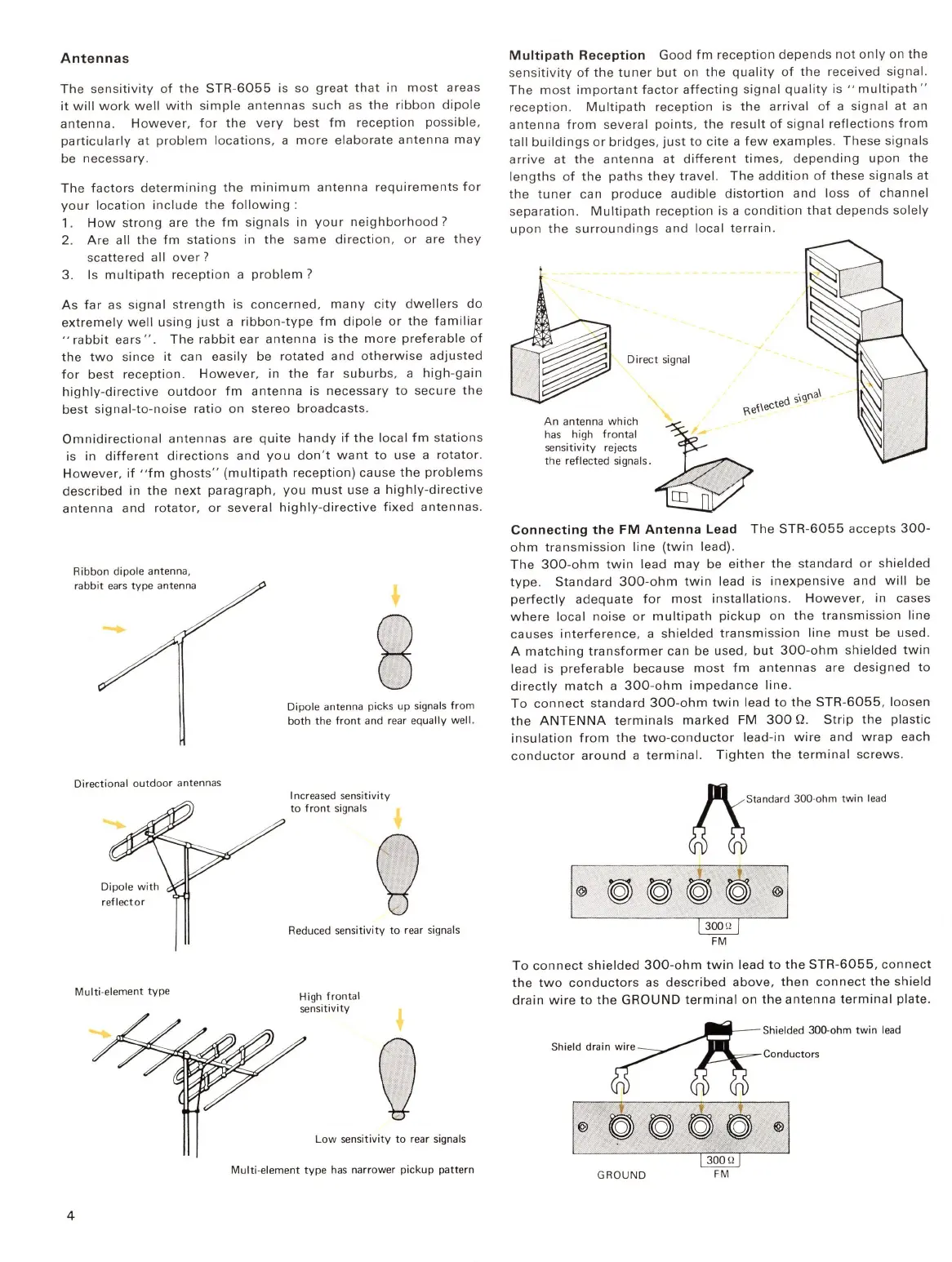
Antennas
The
sensitivity
of
the
STR-6055
is so
great
that
in
most
areas
it
will
work
well
with
simple
antennas
such
as
the
ribbon
dipole
antenna.
However,
for
the
very
best
fm
reception
pos
s
ible,
particularly
at
problem
locations
, a
more
elaborate
antenna
may
be
necessary
.
The
factors
determining
the
minimum
antenna
requirements
for
your
location
include
the
following
:
1.
How
strong
are
the
fm
signals
in
your
neighborhood?
2.
Are
all
the
fm
stations
in
the
same
direction
,
or
are
they
scattered
all
over?
3. Is
multipath
reception
a
problem?
As
far
as
signal
strength
is
concerned,
many
city
dwellers
do
extremely
well
using
just
a
ribbon-type
fm
dipole
or
the
familiar
"
rabbit
ears
".
The
rabbit
ear
antenna
is
the
more
preferable
of
the
two
since
it
can
easily
be
rotated
and
otherwise
adjusted
for
best
reception
.
However
, in
the
far
suburbs,
a
high
-
gain
highly-directive
outdoor
fm
antenna
is
necessary
to
secure
the
best
signal
-
to-noise
ratio
on
stereo
broadcasts.
Omnidirectional
antennas
are
quite
handy
if
the
local
fm
stations
is in
different
directions
and
you
don't
want
to
use a
rotator.
However,
if
"fm
ghosts"
(multipath
reception)
cause
the
problems
described
in
the
next
paragraph,
you
must
use a
highly-directive
antenna
and
rotator,
or
several
highly-directive
fixed
antennas
.
4
Ribbon dipole antenna,
rabbit
ears
type antenna
Directional
outdoor
antennas
Multi-element type
8
Dipole antenna picks
up
signa
ls
from
both
the
front
and rear equally well.
Increased sensitivity
to
front
signals
Reduced sensitivity
to
rear signals
High
frontal
sensitivity
Low
sensitivity
to
rear signals
Multi-element type
has
narrower
pickup
pa
ttern
Multipath
Reception
Good
fm
reception
depends
not
only
on
the
sen si
tivity
of
the
tuner
but
on
the
quality
of
the
received
signal.
The
mo
st
important
factor
affecting
signal
quality
is
"multipath
"
reception
.
Multipath
reception
is
the
arrival
of
a
signal
at
an
antenna
from
several
points,
the
result
of
signal
reflections
from
tall
buildings
or
bridges
,
just
to
cite
a
few
examples
.
These
signals
arrive
at
the
antenna
at
different
times,
depending
upon
the
lengths
of
the
paths
they
travel.
The
addition
of
these
signals
at
the
tuner
can
produce
audible
distortion
and
loss
of
channel
separation
.
Multipath
reception
is a
condition
that
depends
solely
upon
the
surroundings
and
local
terrain
.
Direct
signal
?,e\\ecte
ci
s\gnal
An
antenna
which
~
has
high
frontal
sensitivity rejects
the reflected signals. -_.
•··
''%
OJ
.
Connecting
the
FM
Antenna
Lead
The
STR-6055
accepts
300-
ohm
transmission
line
(twin
lead).
The
300-ohm
twin
lead
may
be
either
the
standard
or
shielded
type.
Standard
300-ohm
twin
lead is
inexpensive
and
will
be
perfectly
adequate
for
most
installations.
However
, in cases
where
local
noise
or
multipath
pickup
on
the
transmission
line
causes
interference,
a
shielded
transmission
line
must
be used.
A
matching
transformer
can
be
used
,
but
300-ohm
shielded
twin
lead is
preferable
because
most
fm
antennas
are
designed
to
directly
match
a
300
-
ohm
impedance
line
.
To
connect
standard
300-ohm
twin
lead
to
the
STR-
6055,
loosen
the
ANTENNA
terminals
marked
FM
300
Q.
Strip
the
plastic
insulation
from
the
two-conductor
lead-in
wire
and
wrap
each
conductor
around
a
terminal.
Tighten
the
terminal
screws
.
To
connect
shielded
300
-ohm
twin
lead
to
the
STR-6055
,
connect
the
two
conductors
as
described
above
,
then
connect
the
shield
drain
wire
to
the
GROUND
terminal
on
the
antenna
terminal
plate.
GROUND
FM

Related product manuals