EasyManua.ls Logo

Sony STR-6055 - SPEAKER AND INPUT CONNECTIVITY; SPEAKER PLACEMENT AND WIRING; RECORD PLAYER HOOKUP

Sony STR-6055
15 pages
Print Icon
To Next Page IconTo Next Page
To Previous Page IconTo Previous Page
Loading...
www.SteamPoweredRadio.Com
Antenna
Orientation
First,
tune
in
the
desired
station
by
adjusting
the
TUNING
kn
ob
for
a
center-channel
meter
indication;
then,
adjust
the
antenna
direction
and
height
for
clearest
sound.
o
If
distortion
is
audible,
adjust
the
direction
and
/
or
height
of
the
antenna
until
the
distortion
is
eliminated
.
Often
a
slight
turn
will
be
sufficient.
o
In
some
cases
multipath
reception
on
two
or
more
stations
may
require
the
antenna
to
be
p.Jinted in
several
different
directions.
An
effective
and
relatively
inexpensive
solution
to
this
problem
is
the
use
of
a
remote-controlled
antenna
rotator.
o
Keep
the
antenna
lead-in
wire
as
short
as
possible
and
avoid
long
horizontal
runs
to
minimize
signal
pickup
on
the
line
.
The
use
of
shielded
cable
is
recommended
in
multipath
areas.
o
If
an
outdoor
antenna
cannot
be
erected,
use
a
good
indoor
antenna;
rabbit
ears
are
satisfactory.
Adjust
the
antenna
for
minimum
distortion
by
listening
to
the
quality
of
the
sound
.
A
-m
Reception
Pull
down
the
built-in
bar
antenna
located
at
the
rear
of
the
set. In
most
cases,
this
ferrite-bar
antenna
will
provide
optimum
a-m
reception.
In
difficult
reception
areas
an
outdoor
antenna
will
be
helpful.
Connect
a
length
of
wire
,
at
least
16
feet
long
,
to
the
AM
ANTENNA
terminal.
The
signal
strength
of
the
a-m
station
is
indicated
on
the
tuning
meter
;
the
stronger
the
signal,
the
greater
the
deflection
toward
the
rig ht.
Speakers
The
STR-6055
can
drive
two
speaker
systems
,
main
and
remote,
simultaneously
or
independently.
B
oth
systems
are
turned
on
or
off
with
the
SPEAKER
selector
on
the
front
panel.
The
speakers
connected
to
these
terminals
should
have
an
impedance
of
4-
16
ohms.
Location
:
In
many
home-entertainment
stereo
systems
,
the
choice
of
speaker
location
is
often
limited
by
the
existing
fur-
niture
arrangement.
However,
if
rearrangement
is
possible
,
or
you
wish
to
furnish
the
area
specifically
for
stereo
li
stening
,
here
are
a
few
suggestions
for
optimizing
your
listening
pleasure
.
Set
up
your
speakers
in a
large
room
having
a
rug
on
the
floor
.
If
the
room
has
heavy
drapery,
so
much
the
better
.
Rugs
,
dra-
pery,
and
upholstered
furniture
minimize
the
multiple
reflections
of
high-frequency
sound
that
occur
in a
bare
room
and
which
degrade
the
stereo
effect
.
The
usual
speaker
location
is on
the
floor
against
a
wall.
If
you
must
position
the
speakers
off
the
ground,
do
not
put
them
higher
than
eye-level.
Because
of
psychological
conditioning,
sound
coming
from
the
vicinity
of
the
ceiling
gives
an
unnatural
feeling
.
Corner
locations
,
however,
are
ideal
for
emphasizing
the
bass
notes
.
The
distance
between
the
right-
and
left-channel
speaker
system
in a
stereo
system
is
important
to
the
stereo
effect.
Closely-
spaced
speakers
produce
minimum
stereo
effect
.
Widely
-sepa-
rated
speakers
produce
maximum
stereo
effect,
although
if
the
separation
is
too
great,
the
unnatural
"ho
le
-in-the-midd
le "
effect
appears
.
The
proper
distance
between
speakers
is
directly
re-
lated
to
the
distance
from
the
speakers
to
the
listening
areas
.
In
most
cases,
fine
results
are
obtained
if
the
speakers
are
separated
by
an
amount
slightly
more
than
the
distance
from
the
listening
area
to
each
speaker.
In
any
case,
experiment
with
different
speaker
and
l
isten
ing
locations
until
you
find
the
setup
that
pleases
you
most
.
Cable
Type:
The
type
of
wire
used
to
connect
the
speakers
to
the
receiver
is
not
critical
in
most
home
stereo
systems
.
Ordi-
nary
dual
-
conductor
lamp
cord
is
often
used
for
this
purpose
.
Common
18
gauge
lamp
cord
is
fine
for
distances
of
under
35
feet.
However
,
14
to
16
gauge
wire
may
be
needed
for
long
runs
to
low
impedance
speakers
to
prevent
excessive
power
losses in
the
wiring
.
If
you
use
lamp
cord
or
any
other
stranded
wire,
make
sure
that
none
of
the
strands
separates
from
its
group
and
shorts
across
the
speaker
or
receiver
terminals.
Connection:
Connect
your
speaker
system
to
the
MAIN
SPEAK-
ER
terminals
.
Connect
the
right
and
left
speakers
to
the
R
and
L
speaker
terminals
respectively.
To
properly
phase
the
speakers
,
make
the
connections
so
that
the
positive
( + )
terminal
of
the
speaker
connects
to
the
positive
(+ )
terminal
of
the
STR-6055,
and
the
remaining
lead
of
the
cord
connects
the
negative
(- )
terminals
on
the
speaker
and
the
receiver
.
This
is easy
to
do
if
one
of
the
wires
in a
lamp
cord
pair
is
coded.
Most
lamp
cord
is
coded
by
means
of
a
ridge
molded
along
one
conductor,
or
a
colored
thread
included
with
the
stranded
wires
of
one
conductor.
If
you
are
also
using
remote
speakers,
connect
them
to
the
REMOTE SPEAKER
terminals
as
described
above
.
Notes
on
Input
Connections
For
input
connections,
use
low
capacitance
shielded
cable
.
Keep
the
cables
as
short
as
possible.
When
reconnection
is
required,
turn
the
VOLUME
control
counter-
clockw
ise.
To
use
the
supplied
phono
plug,
see
the
illustrations
below
.
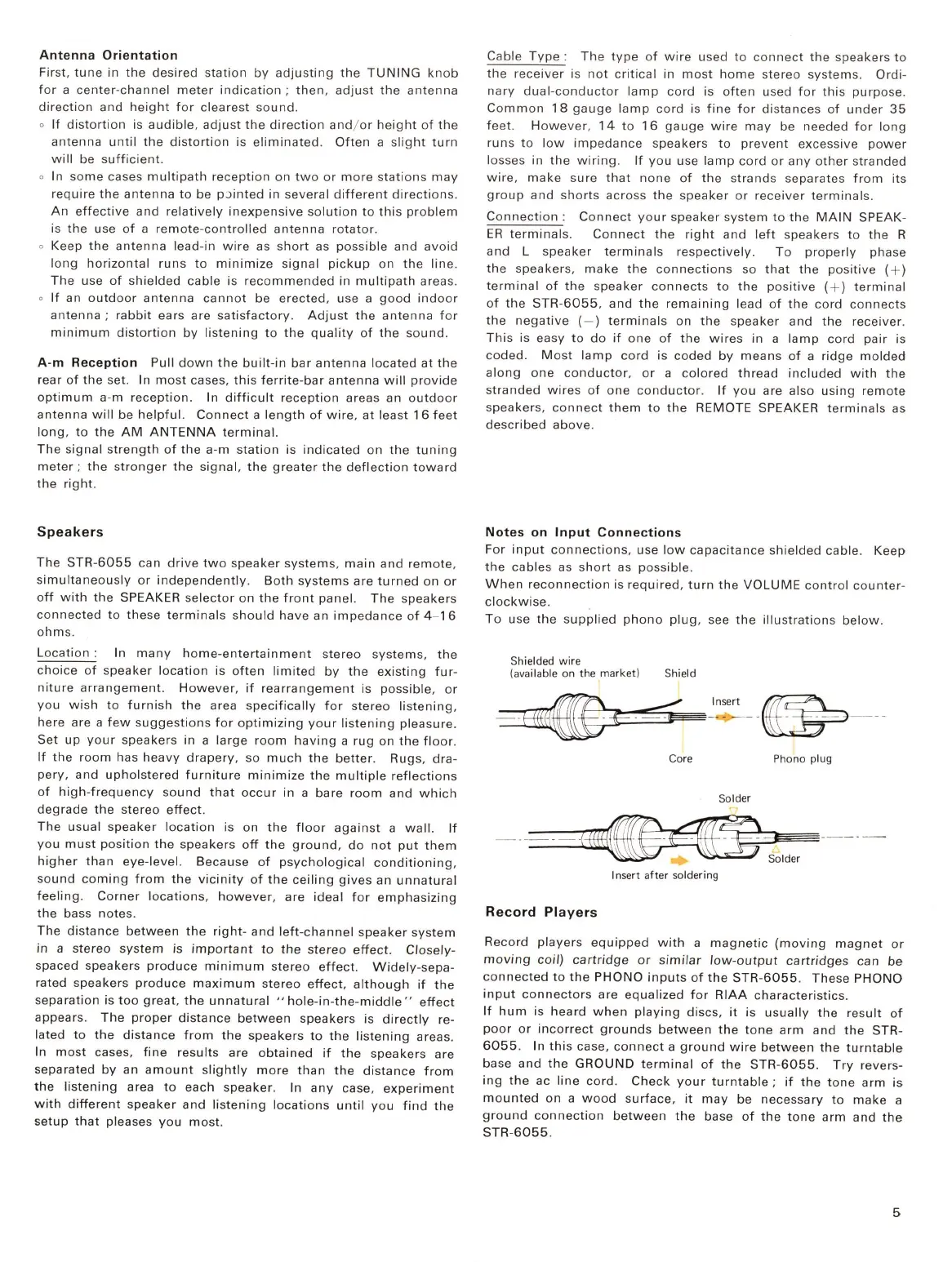
Shielded
wire
(available
on
the market) Shield
Core Phono plug
Solder
Solder
Insert
after
soldering
Record
Players
Record
players
equipped
with
a
magnetic
(moving
magnet
or
moving
coil)
cartridge
or
similar
low-output
cartridges
can
be
connected
to
the
PHONO
inputs
of
the
STR-
6055
.
These
PHONO
input
connectors
are
equalized
for
RIAA
characteristics.
If
hum
is
heard
when
playing
discs,
it
is
usually
the
result
of
poor
or
incorrect
grounds
between
the
tone
arm
and
the
STR-
6055
. In
this
case,
connect
a
ground
wire
between
the
turntable
base
and
the
GROUND
terminal
of
the
STR-6055
.
Try
revers-
ing
the
ac
line
cord.
Check
your
turntable;
if
the
tone
arm
is
mounted
on
a
wood
surface,
it
may
be
necessary
to
make
a
ground
connection
between
the
base
of
the
tone
arm
and
the
STR-6055.
5

Related product manuals