EasyManua.ls Logo

Sony TC-765 - Page 48

Sony TC-765
62 pages
Print Icon
To Next Page IconTo Next Page
To Previous Page IconTo Previous Page
Loading...
TC-765
|
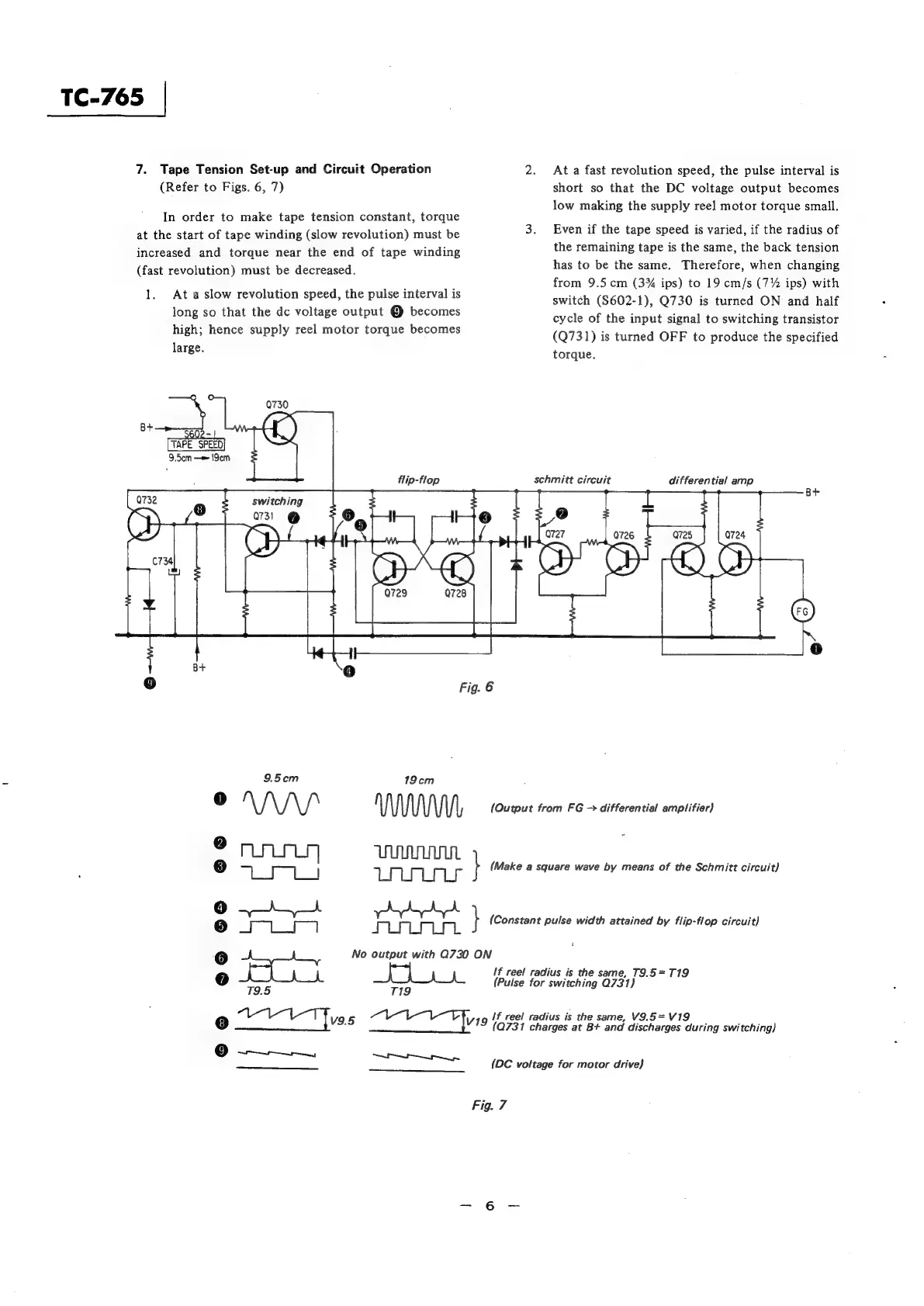
7.
Tape
Tension
Set-up
and
Circuit
Operation
(Refer
to
Figs.
6,
7)
In
order
to
make
tape
tension
constant,
torque
at
the
start
of
tape
winding
(slow
revolution)
must
be
increased
and
torque
near
the
end
of
tape
winding
(fast
revolution)
must
be
decreased.
1.
B+
At
a
slow
revolution
speed,
the
pulse
interval
is
long
so
that
the
dc
voltage
output
@
becomes
high;
hence
supply
reel
motor
torque
becomes
large.
At
a
fast
revolution
speed,
the
pulse
interval
is
short
so
that
the
DC
voltage
output
becomes
low
making
the
supply
reel
motor
torque
small.
Even
if
the
tape
speed
is
varied,
if
the
radius
of
the
remaining
tape
is
the
same,
the
back
tension
has
to
be
the
same.
Therefore,
when
changing
from
9.5
cm
(3%
ips)
to
19
cm/s
(7%
ips)
with
switch
(S602-1),
Q730
is
turned
ON
and
half
cycle
of
the
input
signal
to
switching
transistor
(Q731)
is
turned
OFF
to
produce
the
specified
602-1
TAPE
SPEED
9.5cm
—=
19cm
torque,
flip-flop
schmitt
circuit
differential
amp
9.5cem
19cm
o
NIN
PALANAN
(Output
from
FG
>
differential
amplifier)
eee
piawe
ae
TU
Os
CAs
(Make
a
square
wave
by
means
of
the
Schmitt
circuit}
e
S
sag
a
ces
RAN
}
{Constant
pulse
width
attained
by
flip-flop
circuit)
e
No
output
with
Q730
ON
lf
reel
radius
is
the
same,
T9.5=T19
7)
Senne
(Pulse
for
switching
Q731)
T9.5
T19
<
is
ee
a
|
if
reel
radius
is
the
same,
V9.5=V19
8]
V1
Teas
vig
(Q731
charges
at
B+
and
discharges
during
switching)
080
SE
_—
_
(DC
voltage
for
motor
drive}
Fig.
7