EasyManua.ls Logo

Sony TC-765 - Page 47

Sony TC-765
62 pages
Print Icon
To Next Page IconTo Next Page
To Previous Page IconTo Previous Page
Loading...
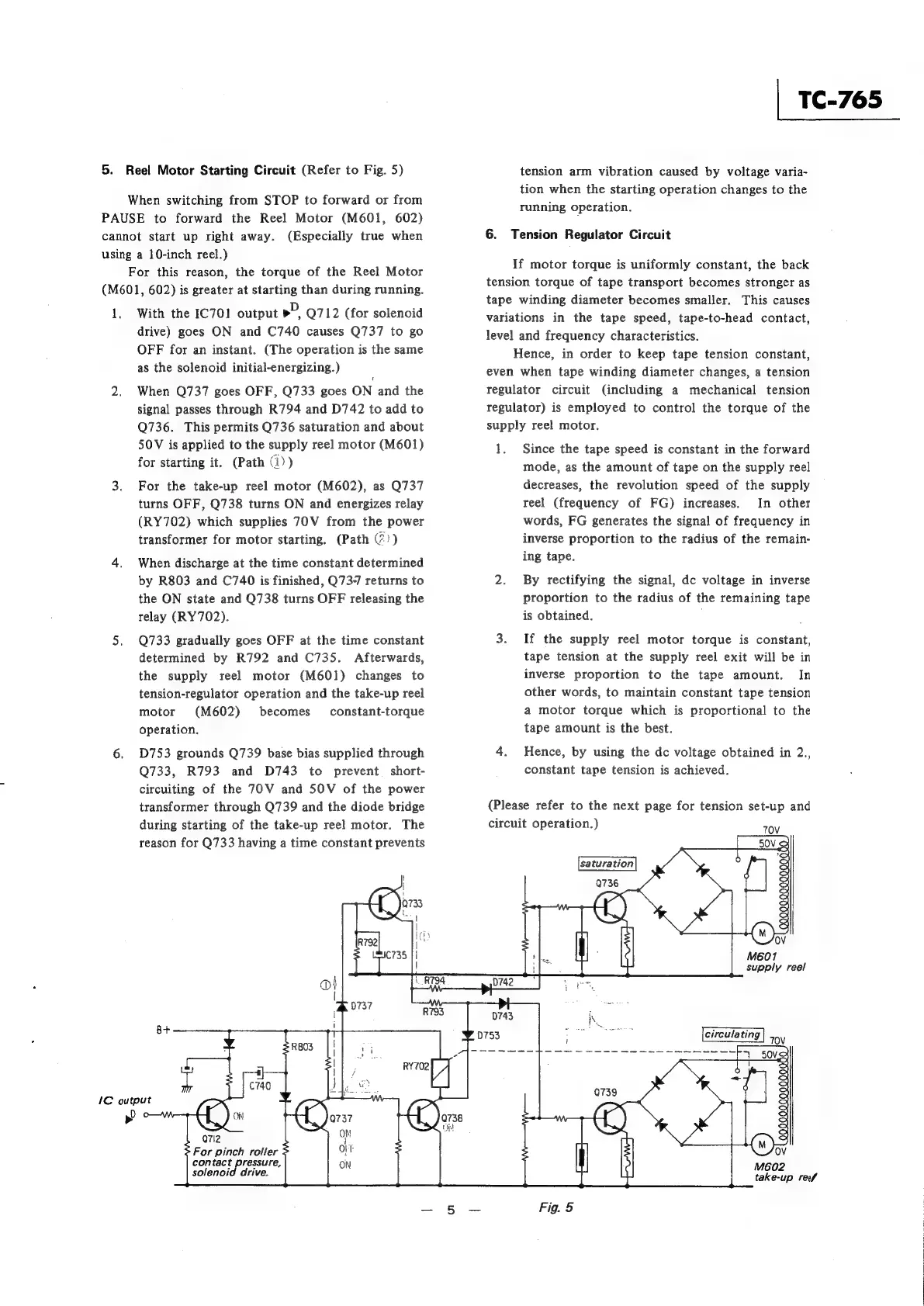
5.
Reel
Motor
Starting
Circuit
(Refer
to
Fig.
5)
When
switching
from
STOP
to
forward
or
from
PAUSE
to
forward
the
Reel
Motor
(M601,
602)
cannot
start
up
right
away.
(Especially
true
when
using
a
10-inch
reel.)
For
this
reason,
the
torque
of
the
Reel
Motor
(M601,
602)
is
greater
at
starting
than
during
running.
1.
With
the
IC701
output
»?,
Q712
(for
solenoid
drive)
goes
ON
and
C740
causes
Q737
to
go
OFF
for
an
instant.
(The
operation
is
the
same
as
the
solenoid
initial-energizing.)
2.
When
Q737
goes
OFF,
Q733
goes
ON
and
the
signal
passes
through
R794
and
D742
to
add
to
Q736.
This
permits
Q736
saturation
and
about
50V
is
applied
to
the
supply
reel
motor
(M601)
for
starting
it.
(Path
(i))
3.
For
the
take-up
reel
motor
(M602),
as
Q737
turns
OFF,
Q738
turns
ON
and
energizes
relay
(RY702)
which
supplies
70V
from
the
power
transformer
for
motor
starting.
(Path
(?))
4.
When
discharge
at
the
time
constant
determined
by
R803
and
C740
is
finished,
Q73-7
returns
to
the
ON
state
and
Q738
turns
OFF
releasing
the
relay
(RY702).
5.
Q733
gradually
goes
OFF
at
the
time
constant
determined
by
R792
and
C735.
Afterwards,
the
supply
reel
motor
(M601)
changes
to
tension-regulator
operation
and
the
take-up
reel
motor
(M602)
becomes
_
constant-torque
operation.
6.
D753
grounds
Q739
base
bias
supplied
through
Q733,
R793
and
D743
to
prevent
short-
circuiting
of
the
70V
and
SOV
of
the
power
transformer
through
Q739
and
the
diode
bridge
during
starting
of
the
take-up
reel
motor.
The
reason
for
Q733
having
a
time
constant
prevents
B+
IC
output
pe
Q712
For
pinch
roller
contact
pressure,
solenoid
drive.
|
TC-765
tension
arm
vibration
caused
by
voltage
varia-
tion
when
the
starting
operation
changes
to
the
running
operation.
6.
Tension
Regulator
Circuit
If
motor
torque
is
uniformly
constant,
the
back
tension
torque
of
tape
transport
becomes
stronger
as
tape
winding
diameter
becomes
smaller.
This
causes
variations
in
the
tape
speed,
tape-to-head
contact,
level
and
frequency
characteristics.
Hence,
in
order
to
keep
tape
tension
constant,
even
when
tape
winding
diameter
changes,
a
tension
regulator
circuit
(including
a
mechanical
tension
regulator)
is
employed
to
control
the
torque
of
the
supply
reel
motor.
1.
Since
the
tape
speed
is
constant
in
the
forward
mode,
as
the
amount
of
tape
on
the
supply
reel
decreases,
the
revolution
speed
of
the
supply
reel
(frequency
of
FG)
increases.
In
other
words,
FG
generates
the
signal
of
frequency
in
inverse
proportion
to
the
radius
of
the
remain-
ing
tape.
2.
By
rectifying
the
signal,
dc
voltage
in
inverse
proportion
to
the
radius
of
the
remaining
tape
is
obtained.
,
3. If
the
supply
reel
motor
torque
is
constant,
tape
tension
at
the
supply
reel
exit
will
be
in
inverse
proportion
to
the
tape
amount.
In
other
words,
to
maintain
constant
tape
tension
a
motor
torque
which
is
proportional
to
the
tape
amount
is
the
best.
4.
Hence,
by
using
the
dc
voltage
obtained
in
2.,
constant
tape
tension
is
achieved.
(Please
refer
to
the
next
page
for
tension
set-up
and
circuit
operation.)
saturation