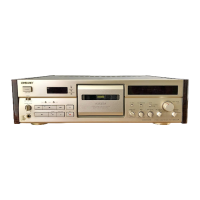
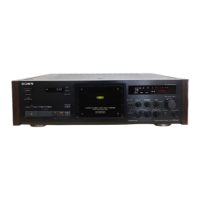
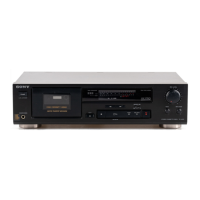
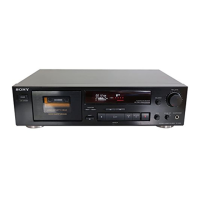
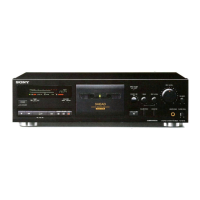
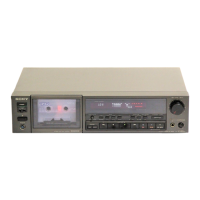
The Sony TC-K333ESR/K730ES is a high-fidelity stereo cassette deck, designed for superior audio recording and playback. This device incorporates advanced features and robust construction to ensure excellent performance and durability.
Function Description
The TC-K333ESR/K730ES functions as a stereo cassette deck, capable of recording and playing back audio on standard compact cassettes. It features a 4-track, 2-channel stereo recording system with a 3-head configuration (erase, record, and playback) for optimal recording quality and monitoring capabilities. The deck supports various tape types, including Metal, CrO2, and Normal, with automatic tape type selection.
Key operational features include:
- Dolby NR System: Incorporates Dolby B, C, and SR noise reduction systems to minimize tape hiss and improve dynamic range during recording and playback.
- MPX Filter: An integrated MPX filter helps to remove the 19 kHz pilot signal during FM stereo recordings, preventing interference with the Dolby NR system.
- Bias Calibration: Allows for precise adjustment of the recording bias to match the specific characteristics of different tape types, ensuring flat frequency response and optimal recording quality.
- Record Level Adjustment: Independent left and right channel record level controls, along with a peak program meter, enable accurate setting of recording levels to prevent distortion.
- Real-time Counter: A digital counter displays elapsed or remaining time, making it easy to locate specific sections on a tape.
- Timer Function: Supports timer-activated recording and playback.
- Headphones Jack: A front-panel headphone jack with a dedicated level control allows for private monitoring.
- Remote Control Capability: Compatible with a remote commander (RM-J600, sold separately) for convenient operation.
Important Technical Specifications
- Recording System: 4-track, 2-channel stereo
- Heads: 3 heads (1 erase, 1 record, 1 playback)
- Motors: 3 motors (1 reel, 1 capstan, 1 assist)
- Wow and Flutter: 0.025% WRMS (weighted root mean square), indicating very stable tape transport.
- Frequency Response:
- Metal Tape (TYPE IV): 20 – 19,000 Hz ±3 dB (DIN)
- CrO2 Tape (TYPE II): 20 – 18,000 Hz ±3 dB (DIN)
- Normal Tape (TYPE I): 20 – 17,000 Hz ±3 dB (DIN)
- Signal-to-Noise Ratio (at peak level):
- TYPE IV (Metal): 73 dB (Dolby NR OFF), 77 dB (Dolby B), 84 dB (Dolby C), 87 dB (Dolby SR)
- TYPE II (CrO2): 72 dB (Dolby NR OFF), 76 dB (Dolby B), 83 dB (Dolby C), 86 dB (Dolby SR)
- TYPE I (Normal): 67 dB (Dolby NR OFF), 71 dB (Dolby B), 78 dB (Dolby C), 81 dB (Dolby SR)
- Inputs:
- Line Inputs (phono jacks): Sensitivity 0.16 V, Impedance 50 k ohms
- CD Direct (phono jacks): Sensitivity 0.43 V, Impedance 50 k ohms
- Outputs:
- Line Outputs (phono jacks): Rated output 0.43 V (–7 dB), Load impedance 47 k ohms
- Headphones (stereo phone jack): Output level continuously variable, Load impedance 32 ohms
- Power Requirements:
- US, Canadian models: 120V AC, 60Hz
- UK model: 240V AC, 50Hz
- AEP model: 220V AC, 50/60Hz
- E model: 120, 220 or 240V AC adjustable, 50/60Hz
- Power Consumption: 30 watts
- Dimensions (W/H/D): Approx. 470 x 125 x 350 mm (18 5/8 x 5 x 13 7/8 inches)
- Weight: Approx. 9.5 kg (22 lb)
Usage Features
The TC-K333ESR/K730ES is designed for user-friendly operation with a logical control layout. The front panel features clearly labeled buttons and knobs for transport functions (play, record, fast forward, rewind, stop, pause), recording level adjustments, and noise reduction selection. The large, illuminated peak program meters provide clear visual feedback of audio levels. The real-time counter simplifies tape navigation, allowing users to quickly find specific tracks or sections. The timer function offers convenience for unattended recording or playback. The headphone jack with its own level control is ideal for monitoring recordings or listening privately. The remote control capability further enhances user convenience, allowing for operation from a distance.
Maintenance Features
The manual provides detailed instructions for various maintenance and adjustment procedures to ensure the longevity and optimal performance of the device. These include:
- Mechanical Adjustments: Instructions for cleaning and demagnetizing the record/playback and erase heads, pinch rollers, and capstan. This is crucial for maintaining sound quality and preventing tape damage.
- Head Height Adjustment: A precise procedure for adjusting the height of the record/playback head to ensure proper tape contact and optimal frequency response.
- Forward Torque/Back Tension Torque Adjustment: Steps to measure and adjust the forward and back tension torque of the reel motors, which is vital for stable tape transport and preventing tape stretching or tangling.
- Electrical Adjustments:
- Tape Speed/WOW Check: Procedure to measure and adjust tape speed and wow and flutter using a test tape and frequency counter/WOW meter.
- Playback Level Adjustment: Calibration of playback levels for both channels using a test tape and VTVM.
- Meter Level Adjustment: Adjustment of the peak program meters to ensure accurate display of audio levels.
- PB Dolby NR Check: Verification of Dolby NR system performance during playback.
- MPX Filter Check: Confirmation of the MPX filter's functionality.
- Provisional Playback Head Azimuth Adjustment: A procedure to adjust the playback head azimuth for optimal high-frequency response and phase alignment.
- Provisional Record Head Azimuth Adjustment: A procedure to adjust the record head azimuth for accurate recording and playback compatibility.
- Bias Osc Frequency Adjustment: Adjustment of the bias oscillator frequency for optimal recording performance.
- Record Head Azimuth Adjustment: Fine-tuning of the record head azimuth.
- Record Bias Adjustment: Calibration of the recording bias for different tape types.
- Normal Bias Adjustment: Specific bias adjustment for normal tapes.
- Metal Bias Adjustment: Specific bias adjustment for metal tapes.
These comprehensive maintenance guidelines underscore the TC-K333ESR/K730ES's design for long-term, high-quality audio performance, allowing technicians to fine-tune the deck to factory specifications.

 Need help?
 General

 To Next Page