
 Need help?
Do you have a question about the Sony TRINITRON KP-43HT20C and is the answer not in the manual?
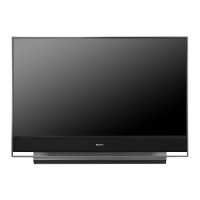
This document serves as a service manual for the Sony Trinitron Color Television, specifically models KP-43HT20C and KP-53HS30C, which utilize the RA-6 chassis. It outlines the procedures for electrical adjustment, maintenance, and troubleshooting, primarily through the use of a remote commander.
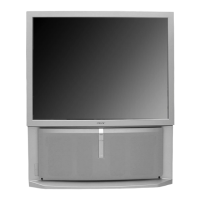
The Sony Trinitron Color Television is a display device designed for home entertainment, capable of reproducing color television signals. The RA-6 chassis, common to these models, integrates various electronic circuits to process video and audio signals, control display parameters, and manage power. The television is designed to receive and display broadcast television signals, as well as signals from external video sources. The "Trinitron" designation refers to Sony's proprietary cathode ray tube (CRT) technology, known for its bright, sharp images and accurate color reproduction.
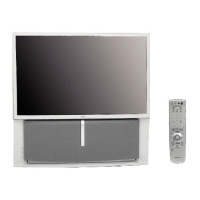
The primary interface for operating and adjusting the television, especially for service and maintenance, is the RM-Y908 remote commander. This remote allows for comprehensive control over the television's functions, including power, volume, channel selection, and access to various menus.
Service Mode Access and Navigation: A key feature for service and maintenance is the "Service Mode," which allows technicians to access and modify internal electrical adjustments. This mode is entered from standby (power off) by pressing a specific sequence of buttons on the remote commander: DISPLAY, then 5, then VOL (+), and finally TV POWER, each within a second. Once in Service Mode, the screen displays the item currently being adjusted.
Item Selection and Data Adjustment: Within Service Mode, the remote commander's buttons are re-purposed for specific adjustment tasks:
Memory Operations: The service mode also supports memory operations crucial for maintaining the television's settings:
PJE Mode: The manual notes a special "PJE mode" (Picture Jitter Elimination mode) which displays an internally generated signal. When this mode is active, the remote commander's buttons may have different functions than those listed for standard Service Mode, requiring reference to a specific page in the manual for PJE button functions. This indicates a specialized diagnostic capability for picture quality issues.
The service manual emphasizes several features designed to facilitate maintenance and ensure the television's longevity and performance.
Electrical Adjustment by Remote Commander: All electrical adjustments can be performed using the RM-Y908 remote commander, eliminating the need for physical access to internal potentiometers or switches for most calibration tasks. This streamlines the adjustment process and reduces potential wear and tear on internal components.
Required Test Equipment: For accurate electrical adjustments, the manual specifies the necessary test equipment:
Memory Write Confirmation Method: To ensure that adjustments are correctly saved, a specific confirmation method is outlined:
Self-Diagnosis Support: The manual cover indicates "Self Diagnosis Supported model," implying that the RA-6 chassis incorporates internal diagnostic capabilities. While not detailed on the provided pages, this feature typically allows the television to detect and report certain internal faults or operational issues, often through error codes displayed on the screen or via LED blink patterns. This significantly aids technicians in quickly identifying the root cause of problems, reducing diagnostic time and effort.
Modular Design (Implied): While not explicitly stated, the concept of a "chassis" (RA-6) often implies a modular design where major circuit blocks are integrated onto a single board or a few interconnected boards. This modularity simplifies repair by allowing technicians to replace entire faulty boards rather than individual components, potentially reducing repair time and requiring less specialized component-level repair skills.
Comprehensive Documentation: The existence of a detailed service manual itself is a crucial maintenance feature. It provides technicians with:
In summary, the Sony Trinitron Color Television models KP-43HT20C and KP-53HS30C, built on the RA-6 chassis, are designed with a strong emphasis on serviceability. The remote commander-based adjustment system, coupled with clear procedures and the requirement for standard test equipment, allows for precise calibration and efficient maintenance, ensuring optimal performance and extending the operational life of the television. The "Self Diagnosis" capability further enhances its maintainability by assisting in rapid fault identification.
 General
| Screen Size | 43 inches |
|---|---|
| Display Technology | CRT |
| Aspect Ratio | 16:9 |
| Inputs | Composite, S-Video, Component |
| Speakers | Stereo |
| Audio Power Output | 20W |



 To Next Page