27/04/04 © Söring Users manual RF-units
1
not valid for MBC600
-12-
3.2 Methods of RF Surgery and electrical Signal Shapes
Cutting and coagulation modes of RF surgery depend in part on the shape of the sine wave of the
electrical current. The frequency is remains around the 350 kHz range but the current amplitude
(power) is changed to meet the surgical demands. A cutting current is a continuous sine wave.
The amplitude is varied to accommodate the tissues being cut as each tissue type has a different
electrical resistance. A coagulating current has a diminishing sine wave form repeated over
intervals of time (parts of a second) and at varying sequence frequencies to achieve selected
levels of coagulation. In the initial phase of a coagulation event the amplitude of the current is
high and then falls to zero or almost so. If such a current could be heard it might resemble the
sound of a ringing bell. See Figure ZZ.
3.2.1 Cutting
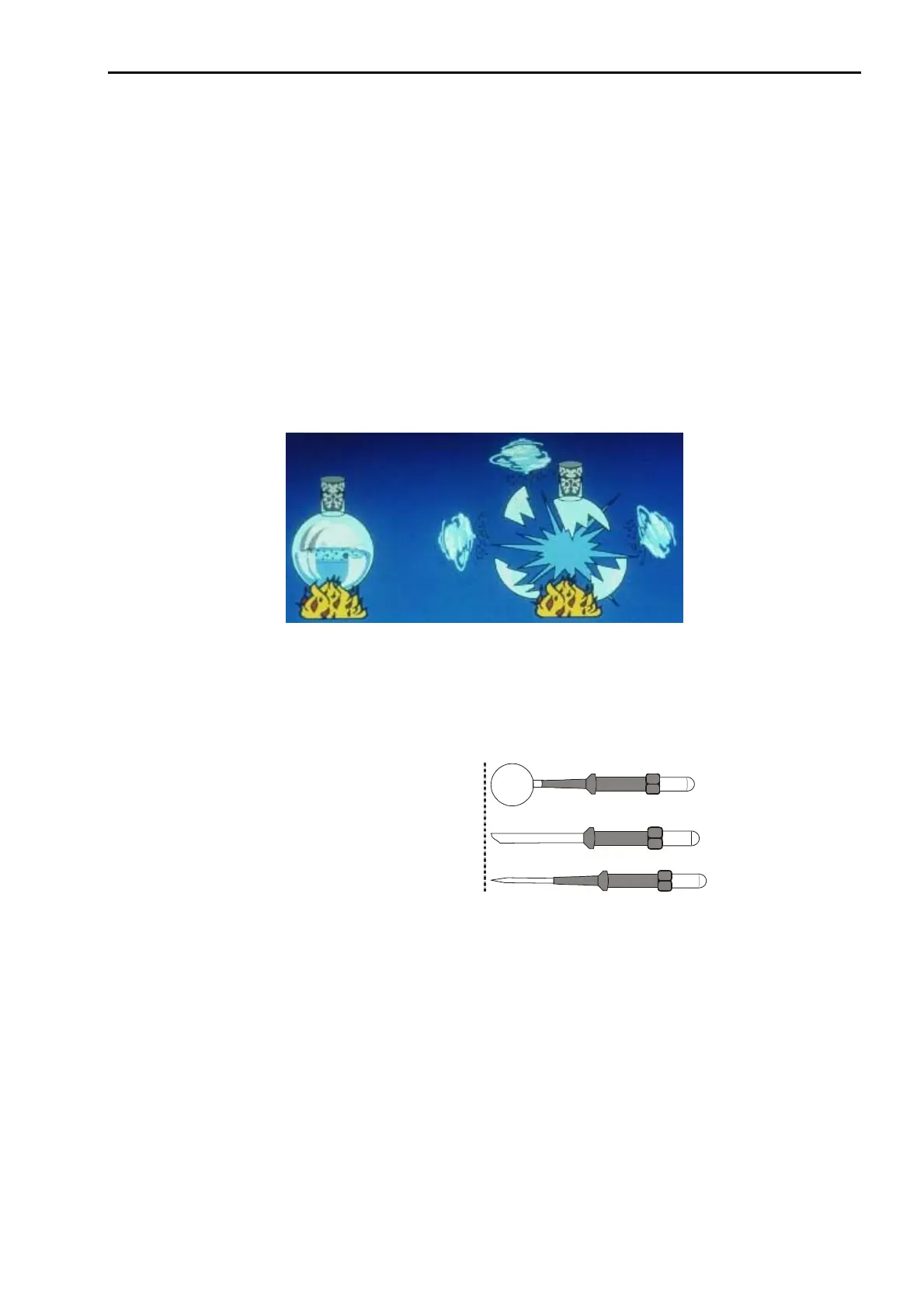
The cutting effect is based on the principle of cellular rupture. This is accomplished by a rapid and
locally limited temperature rise causing an explosion-like vaporization of intra and extra cellular
fluids, which ruptures cells and fractures cell connections. Under ideal conditions no coagulation
occurs at the cut and the surfaces of the cut do not show the typical light color of a coagulation
seam.
Principle of cell destruction
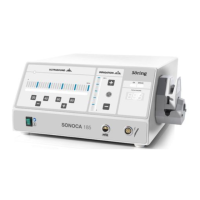
The shape of the electrode influences the cutting action and the kind of cut in electrotomy.
Basically, cutting electrodes should have a tissue contact area as small as possible in order to
obtain a high current density within a narrow space.
Loop or Ribbon Electrode
Knife or Lancet Electrode
Needle or Wire Electrode
Fig 3.5 Shapes of electrodes
Needle or wire electrodes are particularly useful for fine cuts where no or only minor coagulation
is wanted. They present a very small tissue contact area allowing a high current density needed
for fine cuts. With higher power the electrode will overheat and tissue will stick to it.
Knife or lancet electrodes resemble conventional scalpels with respect to their geometrical shape.
The cutting action, however, is based on the above-mentioned principles and not on mechanical
action. The leading edge of a knife has a small contact area where high current density can be
produced for a fine cut, whereas, the broad sides of these electrodes achieve coagulation along
the cut surfaces. Due to the relatively larger surface, compared with the needle electrode, more
RF power is required. However the heating of these electrodes is lower due to their higher thermal
capacity.
Loop and ribbon electrodes are mainly used for the cutting tissue by in slicing. A major application
of this so called “hollow-cut“ is the TUR (Transurethral Resection) in urology. Further parameters
which influence the quality of the cut are the cutting velocity, the condition of the tissue and the
shape of the current.


 To Next Page